Spirited protests weren't enough to stop the Montgomery County Council from allowing accessory dwelling units (ADU) in parts of the county.



"The Montgomery County Council on Tuesday unanimously passed a zoning change allowing accessory dwelling units (ADUs), also known as in-law apartments, in three residential zones of the county," reports Dan Schere.
"The zoning change will allow the apartments as attached and detached structures in zones where the minimum lot size is 6,000 to 20,000 square feet," adds Schere. "Attached ADUs must be limited to 10% of the lot area and less than 1,200 square feet. Detached ADUs must be less than 1,200 square feet except when occupying a basement."
County Planning Director Gwen Wright is quoted in the article saying the county could expect the development of about 100 ADUs per year.
The zoning change proposal sparked controversy and even protests on its way to approval. Rebecca Tan reported the day before the council approval about protestors wielding hand-made signs marching into the Montgomery County Council headquarters. County Executive Marc Elrich opposed the bill, too, "on the grounds that it would lead to increased traffic in neighborhoods and school crowding and cause aesthetic problems related to increased storm water runoff."
FULL STORY: Council Passes Accessory Apartment Zoning Change


ADU Controversy in Montgomery County, Maryland
The Montgomery County Council is preparing to vote on an amendment that would loosen restrictions on the controversial building type known as accessory dwelling units (ADUs).

Fort Collins Code Update Rescinded Due to ADU Opposition
It’s back to the drawing board for a development code update in Fort Collins, Colorado, after residents revolted against zoning reforms that include by-right development of accessory dwelling units.
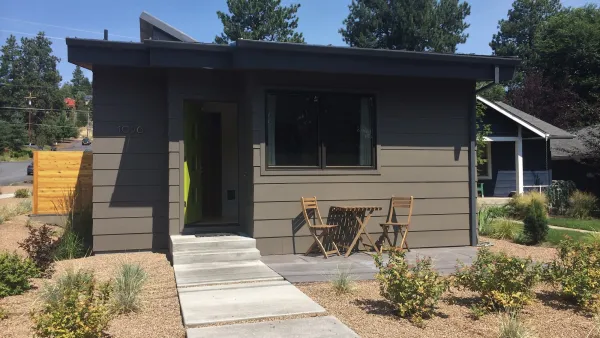
San Diego Residents Challenge the City's ADU Regulations
Residents in some of the city's single-family neighborhoods worry about the potential impacts of ADU construction on local character and parking.

Planetizen Federal Action Tracker
A weekly monitor of how Trump’s orders and actions are impacting planners and planning in America.

The state-sanctioned urbicide of Austin
People don’t kill cities. Freeways do.

US to reduce Colorado River water deliveries to Mexico
A new Colorado Treaty amendment reduces Mexico’s Colorado River water allocation by 250,000 acre feet.

5 New England states march closer to 800 megawatt wind energy project
Securing federal approval for the project may be complicated under the Trump administration, which has historically been hostile towards domestic wind power.

Baltimore to break ground on $50 million Transit Priority Project
The project will bring faster bus trips, safer streets and better bike connections to Baltimore.

Airbnb launches $250 million 'last-dollar financing' housing accelerator, makes first investment in Austin
The company will put $6.4 million towards affordable housing development in Texas’ capital.

FREE Course: Walkable City 1: Why Walkability?
After describing his path towards focusing on walkability as the essence of good planning, Jeff Speck marches through his five principal reasons for making more walkable places.
Reinventing Malls: Planning Alchemy—Turning Gray Fields Into Gold
The course focuses on the opportunities and imperatives that shape reinvention of mall sites.

Eagle County Government
Harvard University Graduate School of Design
Nashville Planning Department
The Architects Foundation
University of Cincinnati Online
The Pocatello Development Authority
The Urban Renewal Agency of the City of Pocatello
Journal of the American Planning Association