Hydroponic farming company Square Roots will expand thanks to a partnership with Gordon Foods.


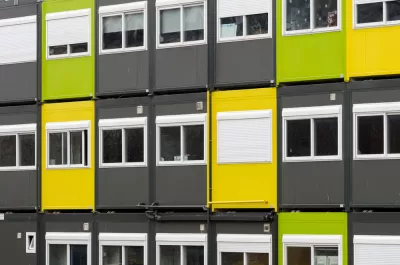
Urban farm company Square Roots uses small scale hydroponic farms to grow food locally, now a partnership with Gordon Foods (GFS) may mean a lot more of these farms. Square roots uses repurposed shipping containers to create hydroponic farms. These farms can grow pesticide free crops in an Urban environment, close to consumers. By partnering with GFS, Square roots hopes to get their foods to more people. "The plan is to build Square Roots facilities (i.e. shipping containers) on or near GFS’s distribution or retail locations in order to shorten the amount of time it takes to go from hydroponic pod to store shelves," Liz Stinson reports for Curbed.
Square Roots hopes to place ten shipping container farms near each store. "With each container generating around 50,000 pounds of produce each year, that’s a major upgrade for locally grown food," Stinson writes.
Read the full story: Shipping container farms expanding to grocery stores around the country
Shipping Container Farms Save Water, Enable Year-Round Growth
Shipping container houses are all the rage right now. So why not a shipping container farm?
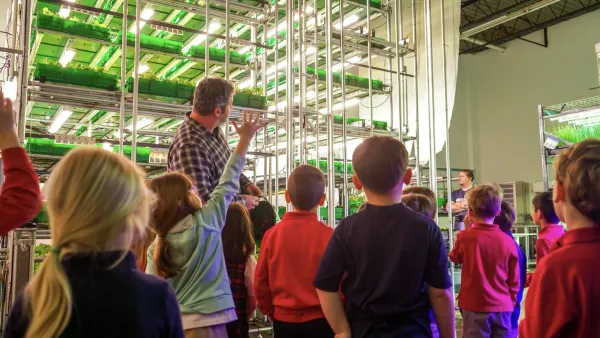
A Multimillion Dollar Virginia Company is Turning Empty Office Buildings Into Farms
Area 2 Farms envisions a world where 90% of the U.S. population lives within 10 miles of an indoor farm.
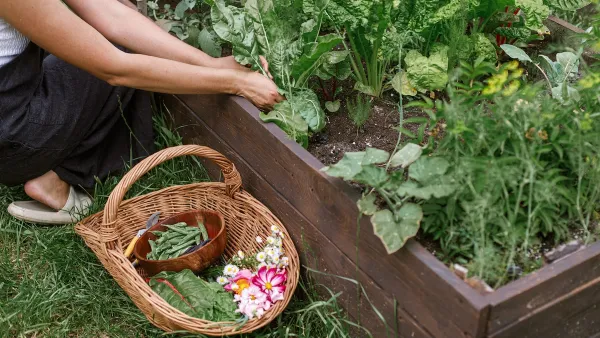
Urban Farming Addressing Hunger (and More) in Pittsburgh
Urban farming provides opportunities to increase food security in addition to other benefits.

Planetizen Federal Action Tracker
A weekly monitor of how Trump’s orders and actions are impacting planners and planning in America.

California plans to bury El Niño’s downpour
If the state plays its cards right, it may be able to store a billion acre-feet of El Niño’s water in aquifers.

Desperate measures: Advocates weigh draining Lake Powell to fill Colorado River
Draining the reservoir could reduce evaporation losses by a couple hundred thousand acre-feet.

Mamdani’s pied-à-terre tax survives legal challenge
A panel of judges found that the plaintiffs failed to demonstrate injury as a result of New York City's implementation of the tax.

Eastern Nebraska is running out of electricity
Data centers and electrification are straining eastern Nebraska’s grid, throttling economic development.

Seattle passes record-breaking transit services expansion
Proposition 1 will double the city’s transit tax to add 95,000 more bus trips and preserve 180,000 bus trips annually.

FREE Course: Walkable City 1: Why Walkability?
After describing his path towards focusing on walkability as the essence of good planning, Jeff Speck marches through his five principal reasons for making more walkable places.
Reinventing Malls: Planning Alchemy—Turning Gray Fields Into Gold
The course focuses on the opportunities and imperatives that shape reinvention of mall sites.

City of Rosemead
Rutgers University, Edward J. Bloustein School of Planning and Public Policy
One Hundred Miles
University of Michigan School for Environment and Sustainability (SEAS)
Hunter College, City University of New York (CUNY)
The Architects Foundation
City of Cambridge
Montrose County
The Pocatello Development Authority