A public-private partnership is under consideration in the Florida State Legislature to create a driverless shuttle route in Altamonte Springs.


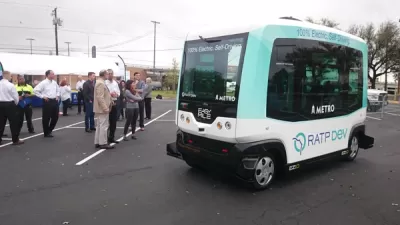
"A bill proposed in the Florida Legislature would bring a smart corridor with autonomous vehicles to Altamonte Springs," reports Ryan Lynch.
"Driverless electric shuttles would take people to the Uptown Altamonte district as well as to places such as the Altamonte Springs SunRail station, AdventHealth Altamonte Springs and the Altamonte Mall," adds Lynch.
HB 403, proposed by Rep. Scott Plakon (R-Longwood), would request $2 million in funding from the Florida Department of Transportation to fund the project. The city of Altamonte Springs would provide $500,000. A joint private partner will pay the remaining $6.2 million needed for the project.
According to the bill, the project is intended to ease congestion on State Road 436. State officials are pitching the corridor as a new, alternate mode of transportation, as well as a "last-mile" transportation solution.
As noted by Lynch, the Altamonte Springs corridor plans are far from the only autonomous vehicle plans in the works in Florida. "Orlando-based Beep Inc. said it plans to add two autonomous shuttles in the fast-growing Lake Nona area in southeast Orlando by this spring as part of a larger mobility program in the area called Move Nona," according to Lynch.
"Also in the works is the SunTrax self-driving vehicle test facility in Polk County — a 2.25-mile test track designed for high-speed travel —which is being built on a 475-acre Auburndale site and is set to have its first phase open this year."
Read the full story: $8.7M driverless shuttle project proposed for Altamonte Springs
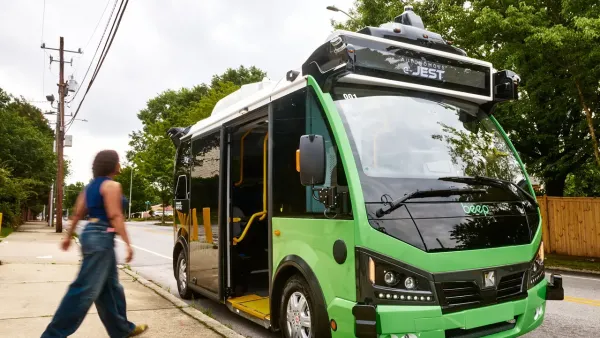
Atlanta launches autonomous Beltline shuttle
The ATL Spoke service connects the Beltline to a MARTA rail station.
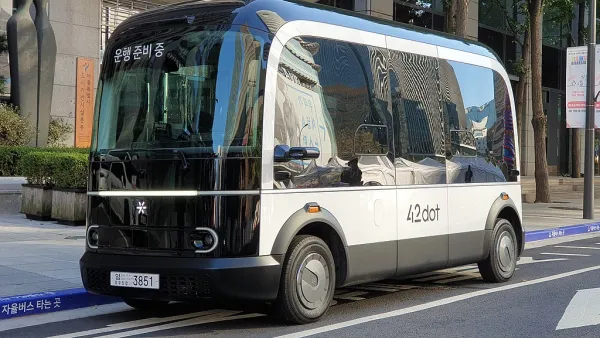
Are We There Yet? AV Shuttles Not Ready for Transit Service, Report Says
According to an assessment of two North Carolina pilot projects, low-speed autonomous shuttles have too many limitations to deploy as a public transit option.
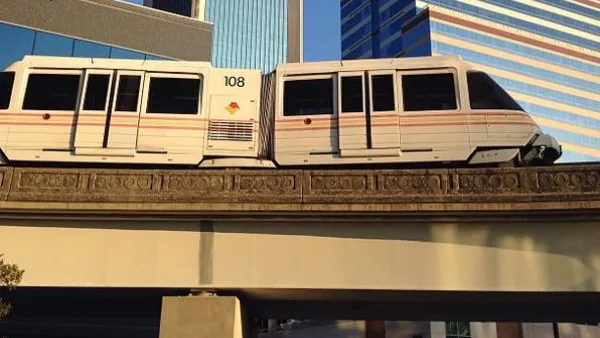
Jacksonville To Replace Monorail With Autonomous Shuttles
The city’s aging monorail system will be repurposed as part of an expanded 10-mile shuttle system.

Planetizen Federal Action Tracker
A weekly monitor of how Trump’s orders and actions are impacting planners and planning in America.

California plans to bury El Niño’s downpour
If the state plays its cards right, it may be able to store a billion acre-feet of El Niño’s water in aquifers.

Desperate measures: Advocates weigh draining Lake Powell to fill Colorado River
Draining the reservoir could reduce evaporation losses by a couple hundred thousand acre-feet.

Mamdani’s pied-à-terre tax survives legal challenge
A panel of judges found that the plaintiffs failed to demonstrate injury as a result of New York City's implementation of the tax.

Eastern Nebraska is running out of electricity
Data centers and electrification are straining eastern Nebraska’s grid, throttling economic development.

Seattle passes record-breaking transit services expansion
Proposition 1 will double the city’s transit tax to add 95,000 more bus trips and preserve 180,000 bus trips annually.

FREE Course: Walkable City 1: Why Walkability?
After describing his path towards focusing on walkability as the essence of good planning, Jeff Speck marches through his five principal reasons for making more walkable places.
Reinventing Malls: Planning Alchemy—Turning Gray Fields Into Gold
The course focuses on the opportunities and imperatives that shape reinvention of mall sites.

City of Rosemead
Rutgers University, Edward J. Bloustein School of Planning and Public Policy
One Hundred Miles
University of Michigan School for Environment and Sustainability (SEAS)
Hunter College, City University of New York (CUNY)
The Architects Foundation
City of Cambridge
Montrose County
The Pocatello Development Authority