As California voters consider a ballot initiative that would greatly expand rent control around the state, researchers are working to inform the populace about rent control.



California voters will consider Proposition 10 in November, which, if passed, would repeal the Costa-Hawkins Rental Housing Act of 1995.
Put simply, Proposition 10 would enable a large expansion of rent control throughout the state of California.
Given the incredibly high stakes of such a consequential policy change, the debate over the potential effects of rent control has been much more public in recent months. Enter into the fray a new study by researchers at the University of Southern California, Manuel Pastor, Vanessa Carter, and Maya Abood.
The study, titled "Rent Matters: What are the Impacts of Rent Stabilization Measures?" finds that rent control has "far fewer negative impacts than is generally thought." In fact, rent control "is a useful tool in a crisis."
According to the study's abstract:
Surveying existing research on rent regulations, we find that moderate rent controls do not constrain new housing, do promote tenant stability, may lead to condo conversion (which can be limited with other tools), and may deter displacement from gentrification.
Across town, at the University of California, Los Angeles, Alisa Belinkoff Katz has taken a different approach to presenting new information on the subject of rent control by writing a history of the policy in Los Angeles. "The study is the first major publication of the UCLA Luskin Center for History and Policy, which was founded in 2017 with a mission to bring historical perspective to contemporary policy issues," according to a website promoting the new paper.
Exemplifying yet another approach, probably more familiar to academic audiences, is a study from researchers at Stanford University in January 2018, which found a mixed bag of benefits and drawbacks, depending on whether you're a tenant, a landlord, or looking for a new apartment in a crowded market.
Read the full story: Rent Matters: What are the Impacts of Rent Stabilization Measures?

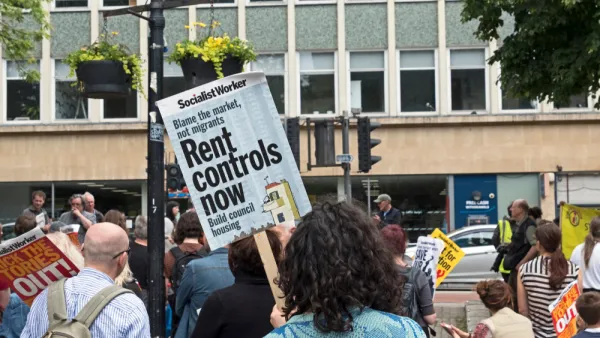
Another Rent Control Initiative on the Ballot in California
There are significant differences between Proposition 21, a statewide rent control measure on the ballot in California, compared to a similar measure defeated soundly by voters in 2018.
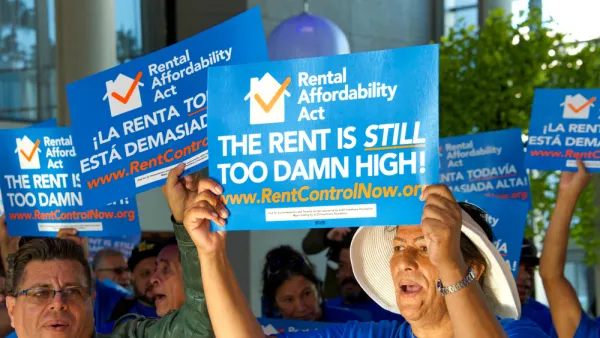
Lessons From Rent Control's Latest Election Rejection
California voters, with a reputation for liberal politics, have repeatedly refused to approve statewide rent control laws at the ballot box.

Report: $15.5 Billion Per Month Needed for Housing Market Relief
A new report from researchers at the Urban Institute makes the case for federal and state relief for renters and property owners hurt by the economic realities of the coronavirus pandemic.

Planetizen Federal Action Tracker
A weekly monitor of how Trump’s orders and actions are impacting planners and planning in America.

Northwest rail fans eager for Sept. 30 debut of Amtrak’s Airo fleet
Get ready for that new train smell and more seats. But they won’t go faster or run more frequently on the Cascades route in Washington and Oregon.

Record-breaking wildlife overpass in Colorado brings 91% reduction in animal collisions
Prior to the overpass, vehicles were hitting one deer per day on Colorado’s Interstate 25.

‘Going backwards:’ Baltimore mayor, students rally against state's transit funding plan
Maryland's proposed six-year plan provides no funding for Baltimore’s BMORE bus program and reduces its road maintenance funding.

Trump wants to cancel nearly 98% of funding for HUD housing support program
Multiple housing groups are suing the administration in an effort to preserve the funding.

See the 12 communities on New York City’s affordable housing naughty list
The Upper East and West Sides, Elmhurst, and Bayside are among the communities that have built little affordable housing over the past five years, and now will see certain projects fast-tracked under new city rules.

FREE Course: Walkable City 1: Why Walkability?
After describing his path towards focusing on walkability as the essence of good planning, Jeff Speck marches through his five principal reasons for making more walkable places.
Reinventing Malls: Planning Alchemy—Turning Gray Fields Into Gold
The course focuses on the opportunities and imperatives that shape reinvention of mall sites.

City of Thousand Oaks
City of Wisconsin Rapids
Harvard University Graduate School of Design
The Architects Foundation
University of Cincinnati Online
Northern Illinois Transit Authority (NITA)
The Pocatello Development Authority
The Urban Renewal Agency of the City of Pocatello