Since its passage 40 years ago, the controversial legislation has remained consistently popular with Californians.



Matt Levin takes a closer look at how support for Proposition 13 in California has fared over the years. While there has been no shortage of criticism about the legislation and its impacts, a recent survey by the Public Policy Institute of California shows robust support for Prop. 13, with 65 percent of likely voters reporting they think it has been “mostly a good thing.”
While there have been some dips in support over time, this is the same percentage of voters who approved of Prop. 13 when it passed in 1978. Even housing prices have surprisingly not helped move the gauge much, reports Levin. And while the survey found some differences by party affiliation, age, income, and status as a renter or homeowner, a majority held strong across all groups.
In addition, a proposal that would change how Prop. 13 operates has lost support. A "split-roll" property tax system, which would tax commercial properties at current market value, will possibly be on the ballot in 2020. Levin reports that 60 percent of respondents supported this initiative in 2012, but this year that number has dropped to 46 percent.
Read the full story: Californians still really like Prop. 13—except for the big parts they don’t like


Signatures Submitted for Initiative to Reform California Proposition 13
A coalition of groups advocating for more funding for local communities and schools want to reform the landmark tax-cutting initiative by treating commercial and industrial properties different than residential, creating the so-called "split roll."

California's 'Split Roll' Property Tax Reform, Explained
California voters will consider a landmark reform of its infamous property tax system this November. Prop. 15 would remove property tax caps on commercial properties established by Prop. 13 in 1978.
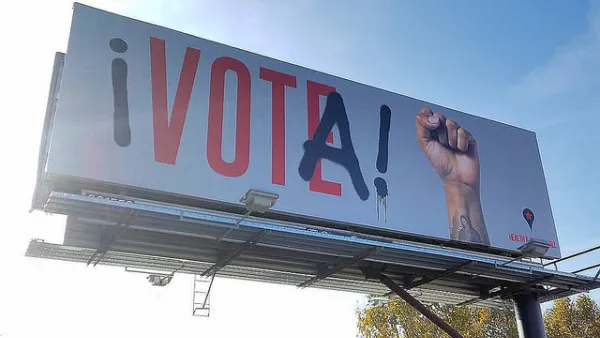
Prop 13 on the Ballot in California—Just Not the Prop 13 Everyone's Worried About
A case of mistaken identity has embroiled California in election controversy, as claims of bias and misinformation swirl around Prop 13 (2020), Prop 13 (1978), and an anticipated "split roll" initiative.

Planetizen Federal Action Tracker
A weekly monitor of how Trump’s orders and actions are impacting planners and planning in America.

California plans to bury El Niño’s downpour
If the state plays its cards right, it may be able to store a billion acre-feet of El Niño’s water in aquifers.

Chicago breaks ground on $3 billion megadevelopment
The new neighborhood, titled Foundry Park, will one day host 3,700 residences.

California High-Speed Rail Authority CEO resigns after $600,000 scandal
Under Ian Choudri, the authority used taxpayer dollars to fund first class flights and trips to nightclubs.

Want to study the Missouri River? Soon, you may need unanimous approval from 10 states
Legislation would require 10 governors’ permission to study or build projects moving water outside the basin.

Desperate measures: Advocates weigh draining Lake Powell to fill Colorado River
Draining the reservoir could reduce evaporation losses by a couple hundred thousand acre-feet.

FREE Course: Walkable City 1: Why Walkability?
After describing his path towards focusing on walkability as the essence of good planning, Jeff Speck marches through his five principal reasons for making more walkable places.
Reinventing Malls: Planning Alchemy—Turning Gray Fields Into Gold
The course focuses on the opportunities and imperatives that shape reinvention of mall sites.


City of Rosemead
Rutgers University, Edward J. Bloustein School of Planning and Public Policy
One Hundred Miles
Hunter College, City University of New York (CUNY)
The Architects Foundation
University of Cincinnati Online
City of Cambridge
Montrose County
The Pocatello Development Authority