Even if the money for repairing New York City's public housing were to materialize, it would be money poorly spent, according to this editorial.


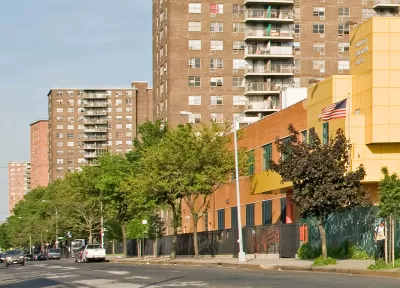
An editorial by Crain's New York Business makes the argument that it makes more sense to raze New York City Housing Authority properties (i.e., the projects) and build new than it does to repair the existing properties.
To bring New York City Housing Authority properties to a state of good repair would cost $31.8 billion, according to an assessment released last month. That is 23 times greater than the agency's capital budget and more than 100 times the federal capital funding it gets in a year. The city won't allocate that kind of money, which is as much as it costs to operate the entire Police Department for five years. Albany has pledged $550 million, less than 0.2% of what's needed.
But even if $31.8 billion fell from the sky, patching up Nycha's 326 projects and 176,000 apartments would waste money and human potential.
The argument made by the editor's of Crain's appeals to the purely rational (i.e., money would be saved in the long run) and the political (i.e., "no politicians are held accountable, and the system needs to be rebuilt along with the buildings).
FULL STORY: Knock down the projects and bring in the cranes


A New Housing ‘Blueprint’ for New York City
With every new mayoral administration in New York City comes a new plan for addressing the city’s housing affordability crisis. Now it’s Mayor Adams’s turn.
New York Residents Support Affordable Housing, Survey Says
Contrary to the dominant narrative about the negative perceptions of affordable housing projects among the public, a recent survey reveals widespread support for affordable housing in the New York-New Jersey-Connecticut metropolitan region.

Housing Advocates Gain More Allies on Capitol Hill, by Way of New York City
A growing number of congressional representatives serving the city of New York support aggressive public investment in housing programs.

Planetizen Federal Action Tracker
A weekly monitor of how Trump’s orders and actions are impacting planners and planning in America.

The state-sanctioned urbicide of Austin
People don’t kill cities. Freeways do.

US to reduce Colorado River water deliveries to Mexico
A new Colorado Treaty amendment reduces Mexico’s Colorado River water allocation by 250,000 acre feet.

Amtrak not solely to blame for New Jersey commuter rail's unreliability, report finds
A new study from the Garden State initiative found that NJ Transit’s budget grew 20% across a 4 year period, but reliability declined significantly over the same period.

EPA erases limits on planet-warming pollution from power plants
Under Monday’s plan, power plants would still have some limits on how much mercury, arsenic and other contaminants they can emit.

Phoenix announces new on-demand transit service, more frequent RAPID buses
Both new services will launch in October, and are part of Phoenix's Project Effective Access Solutions for Easing Congestion.

FREE Course: Walkable City 1: Why Walkability?
After describing his path towards focusing on walkability as the essence of good planning, Jeff Speck marches through his five principal reasons for making more walkable places.
Reinventing Malls: Planning Alchemy—Turning Gray Fields Into Gold
The course focuses on the opportunities and imperatives that shape reinvention of mall sites.

Eagle County Government
Harvard University Graduate School of Design
Nashville Planning Department
The Architects Foundation
University of Cincinnati Online
The Pocatello Development Authority
The Urban Renewal Agency of the City of Pocatello
Journal of the American Planning Association