Planned community developer LStar Ventures is building a smart city experiment near Boston.


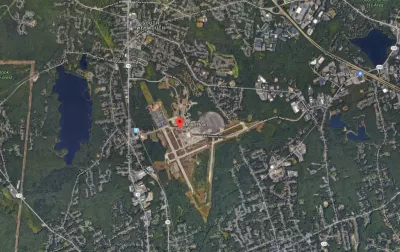
"Kyle Corkum imagines a 'smart city' with futuristic amenities like driverless shuttle services, heated sidewalks and a super-resilient energy grid that keeps humming through the harshest of storms," reports Lisa Prevost.
Prevost reports on the details of the Union Point development,which includes plans for "thousands of housing units and millions of square feet of high-tech commercial space on about 1,500 acres that extend into the neighboring towns of Rockland and Abington. The community’s glass towers, public plazas, clustered housing, scattered parks and retail zones will be contained within 500 acres, leaving the rest as dedicated open space."
"So far, the community consists of about 1,200 occupied single-family homes, townhouses and apartments, as well as a nearly completed $28 million sports complex with a miniature replica of Fenway Park," adds Prevost. "A cavernous aircraft hangar will be renovated for use as the centerpiece for a downtown district with shops, restaurants and open spaces with public programming."
According to the article, Union Point's technological innovations are made possible by a partnership with General Electric to "embed smart technology into the energy, water, lighting and transportation systems that will serve the community."
Read the full story: Building a Connected City From the Ground Up

Smart City Master Plan Announced Near Boston
"Smart city" plans are being announced at a steady clip. The latest master planned "smart city" proposal comes for a former U.S. Navy-owned site near Boston.
The Potential of New Towns
Richard Peiser and Ann Forsyth discuss their latest book, New Towns for the Twenty-First Century: A Guide to Planned Communities Worldwide, with the Penn Institute for Urban Research.
Salt Lake City debuts new bus rapid transit line
The third BRT line in the Utah Transit Authority system connects destinations from Taylorsville to the West Valley.

Planetizen Federal Action Tracker
A weekly monitor of how Trump’s orders and actions are impacting planners and planning in America.

Amtrak, CN end decades-long dispute with eight-year agreement
The new operating agreement establishes an updated framework for the companies to work together, including processes to resolve disputes.

Judges permit Denver to divert 77,000 acre feet from the Colorado River for reservoir expansion
Overuse and climate change have caused the Colorado River’s water levels to plummet.

NYC DOT wants faster, more permanent street upgrades
The city is examining ways to build more concrete infrastructure without getting entangled in 'decades-long' projects.

'Something we’ve never seen before:' rising utility rates could strain city finances nationwide
Data centers, climate change and other factors have caused utility rates in the United States to increase by 38% since 2020.

Trump to overrule local leaders, lease millions of acres of America’s Pacific Island territories’ seafloors to mining companies
International law says that the Indigenous people of America’s territories have a right to prior and informed consent regarding projects that impact their countries.

FREE Course: Walkable City 1: Why Walkability?
After describing his path towards focusing on walkability as the essence of good planning, Jeff Speck marches through his five principal reasons for making more walkable places.
Reinventing Malls: Planning Alchemy—Turning Gray Fields Into Gold
The course focuses on the opportunities and imperatives that shape reinvention of mall sites.

Harvard University Graduate School of Design
KFH Group Inc.
Greater Baltimore Committee
The Architects Foundation
University of Cincinnati Online
The Pocatello Development Authority
The Urban Renewal Agency of the City of Pocatello