A detailed and completely unbiased history of one of American transit's greatest comebacks.


This article is part of a regular column by Chicago-based transit planner extraordinaire Joshua Woods, who authors Thoughts About Cities. Check out his popular 2025 series, Transit Planning 101, and its follow-up sibling, Transit Scheduling 101.
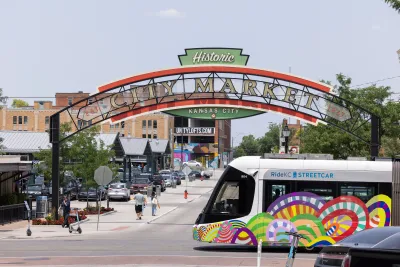
I’ve lived in Chicago for most of my adult life, but I was born and raised in Kansas City, MO. If you’ve never been, Kansas City is a grown up cow town with a hint of southern charm, known for its fountains, barbeque, and loud football stadiums. If you only know Kansas City through planning circles, you might know it as the 2016 runner-up for the “Sorriest Bus Stop In America” ranking hosted by StreetsblogUSA, or from now disputed claims about it having the most freeway miles per capita in the United States. Given this backdrop, Kansas City seems an unlikely place for a transit success story. But the Kansas City Streetcar is challenging this narrative, opening two extensions within the past year, and proving there actually is an appetite for walkable, transit-oriented urbanism in mostly car-centric Kansas City.
In October, 2025, the Main Street Extension of the Kansas City streetcar started revenue service. This extension stretched the southern terminus of the Kansas City streetcar from Union Station to the University of Missouri-Kansas City (UMKC), 3.5 miles to the south. The new, 5.7 mile alignment connects downtown Kansas City and the City Market to the National WWI museum, the Westport entertainment district, the Country Club Plaza, and through some of the most walkable neighborhoods in Kansas City.
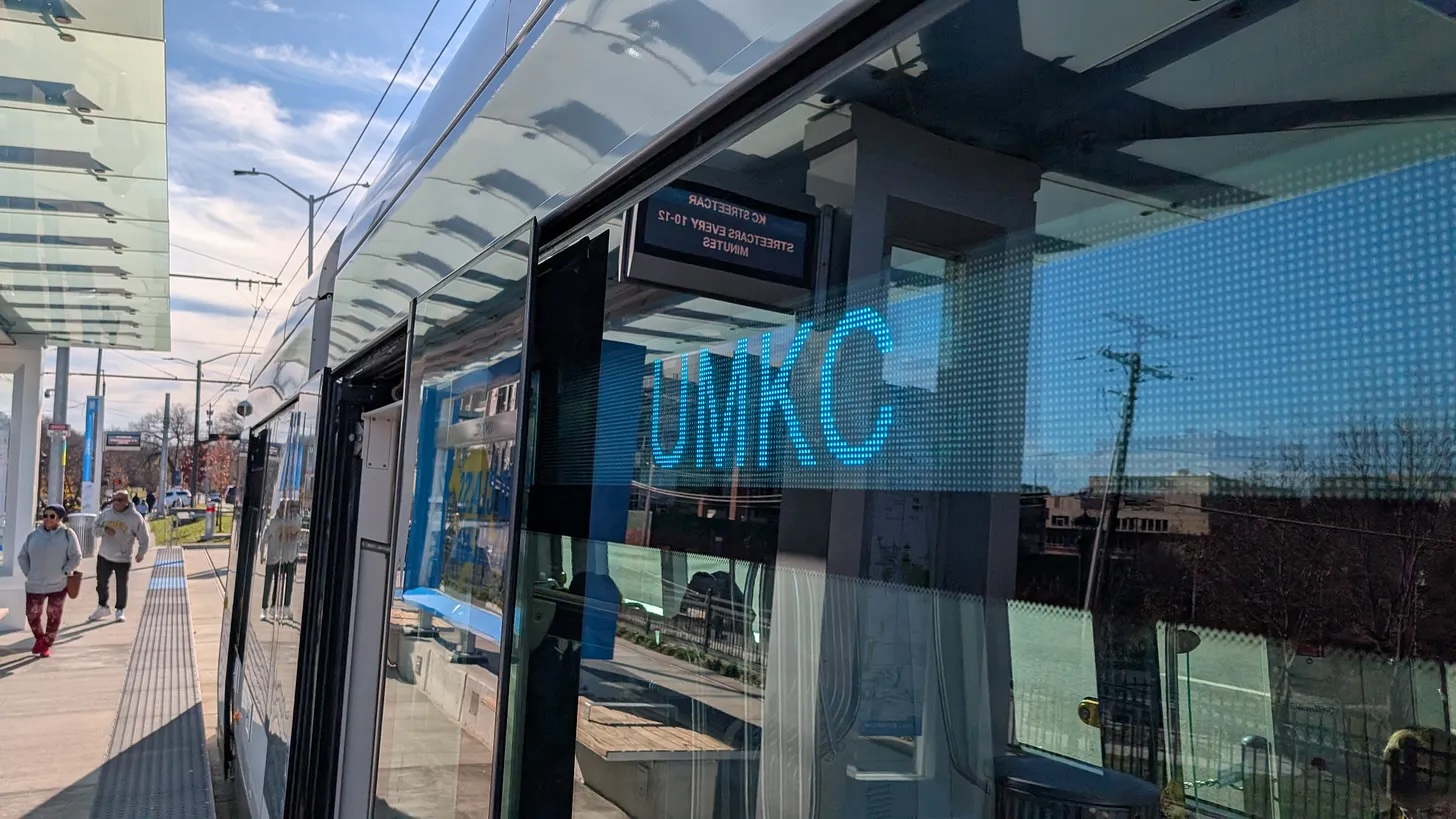
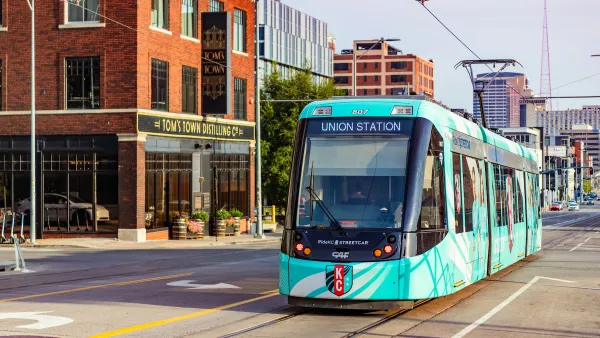
In May, 2026, just seven months after the opening of the Main Street Extension, and just in time for the FIFA festivities, the Kansas City Streetcar opened its Riverfront extension. This 0.7 mile extension stretched the northern terminus of the route to the Berkley Riverfront, where KPKC Stadium, home of the KC Current Women’s soccer team, and tons of multifamily housing units have conveniently cropped up over the past few years. The extension also featured a multi-use trail connecting the City Market to the Riverfront.
With the concrete and steel for these extensions barely set, the KC Streetcar authority is already planning for future extensions. The NorthRail Study is investigating extending the Streetcar across the Missouri River into North Kansas City, the 18th and Vine Study is investigating extending the Streetcar to Kansas City Historic Jazz District, and the East-West Transit Study is investigating east-west extensions generally. Kansas City, which once featured one of the largest cable car and streetcar networks in the United States, might be looking to regain its title, and it all started with a 2.2 mile starter line in 2016.
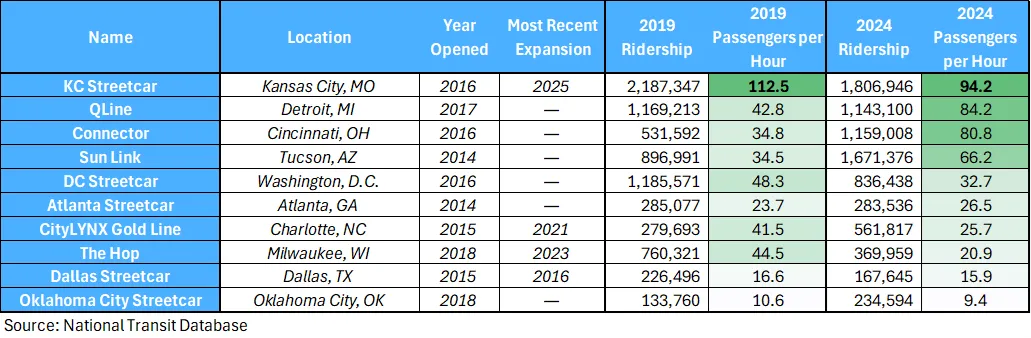
Even before any extensions, the 2.2 mile starter line was already a bright spot amongst modern streetcar systems, carrying more passengers on an hourly and absolute basis than any of the other 9 modern streetcars that started around the same time.
Notably, the initial segment that opened in 2016 achieved its success while operating in mixed traffic, along an alignment that mostly limited its utility to tourists, lookie-loos1, parents looking for something free fun to do with their kids and the subset of workers who both live and work along the line. When the initial segment opened, if you worked in downtown Kansas City, but lived beyond the 2.2 mile initial alignment, you probably still drove to work. If you already commuted downtown via Kansas City’s relatively anemic bus system, the streetcar probably didn’t change that either. Still, the Kansas City streetcar rumbled on along, offering a comfortable, free, direct ride to downtown Kansas City’s most popular attractions, catalyzing over $4 billion in economic development since 2014, converting initial opponents into supporters, and demonstrating that there is still room and appetite for a version of Kansas City that lets you exist without bringing your Chevy Suburban as a +1 everywhere you go.
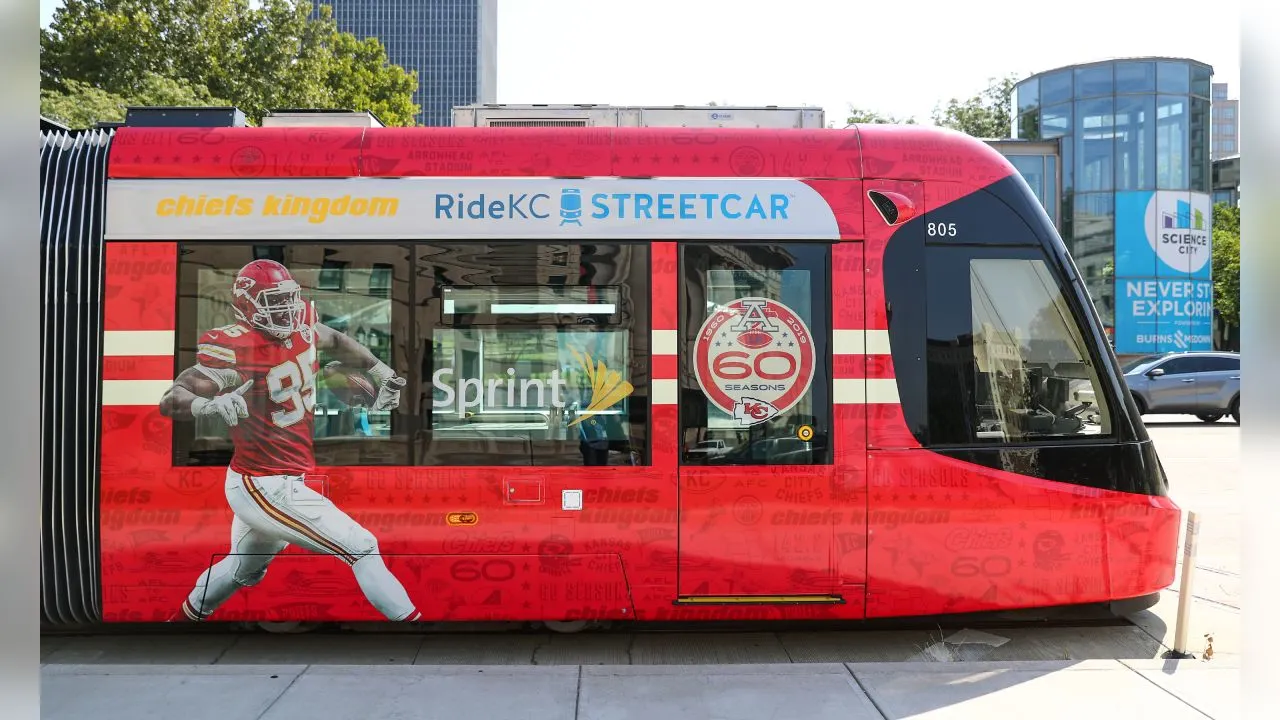
(The KC Streetcar also probably earned solid brownie points by leaning into a cultural force that unites Kansas Citians of all backgrounds and persuasions; those Kansas City Chiefs 🔴🟡.)
As a Kansas City expat, I’m excited to see my hometown, the birthplace of the pejorative “Jaywalker” lean into sustainable transportation in a way I’ve not really seen in my lifetime. With two extensions in operation and several in planning, the Kansas City Streetcar made the leap from a development catalyzing novelty, to a true transportation asset, linking some of Kansas City’s most notable attractions to some of its most walkable and bikeable neighborhoods. Notably, this transformation was several decades in the making. Timeline below!
Main Street: A Story of Corridor Development
Circa 2005
The groundwork for the Kansas City Streetcar was being laid long before a train was anything more than an urbanist’s pipe dream. In 2005, Kansas City debuted its take on Bus Rapid Transit, with the launch of the Main Street Metropolitan Area Express (MAX).
Bus Rapid Transit (n) - Bus Rapid Transit is a form of bus service that uses rail-like features to provide faster, more reliable, and more comfortable trips than standard bus routes. A BRT corridor typically includes elements such as dedicated bus lanes, off-board fare payment, all-door boarding, signal priority at intersections, enhanced stations and frequent service.
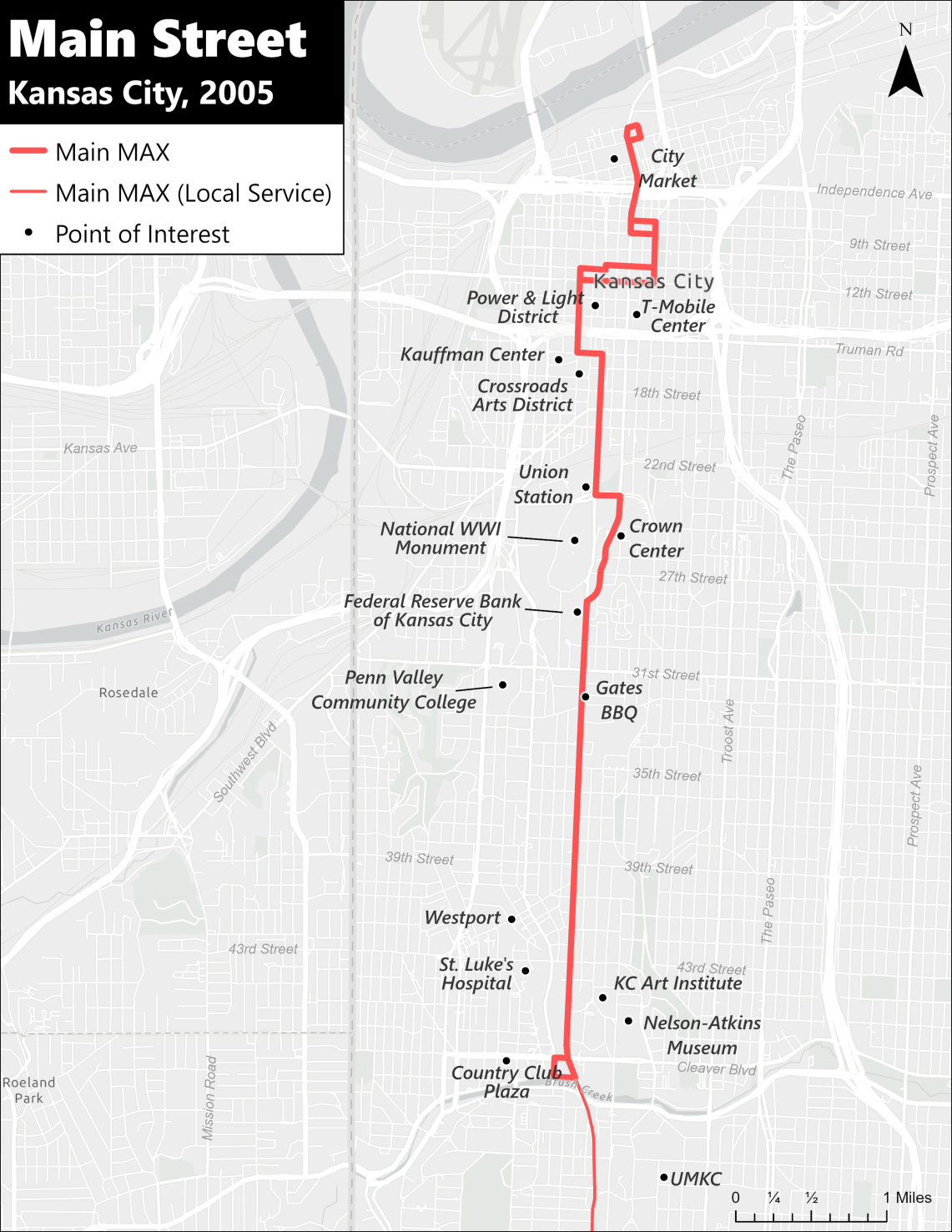
While this modest service fell short of the true definition of BRT, it did offer higher frequencies, elevated stations, wider stop spacing, faster travel times, and branded vehicles along the Main Street corridor, establishing the precedent for frequent transit service on Main Street, and in Kansas City generally. Upon its launch, the Main MAX became one of the busiest RideKC2 bus routes, only eclipsed by the Troost MAX and the Prospect MAX, which opened in 2010 and 2019, respectively.
Circa 2016
In 2012, after citywide and regionwide ballot measures to fund a more expansive rail transit network failed, voters in downtown Kansas City approved the Kansas City Downtown Streetcar Transportation Development District (TDD) that provided funding for the initial streetcar segment. In 2014, the KC Streetcar broke ground, and in 2016, construction was complete, coming in $250,000 below its projected $102M budget. Service started later that year, operating between City Market and Union Station.
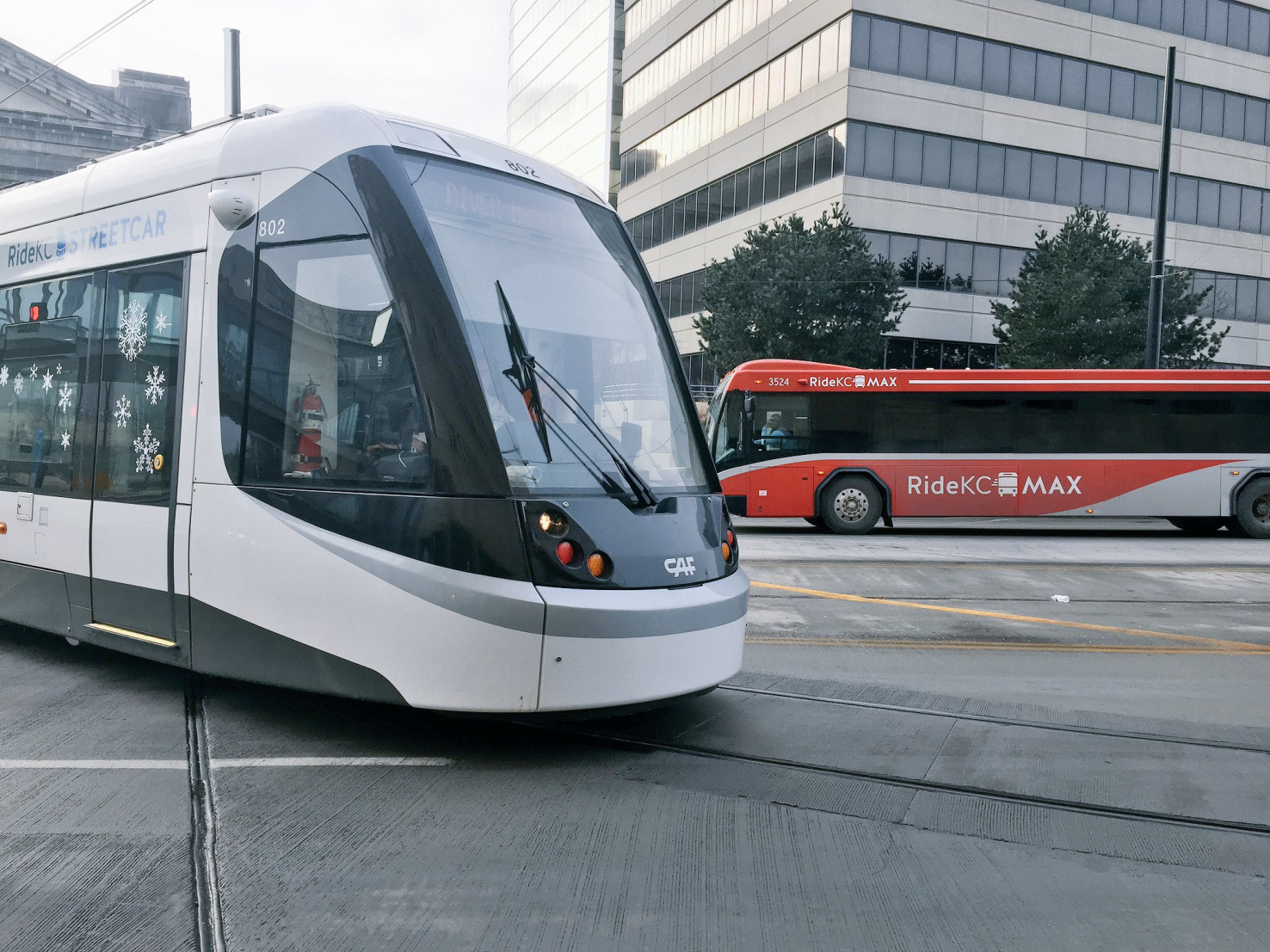
With this segment open, the downtown portion of the Main Street Max was effectively upgraded from BRT service meant to approximate rail, to proper Light Rail Transit service.
Light Rail Transit (n) - Light rail transit is an urban rail mode that operates smaller, lighter vehicles than traditional heavy rail or subways and is designed for medium-capacity corridors. Light rail typically runs on an exclusive or semi-exclusive right of way, can operate both at street level and on separate guideways, and offers faster, more reliable service than local buses due to features like signal priority, wider stop spacing, and higher operating speeds. LRT is well suited for corridors that need more capacity and permanence than buses can provide, but where a full subway is not warranted.
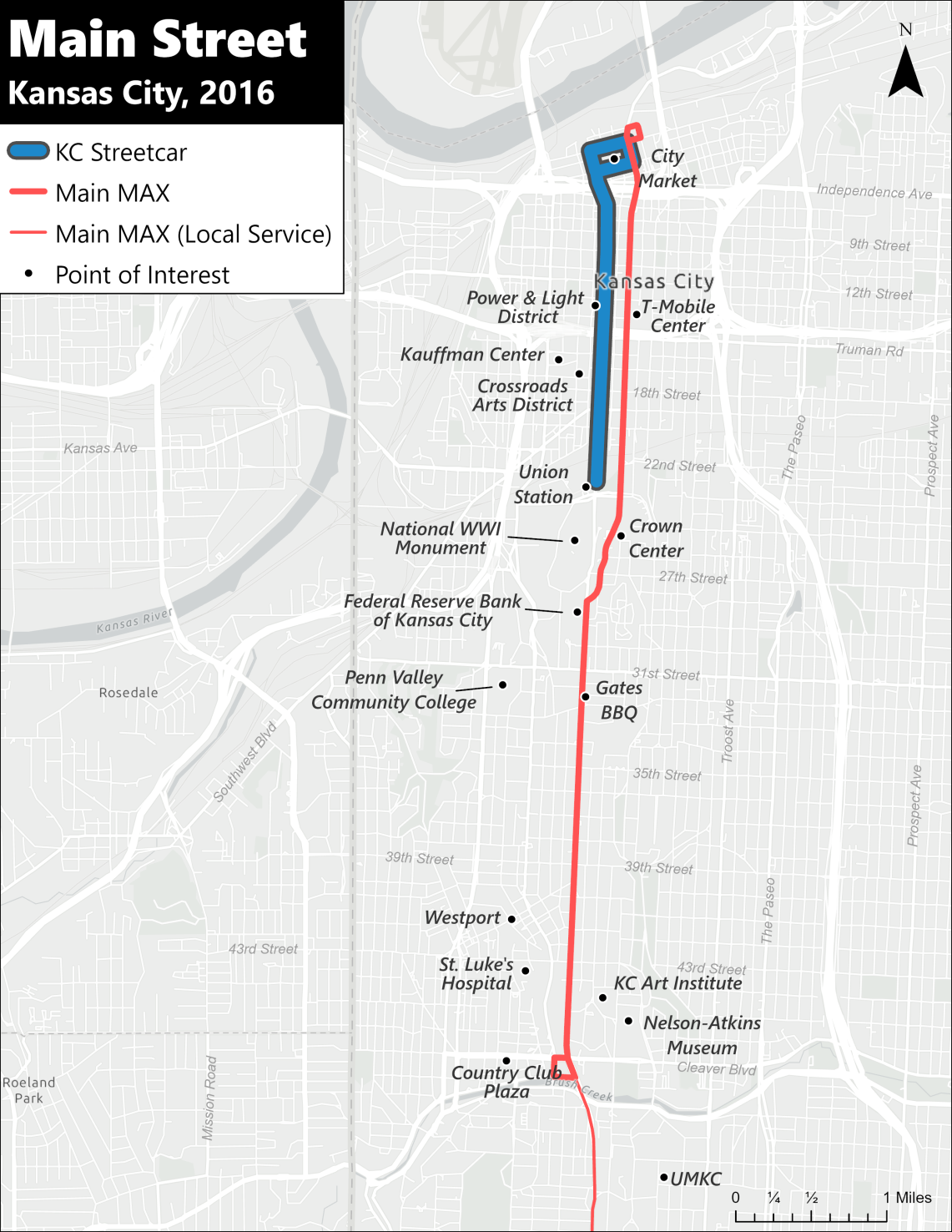
In order to avoid duplication of the new streetcar line, and in an effort to streamline transit operations downtown generally, the Main Street MAX and several other RideKC routes were rerouted to Grand Blvd two blocks east, where stops were upgraded and transit priority treatments were provided.
South of Union Station, the Main MAX picked up where the streetcar ended, serving Main Street between Union Station and the Country Club Plaza, continuing the precedent of frequent transit service along Main Street. South of the Plaza, the Main MAX provided local service to the Brookside and Waldo neighborhoods.
Circa 2025
In 2017, voters approved an extension of the TDD south to the Country Club Plaza and UMKC. Ground broke on the 3.5 mile extension in 2022, and service started in October 2025. With the opening of the main street extension, the entirety of the frequent portion of the Main Street MAX is now upgraded to rail service, and Kansas City’s first BRT line is being retired.
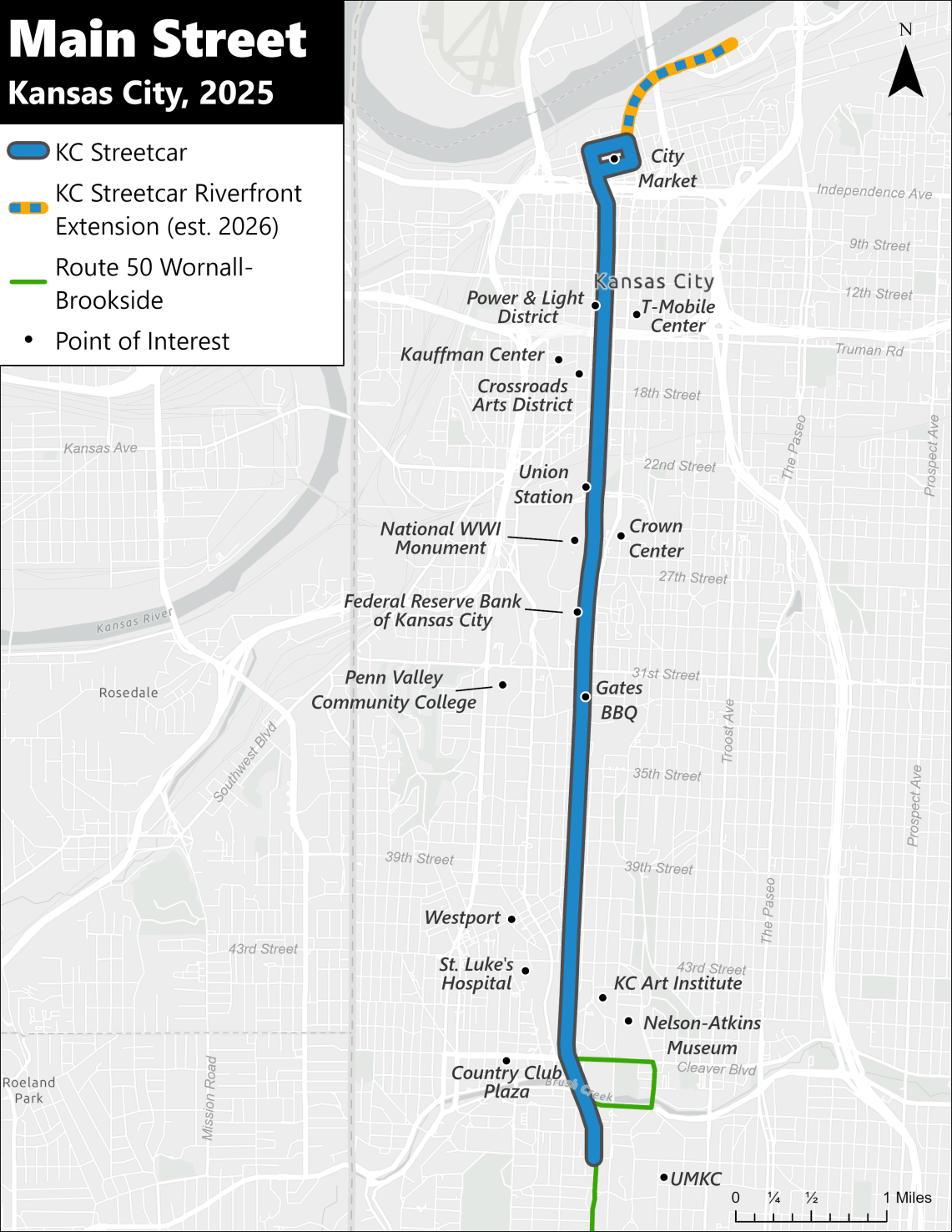
With the retirement of the Main MAX, the local portion is now covered by the new Route 50 Wornall-Brookside, offering every 20 min weekday service, and every 20-30 minute weekend service.
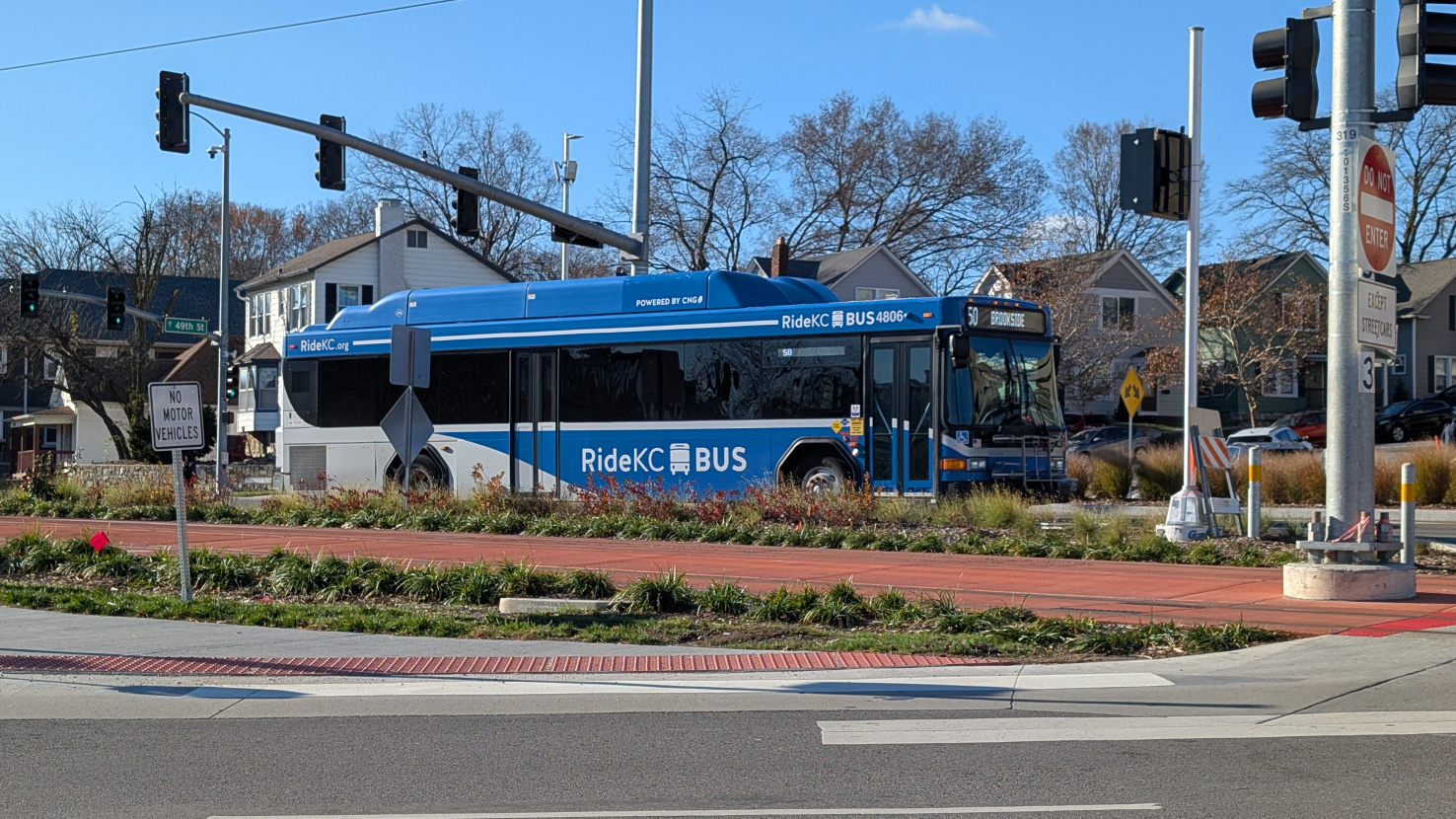
If the first BRT line in the city being fully converted to rail service wasn’t exciting enough, in early 2026, the 0.7 mile Riverfront Extension started service. This extension stretches the KC Streetcar beyond the original Main Street MAX footprint, offering a direct rail connection from the Country Club Plaza to Kansas City’s quickly growing riverfront.
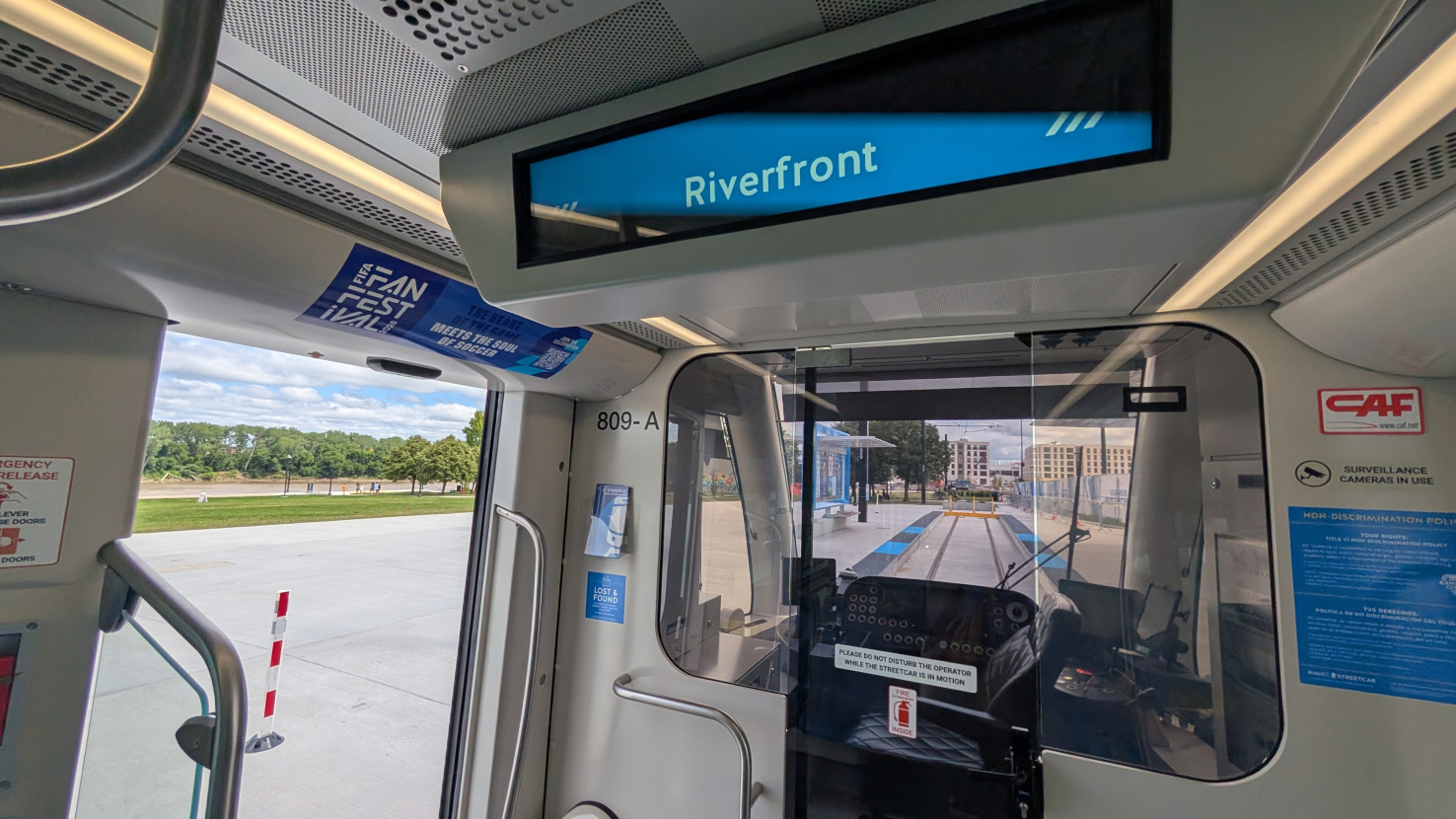
Beyond connecting key attractions to walkable neighborhoods, the Kansas City Streetcar now serves as a rail spine for the local bus network.
Note: Despite both carrying the RideKC branding, the streetcar is operated by the Kansas City Streetcar Authority, while the bus network is operated by the Kansas City Area Transportation Authority (KCATA). While these two entities do coordinate with one another, they are distinct entities with separate funding mechanisms.
KCATA operates a network of about 30 fixed routes that operate in and around Kansas City. Of these 30 routes, 10 carried over 70% of total weekday ridership in October 2025. Those routes are the:
- Prospect MAX (15%)
- Troost MAX (12%)
- 24: Independence (9%)
- 31: 31st Street (8%)
- 101: State Ave (7%)
- 39: 39th Street (5%)
- 25: Troost (5%)3
- 11: Northeast-Westside (4%)
- 18: Indiana (4%)
- 201: North Oak (3%)
With the opening of the Main Street extension, all 10 of these routes now connect directly with the Kansas City Streetcar, offering service every 10-20 min.
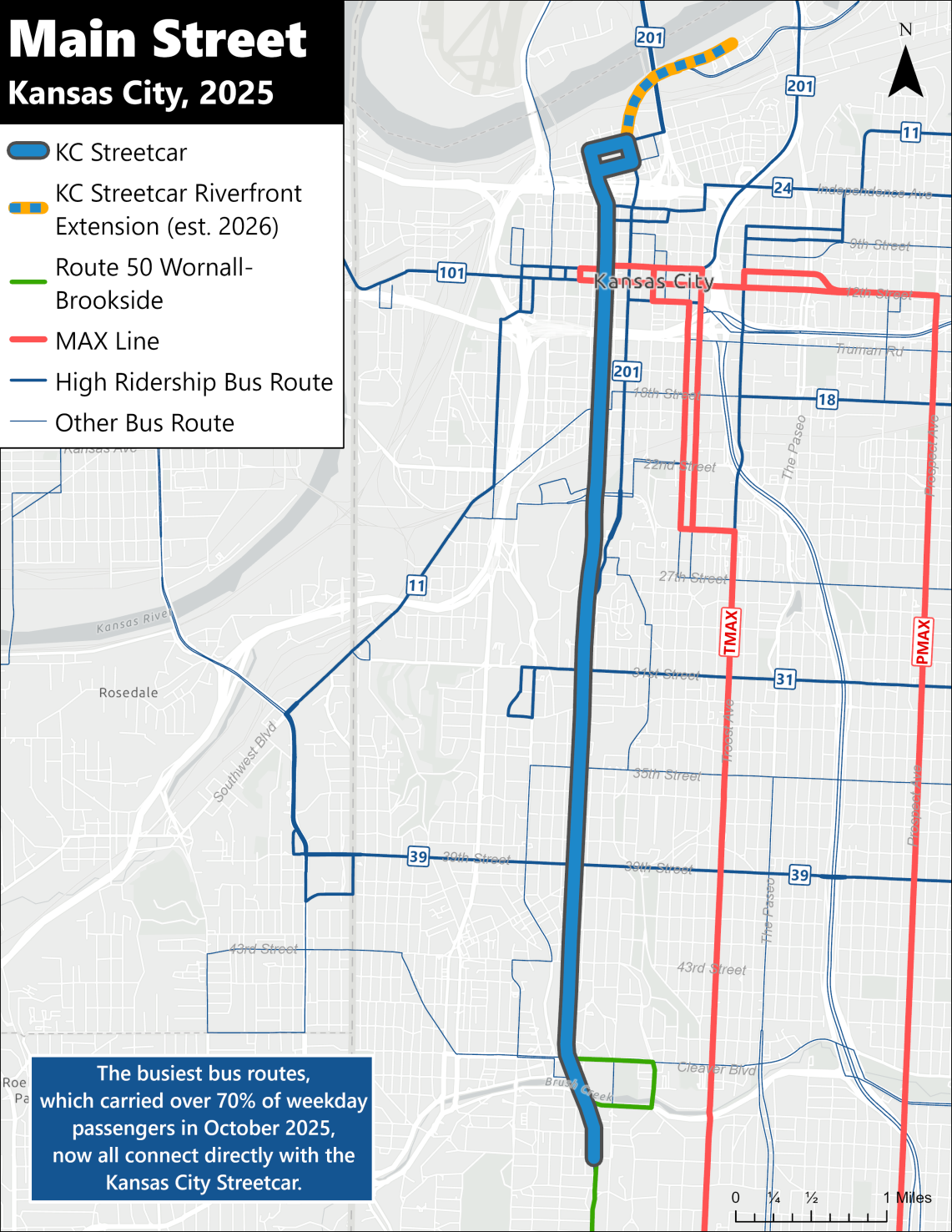
Put differently, now anyone in Kansas City wanting to opt out of the $14k/year expense associated with vehicle ownership, or anyone with a disability that prevents them from driving, or anybody that just doesn’t want to drive everywhere now has a reasonable option to stay in Kansas City and live the life they want to live.
Riding the Streetcar
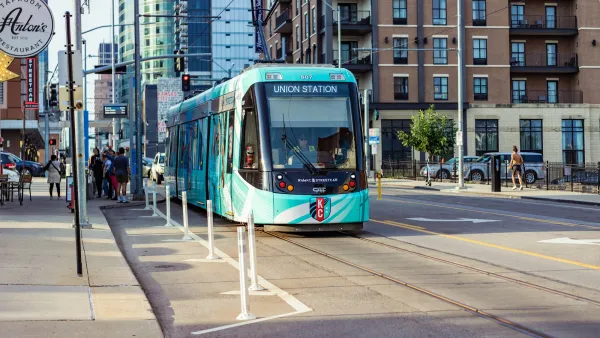
The Kansas City Streetcar operates a fleet of 14 CAF Urbos 3 light rail vehicles with an open gangway design that lets passengers enter through any door and spread throughout the entire train, which is great since it’s not uncommon for the train to reach standing room only conditions. Since its opening, the Kansas City Streetcar has been free to ride, a detail likely to remain indefinitely due to the dedicated funding stream provided by the Transit Development District.
Because of this, a common, low cost Kansas City excursion is to park at Union Station, check out the Science City children’s museum or the 8,000 square foot model train exhibit located inside, and hop on the streetcar, maybe hopping off at City Market to shop and grab a snack, or at the Power and Light District to grab a drink before returning to Union Station.
I actually think this has a lot to do with the success of the system. If you’re on the fence about the project (or the concept of public transit generally), the Kansas City Streetcar provides a fun, family-friendly outing for anybody in town looking for something to do. Over time, this naturally builds supporters
Even with the line extended south, this tradition still appears to be going strong. The trains I rode tended to fill up at Union Station heading north and empty out in City Market before filling back up with a fresh cohort destined for Union Station.
South of Union Station, the streetcar still seemed to maintain a decent crowd, with most seats full and some passengers standing. Where north of Union Station the crowd felt pretty tourist heavy, south of Union Station, the crowd had a decent mix of tourists and locals. Notably, 31st Street and 39th street, where the streetcar intersects with two major bus routes were busy stops, suggesting that Main MAX passengers are making the jump to the streetcar.
For the majority of the alignment, the track configuration is pretty straightforward, with curb running lanes and side platforms. Some of the intersections in City Market get a little spicy since the existing roadway widths make for turn radii tighter than a streetcar can handle, but nothing some creative signal timing can’t handle. South of the Art Museum (45th & Main) stop, the track configuration gets more creative.
Between the Art Museum and the Plaza Stop, southbound trains move into the painted median, an area of the road that would already be off limits to cars in the first place. This is probably one of my favorite sections of the streetcar because it’s such a simple solution to keep the streetcar moving while avoiding the technical and political hurdle of taking a lane of traffic leading into the County Club Plaza, which opened in 1923 as the first regional shopping center in the United States designed with parking for automobile access. (The original developer literally designed to to feel like Seville, Spain, but with a crap ton more parking.)
The Plaza Station features a bus terminal with dedicated bus lanes where the 50 Brookside currently takes its layover. Heading south from the Plaza, the streetcar crosses through probably the most imposing intersection along the entire route before entering its own dedicated right of way, following the Trolley Track Trail, marking a full circle moment for this rails to trails project.4
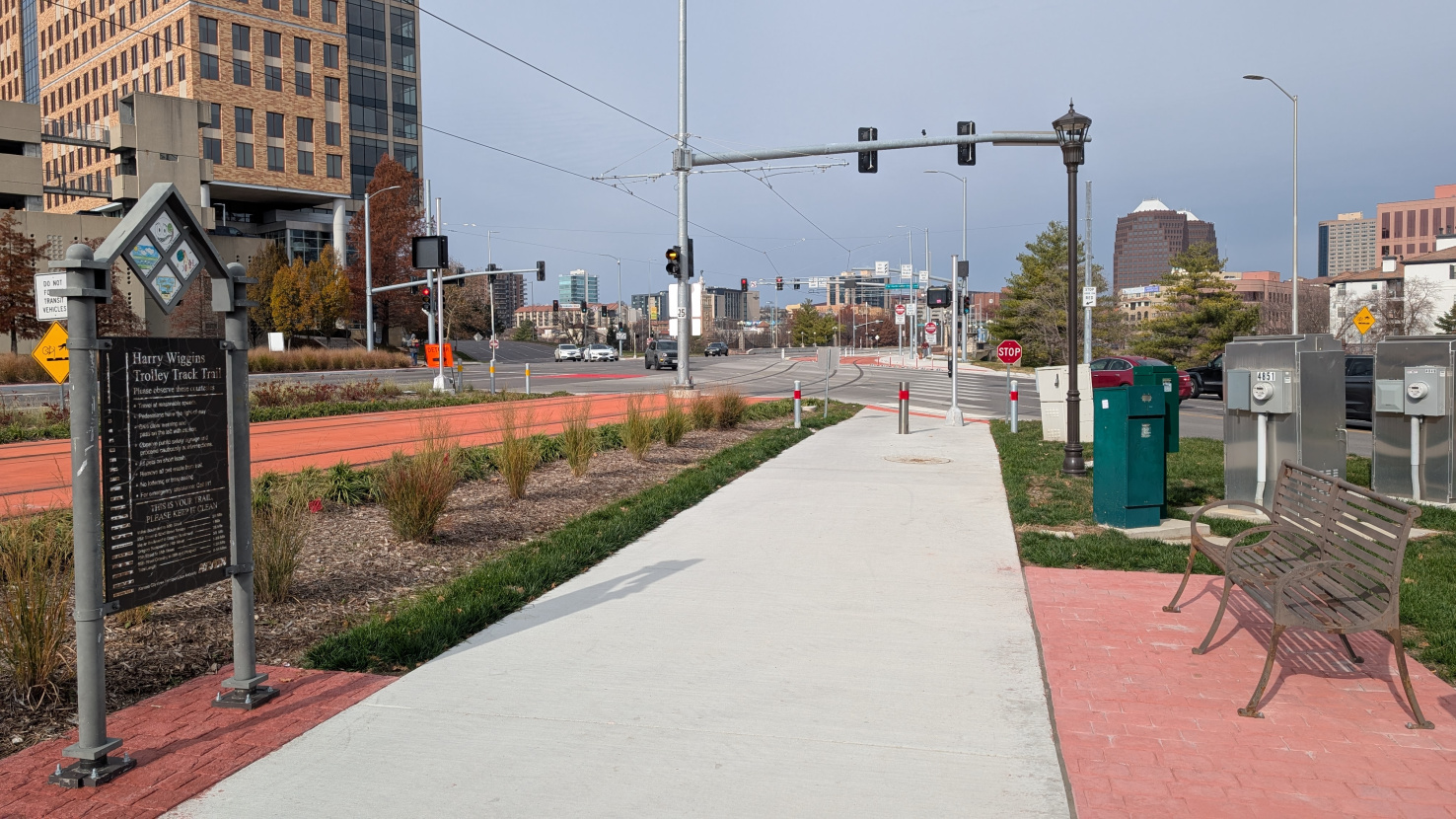
At UMKC, the streetcar ends with a simple middle platform with a crossover just before it, with room to stage up to 4 trains.
A modest terminal for a modest transit service, in a modest city, delivering above average results. If you’re ever in Kansas City looking for something to do, why not hop in the trolley?
And if you enjoyed this article, check out its companion Youtube video!
-
I ride it every time I come back to Kansas City.
-
Then KCATA.
-
This is the local underlay for the Troost MAX. This route maintains weekday service every 30 minutes, unlike the local underlay for the Prospect MAX (the 71), which operates less than hourly. I’m not sure why the 25 maintained this service level.
-
Don’t worry, they kept the trail, so now I guess it’s a rails to trails to trails and rails project.

Kansas City completes riverfront streetcar extension
The streetcar line carries a third of the region's transit riders.
Kansas City Announces Another New, Fare-Free Streetcar Line
The once-derided transit system continues to add new lines as ridership grows.
Kansas City Streetcar Doubles Ridership After Expansion
Daily weekday ridership on the system jumped from 4,000 to 10,000 after the Main Street extension opened in October.

Planetizen Federal Action Tracker
A weekly monitor of how Trump’s orders and actions are impacting planners and planning in America.
‘Going backwards:’ Baltimore mayor, students rally against state's transit funding plan
Maryland's proposed six-year plan provides no funding for Baltimore’s BMORE bus program and reduces its road maintenance funding.
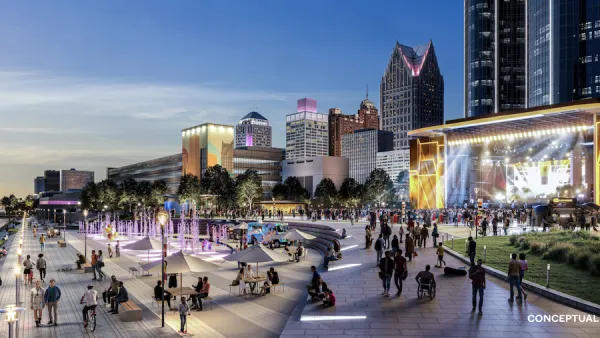
Detroit to transform waterfront with $2.2 billion investment
Developers will convert about 18 acres of unused parking lot space into civic spaces.

Exemption applications for NYC’s pied-à-terre tax see 55% success rate
The city sent nearly 40% of its initial pied-à-terre tax warnings erroneously.

MTA invests $1.1 billion in ‘nearly-impossible’-to-evade fare gates
The new technology marks the Metropolitan Transit Authority's first turnstile redesign in decades.

HUD modernizes 50-year-old manufactured housing framework
The Next Generation Manufactured Housing Action Plan establishes new energy-efficiency standards for manufactured homes, and new guidelines for anchoring them.

FREE Course: Walkable City 1: Why Walkability?
After describing his path towards focusing on walkability as the essence of good planning, Jeff Speck marches through his five principal reasons for making more walkable places.
Reinventing Malls: Planning Alchemy—Turning Gray Fields Into Gold
The course focuses on the opportunities and imperatives that shape reinvention of mall sites.

One Hundred Miles
County of Mendocino
planning NEXT
The Architects Foundation
University of Cincinnati Online
Montrose County
Northern Illinois Transit Authority (NITA)
The Pocatello Development Authority

