New York’s new mayor Zohran Mamdani has said he’ll make every bus free to ride. This French city did just that — and is reaping the rewards.


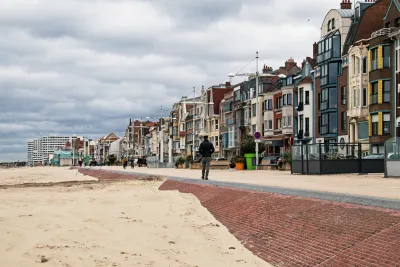
This article by Peter Yeung was originally published in Reasons to be Cheerful. It is reprinted here with permission.
The open-air central bus station in Dunkirk feels like a Formula 1 pit lane. In the space of a few minutes, a dozen pink, green and blue buses speed in and out, with passengers descending and mounting through all available doors. The arrivals board, displaying destinations such as Grande-Synthe, Cappelle-la-Grande and Malo-les-Bains, ticks over so quickly it’s as if drivers are vying for a podium spot.
As the C4 bus pulls in, a teenage girl with chunky headphones and a mother with a baby in a stroller are among those to board. But there are no beeps registering cards, nor the clink of coins used to pay for tickets. Because in this northern French city, no passenger pays.
“It’s not bad, really not bad,” says Theo, a 23-year-old gardener in the city and a daily user of the service, in typical French understatement. “You never have to wait long. There’s less car traffic and less pollution because of it. And it’s free.”
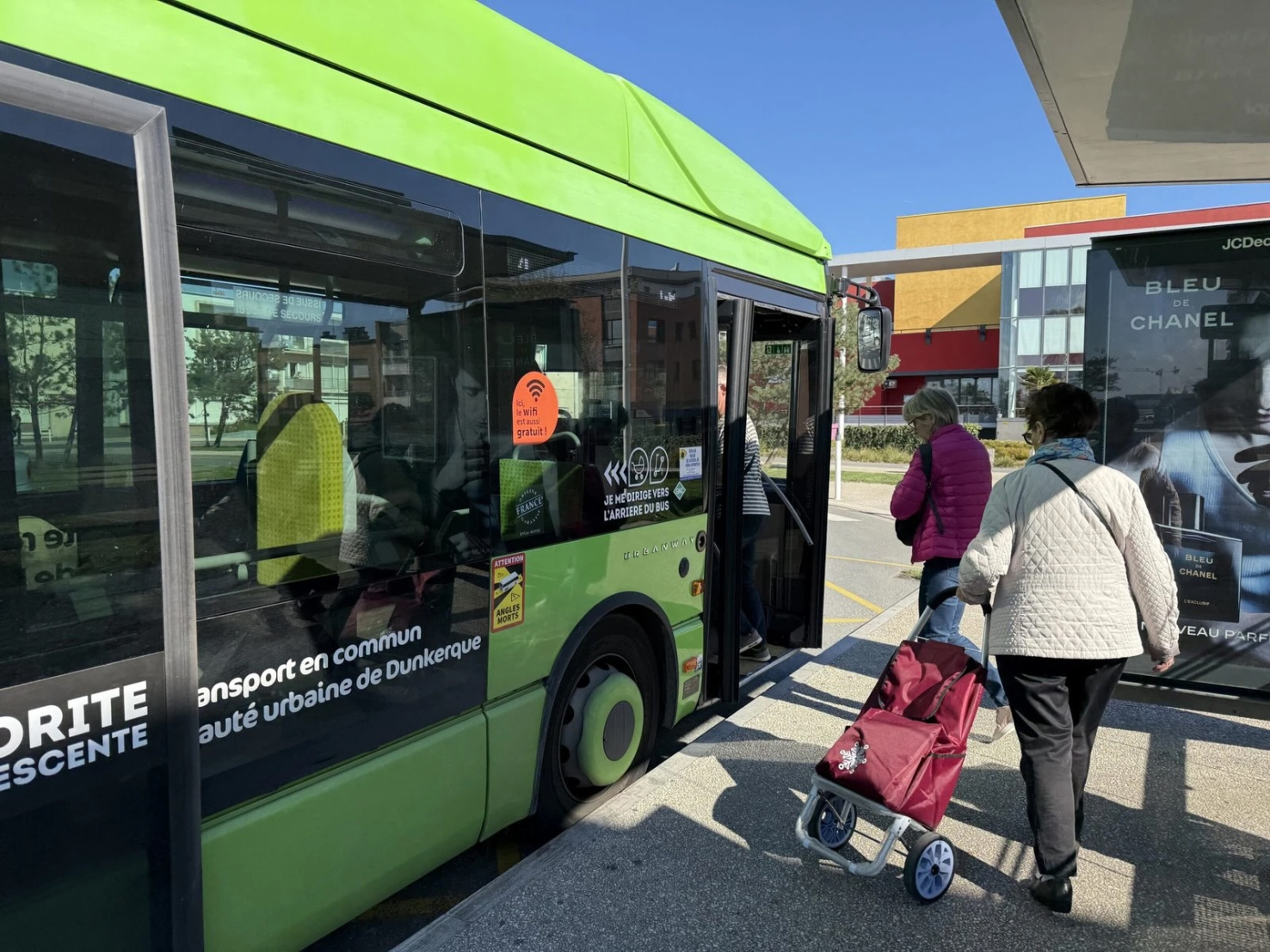
In 2014, Dunkirk made the decision to get on board with free public transit. Mayor Patrice Vergriete, who has a doctorate in urban planning, pledged during his election campaign that the city would become the largest in France to drop fares on local networks. Today about 150 vehicles — labeled “100% free bus, 7 days a week” — crisscross the city and its surroundings, giving 200,000 residents free access to 18 routes.
“We made this decision to prioritize freedom [for residents] and really create a shock to improve mobility in Dunkirk,” says Jean-François Montagne, the deputy mayor of Dunkirk and head of the region’s ecological transition efforts.
Proponents like Montagne say that making public transit free reduces carbon emissions, air pollution and traffic, and supports low-income households. They also argue that a funding model that relies on government subsidy rather than passenger fares is more resilient in the face of shocks like pandemics. But critics say that there are high costs linked to these policies — and that scaling them up to sprawling metropolitan hubs, just as New York City’s new mayor Zohran Mamdani has pledged to do, is unlikely to be a smooth ride.
In Dunkirk, it took four years — from 2014 to 2018 — for efforts to hit the road. First, authorities publicized the program in the media and on the streets, carried out surveys with residents, simplified and reworked timetables, improved the quality of vehicles, repositioned bus stops and increased the size of the fleet. In 2015, they launched free travel on weekends as a testing period, before rolling out the service seven days a week in September 2018.
“You can’t just make buses free from one day to the next,” says Montagne. “If the service is underused, timetables not well understood, if buses are always late, and you don’t change people’s views of public transit, then it won’t work.”
Central to Dunkirk’s strategy was reinventing the image of public buses, which were typically seen as overloaded, unclean and not particularly safe. Authorities now clean buses every day, and if a seat is broken then it is replaced within a day. Each route, they decided, should have a scheduled arrival every 10 minutes. Smartphone applications also allow passengers to track where and how full their bus is.
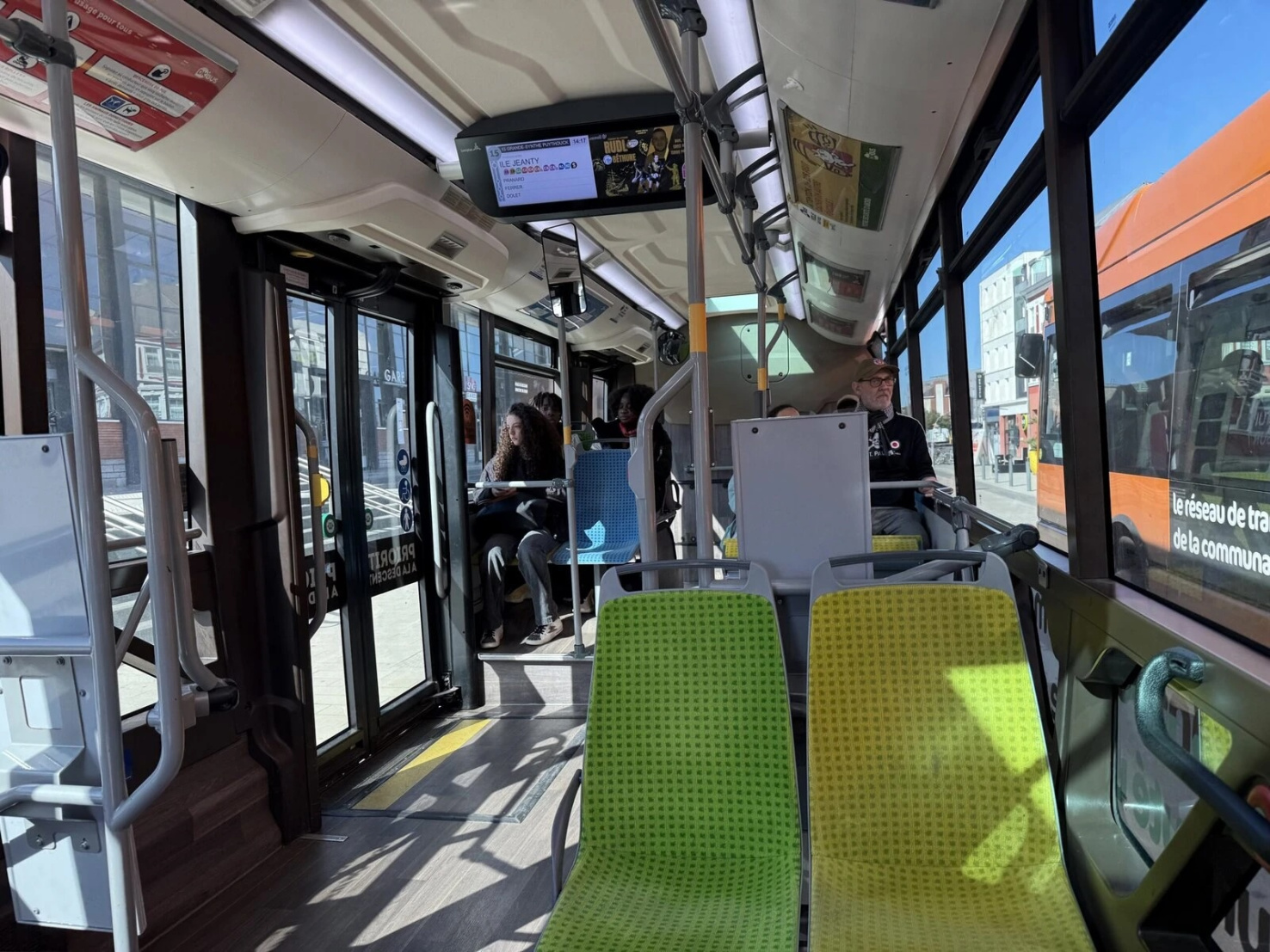
“These might seem like small details, but we worked a lot on this,” says Montagne.
And just over a decade since Dunkirk kickstarted its free bus program, the policy has hit top gear. According to Dunkirk city hall, the number of bus passengers has increased by 165 percent since the initiative was introduced.
“In Dunkirk, it’s led to a huge rise in users, it’s revitalized the city and it works as a kind of social redistribution,” says Maxime Huré, a lecturer in political sciences at France’s University of Perpignan Via Domitia who has studied the program.
A 2019 study by the Observatory of Free Transport Cities, an independent body, found that the policy has led to residents making more trips to the city center, that about half of the new bus riders were taking bus journeys they previously made by car, and that the attractiveness and image of the city has improved.
Separate research in 2021 found that free buses are helping young people in Dunkirk shift away from the “idealized” image of private car ownership. Indeed, according to Montagne, city hall figures show that 10 percent of Dunkirk bus users have abandoned their cars since 2018, cutting use of city parking lots by 30 percent.
Monique, a 75-year-old retiree, stopped driving two years ago with her weakening eyesight and the ease of the free bus transport as an alternative. She’s pleased that there’s even a standalone night service akin to a city-run Uber service that can be ordered on demand at 10pm, taking her directly home for just €2 when she goes to the theater.
“I think it’s really super, it’s very well serviced,” she says.
In France, where the transportation sector accounts for 34 percent of greenhouse gas emissions, a growing number of authorities are getting on board with free public transit. Today more than 45 local authorities have made some form of public transport free for all passengers, including Aubagne, Compiègne and Montpellier. In the latter, where the policy applies only to permanent residents, bus ridership increased by 27 percent in just one year and the number of people being overexposed to nitrogen dioxide, a pollutant linked to road traffic, fell by 90 percent.
And while Dunkirk has introduced completely free transit, others have adopted other models, such as age-based criteria — in Lille and Strasbourg, for example, bus travel is free for those under 18. Free weekend travel, meanwhile, is offered for everyone in Nantes, Rouen and Nancy.
But France is far from the only nation to have introduced free public transit.
According to a 2025 report by Italian researchers, fare-free public transit has been rolled out in 100 places across the world, notably in the U.S., Brazil and European countries such as Poland. Estonia’s capital Tallinn introduced free transit to its 450,000 residents in 2013, and Luxembourg became the first nation in the world where all public transportation is free (except for first class on trains) in 2020.
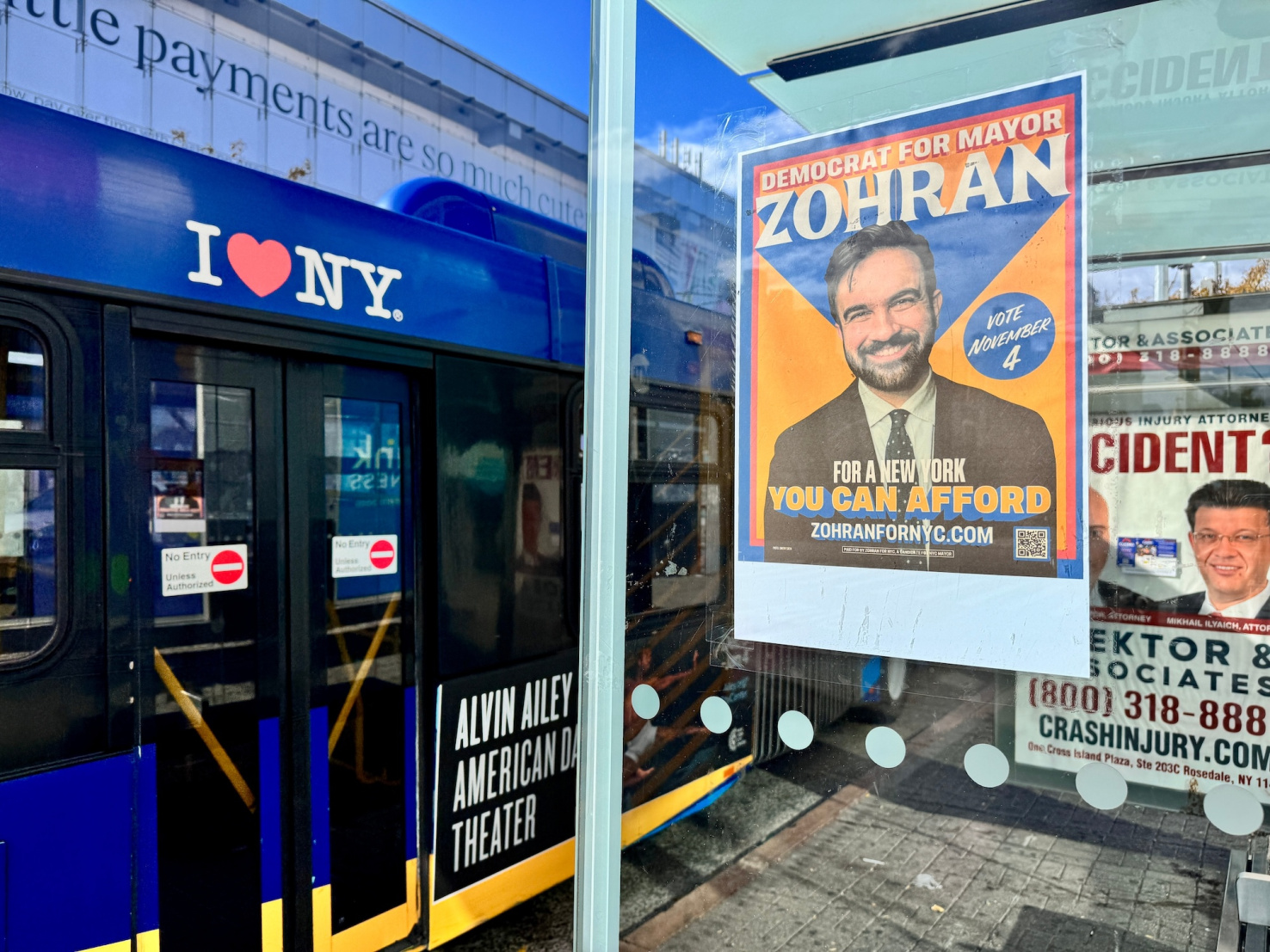
Some of the oldest examples of fare elimination trace back to the U.S. The California city of Commerce pioneered free buses in 1962. A 1974 federal law provided $40 million for pilots in Denver and Trenton, New Jersey. More recently, Iowa City eliminated bus fares in August 2023 — paid for with a one percent increase in utility taxes and doubling most public parking rates. The two-year pilot led to ridership exceeding pre-pandemic levels by 18 percent, with emissions dropping by 778 metric tons of carbon dioxide a year.
Yet opinions are divided on whether a major city like Paris, London or indeed New York City could successfully implement a fare-free model.
Some critics say that free transport systems lead to loss of public income and divert money away from infrastructure upgrades.
A report published in September 2025 by France’s Court of Auditors found that free public transport in smaller cities led to ridership increases at a limited cost, but in larger, already well-used networks, the introduction of free transit is “very costly” because it is accompanied by significant losses in fare revenue and additional costs related to the necessary reinforcement of the existing network, which is under greater strain.
The report found that, in Montpellier, free public transport has primarily led to a surge in short trips more at the expense of walking and cycling than driving. In Lyon, in contrast, where public transit fares have increased — €90 ($105) for a monthly subscription — the additional funds have made it possible to finance a wider range of transport services and reduce car traffic.
But Dunkirk authorities defend the scheme. Montagne says the €17 million ($19.9 million) annual cost — out of the city’s €500 million annual budget — for running the free buses is an important social investment. “The money serves the population, it helps workers, but also families, for leisure, to attend healthcare.”
“[The Court of Auditors] claim that it devalues the service, but it’s totally the opposite — we have fewer crimes and issues than before.”
Surveys during Dunkirk’s 2020 municipal elections even found that 99 percent of respondents ranked the free bus service as the most important public policy.
Huré argues that, given the percentage of transit network income that passenger fares represent is broadly falling, making buses free is far less radical than it seems: Fare revenue has been declining almost universally. “But politically, it’s presented as a rupture,” he says.
But whether free buses can work elsewhere depends on other factors such as the capacity of networks to deal with an increase in passengers and funding sources, according to Huré. In France, public transit systems are already partly funded by the versement mobilité, or mobility levy, which relies on a percentage of social security contributions paid by French employers.
“It could work in large cities, but it depends on the context,” he says.
The road ahead appears to show even more places treating buses and mobility as a public good and not a paid privilege. On January 1 of this year, buses and regional trains became free across France’s Lens-Liévin, Hénin-Carvin and Béthune-Bruay metropolitan areas, making it the largest fare-free public transport network in France. Perhaps New York Mayor Mamdani, whose city already sees 1.4 million bus journeys a day, could take the trend to the next level.
“There is strong demand for free transit,” says Huré, “and I believe it will continue.”
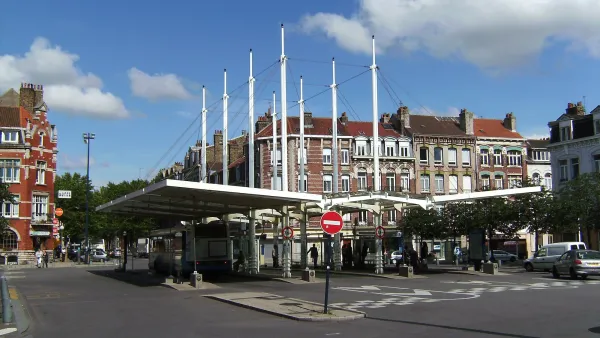
Zohran's Free Buses are Possible — Just Ask This French City
Dunkirk’s free buses are bringing social and economic rewards at a small cost to the city.
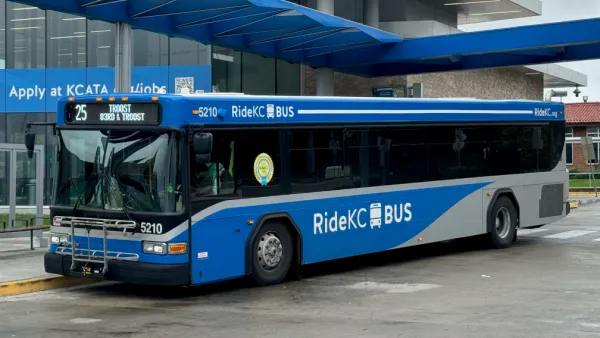
Kansas City Will Start Charging Bus Fares in June — With no Plan in Place for Low-income Riders
Service providers say they haven’t been told how their clients can access free or reduced fares after the agency starts charging again this summer.

Albuquerque Remains Committed to Free Transit
Ridership on the city’s transit system has gone up by 20 percent since they eliminated bus fares in 2022.

Washington state to charge fee to drivers with fuel-efficient cars
Revenue from the fee will go towards supporting the state’s highways.

Illinois considers spending $1 billion in taxpayer money on data center
A quantum computing campus and data center are currently under construction in Chicago.

Trump to blast ‘hydrocarbon highway’ through ‘world’s longest art gallery’
Environmental and historic preservation groups are suing to stop the project.

Boston City Council votes to no longer mandate parking in residential developments
The Boston Zoning Commission still needs to approve the proposal.

Passengers in New York, California lift off in air taxis
Two air taxi companies have received a Special Airworthiness Market Survey Certificate, which allows them to service passengers.

MTA to upgrade subway signals for entire network by 2050
This is the first time New York City has planned to modernize subway signals in the Bronx.

FREE Course: Walkable City 1: Why Walkability?
After describing his path towards focusing on walkability as the essence of good planning, Jeff Speck marches through his five principal reasons for making more walkable places.
Reinventing Malls: Planning Alchemy—Turning Gray Fields Into Gold
The course focuses on the opportunities and imperatives that shape reinvention of mall sites.

City of Charlotte
City of Rosemead
Rutgers University, Edward J. Bloustein School of Planning and Public Policy
University of Michigan School for Environment and Sustainability (SEAS)
Hunter College, City University of New York (CUNY)
The Architects Foundation
University District Partnership

