Microtransit is in vogue. Cultivating a strong understanding for what it can and can't do will help prevent you from getting rizzed up by this charismatic mode of transportation.



This is the final column of a seven-part series in partnership with Chicago-based transit planner extraordinaire Joshua Woods, who authors Thoughts About Cities. Titled “Transit Planning 101,” it’s the transit planning boot camp you wish you got in planning school. Learn more about Joshua and the inspiration for the column, and read his other installments here. Want to hear more from Joshua? Let us know in the comments below!
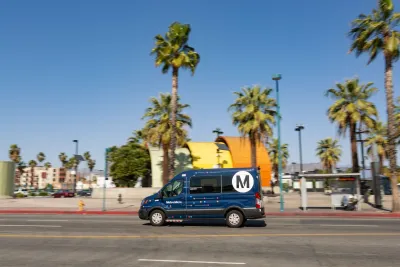
Microtransit is an updated version of an old mode of transportation: Demand Response Transportation. Demand Response Transportation (DRT) is a mode of transportation where vehicles do not operate on a fixed route or schedule. Instead, vehicles are requested by passengers and the transit operator dispatches a vehicle to take the passenger from Point A to Point B.
Demand response transit is not a new transit mode. However, the widespread adoption of cell phones has facilitated iteration on this mode. Instead of phoning in to request a ride, people can now request a bus like an Uber. Boom! Microtransit is born. Microtransit = app powered Demand Response Transit.
Under this general definition, dozens of services, operating in different contexts, with different vehicles and different operating rules have entered operation under the label “microtransit.” Here’s a rundown from the American Public Transportation Association (APTA) that speaks to the range of services that have worn or currently wear the microtransit label.
Let’s get back to Demand Response Transit
Really. Let’s just call it demand response transit. The term “microtransit” communicates more uncertainty than information. So what do we know about demand response transit?
- Demand Response Transit is good at providing coverage service in places where demand or underlying land use does not support fixed route transit.
- Demand Response Transit’s capacity is necessarily lower than fixed route transit.
Why do places operate demand response transit?
- To provide coverage service in rural or low-density areas.
- To provide transportation or people with specialized needs.
Why don’t more places operate demand response transit?
- Demand response transit generally carries a high cost per passenger, since it provides more specialized trips to fewer people.
- Demand response transit does not scale with ridership. Increases in ridership require increases in revenue hours.
I’ve developed the following graphic that helps me understand the inherent tradeoffs and limitations of DRT.

If frequency and service design are Transit Planning 101, then microtransit is solidly Transit Planning 102, if not 201 — not because it’s exceptionally complicated, but because successful implementation requires a strong understanding of why microtransit service is being pursued.
Otherwise, the fact that microtransit is fun has a tendency to dominate the conversation.
Microtransit leaves people with a broader view of what public transit can be, and, if done well, a positive association with transit. Throw in a gimmick like cute little electric GEMs around a cute town square, and you’re getting dangerously close to fun.
Fun is not a bad look for transit. Transit often feels cold and utilitarian, so a little delight can help people feel more connected to the system. That said, fun cannot replace pragmatism.
Microtransit can serve relatively few people and carries a higher cost per passenger than traditional fixed-route service. This must inform how money is allocated to this service type. Below are several common justifications for microtransit, and how well each one holds up.
Common reasons for pursuing microtransit
1. If you’re using microtransit to solve the first/last mile problem,1 bike/ped improvements or allowing more dense, mixed-use development around transit2 are probably more robust, long term and cost effective solutions.
This is particularly true if you’re pursuing microtransit in urbanized areas. I live in Chicago. Per Replica cell phone data, about 250 daily trips start and end in my neighborhood between 3 and 4pm on the typical weekday.3 Capturing just 10% of those trips would require 5-8 microtransit vehicles.4 The one time capital cost of building a sidewalk (or the free cost of changing your zoning code) is always going to be cheaper in the long run. Check out the National Association of City Transportation Officials (NACTO) Multimodal Streets Design Guide if you want to learn about how to make bike/ped improvements. Check out Pace suburban bus’s Transit Supportive Guidelines if you want to learn about what transit supportive land use looks like.
2. If you’re using microtransit to replace fixed route transit service, make sure the service you’re replacing is not super productive.
If the fixed route service carries more than 5 passengers per hour, microtransit will struggle to support this demand in a cost effective way. Check out the Dallas Area Rapid Transit (DART) Service Standard document for guidance on transitioning fixed route service to demand response (microtransit) service.
3. If you’re using microtransit to increase overall ridership, stop it.
Fixed route transit achieves its productivity by making people come to it and aggregating those trips. Jarrett Walker calls this being on the way. Microtransit sacrifices this advantage to provide more individualized, direct trips to fewer people. This sacrifice means that these services necessarily have a lower capacity than fixed route transit service.

4. If you’re using microtransit to provide coverage service where there is not enough demand to support traditional fixed route transit service, you’re on solid footing.
Microtransit is good at providing coverage service. It’s also a great tool for testing the service demand in an area where you have not previously run service. If there is a common microtransit trip that a lot of people request, that might signal the demand for a new, fixed route option. However, whenever you’re providing coverage service, it is super important to regularly ask yourself why.5 There are plenty of valid answers to this why, but none of them change the high opportunity cost of coverage service.
The Bay Area Transit Authority (BATA) in Traverse City, MI6 operates a the Bayline, a high frequency transit service, as well as several coverage routes. In 2019, the Bayline consumed 30% of the agency resources ($$), but provided 44% of the agency’s total ridership. In 2021, the gap had closed a bit7, but the Bayline still delivered more ridership than it consumed agency resources. BATA also operates a network of fixed-routes, known as Village Loops that serve the rural areas in the surrounding county. These services consume about 33% of agency resources, but provide 20-23% of the agency’s total ridership. The opportunity cost of Village Loop service is high. Every additional dollar spent on Village Loop service that serves relatively few people represents a dollar that could be spent on Bayline service that serves more people.

This is not to say that Village Loop service (or coverage service) isn’t valuable; but it comes with tradeoffs that it behooves us to be open about. The best approach I’ve seen to managing this tradeoff is to decide explicitly (set an actual percentage) what share of agency resources should go to coverage service, and hold the line.
5. If you’re using microtransit because its cost per revenue hour is (generally) cheaper than that of fixed route service, you’ve stumbled upon a larger challenge that the transit industry is facing.
I mentioned in my article “Is the Bus Still Running” that since the pandemic, the cost of the inputs of operating transit service (diesel fuel, operator wages, electricity) have increased, while the budgets for operating transit service have not.
This increase in cost presents a valid question on how to deliver transit service cost effectively. However, replacing expensive fixed route service with the capacity to carry a lot of people with cheaper, microtransit service with the capacity to carry fewer people replaces one problem with another. What happens when you match what you were spending on fixed route transit, but you’re only carrying a fraction of the people? Are you still achieving your sustainability goals under this approach?
Here’s a (messy) flowchart I developed to understand when to use demand response (microtransit) service.

Final thoughts
If you’re pursuing microtransit demand response service, you should have a strong understanding of why before doing anything else. Microtransit has rizz. It promises to make the bus as sexy and convenient as Uber, for a fraction of the cost. It accomplishes this through heavy public subsidy, particularly if your metric is cost per rider.
Mass transit’s value shouldn’t come from its ability to rizz you up.8 It should come from its capacity to get a lot of people where they need to go in a safe, pleasant and reliable way. Good Transit accomplishes this necessarily.
1 First-last mile refers to the journey between the bus stop or rail station and the final destination. Bad land use makes this a challenge.
2 This is all Transit Oriented Development (TOD) is. You don’t need a formal plan; you just have to change the zoning code.
3 I’m using my census tract as a proxy for my neighborhood.
4 250 trips * 10% → 25 trips. At 3-5 trips per hour, that’s 5-8 vehicles.
5 In general, planning should ask itself “why?” a lot more than it currently does.
6 Super cute place, btw. You should check it out if you get the chance.
7 During the pandemic, BATA had to reduce service frequency to every 20 minutes due to a shortage of bus drivers. They have since restored service.
8 This is not an excuse for the bus to be an awful experience.


Microtransit Can Boost Ridership, but Agencies Struggle With Cost
Minnesota’s on-demand microtransit service is helping connect residents to fixed-route service and daily needs.
Opinion: Microtransit Isn’t the Answer to Transit Woes
On-demand services can’t scale successfully without massive government subsidies, and could obscure the impacts of car-centric sprawl.
West Memphis to launch new transit system
The city across the Mississippi River from Memphis, Tennessee will soon begin service on its own, on-demand transit system.

Planetizen Federal Action Tracker
A weekly monitor of how Trump’s orders and actions are impacting planners and planning in America.

Amtrak, CN end decades-long dispute with eight-year agreement
The new operating agreement establishes an updated framework for the companies to work together, including processes to resolve disputes.

Nation's most wind-powered state turns to coal as data centers increase energy demand
For the first time in decades, Iowa has increased its generation of coal power.

Alabama scores up to $2.5 billion federal loan for largest infrastructure project in state’s history
The Mobile River Bridge and Bayway Project aims to ease congestion at Alabama’s worst bottleneck.

Trump is considering data centers on 6 states' public land — some state officials say they had no idea
If the administration approves the proposed projects, data center and data center-related developments will cover 17,600 acres of public land.

Despite court ruling, Trump is keeping nearly all wind projects in the US on hold
At least 110 wind energy projects have not heard from the government since a federal judge ruled that the Trump administration's freeze on wind turbine clearances was likely illegal.

FREE Course: Walkable City 1: Why Walkability?
After describing his path towards focusing on walkability as the essence of good planning, Jeff Speck marches through his five principal reasons for making more walkable places.
Reinventing Malls: Planning Alchemy—Turning Gray Fields Into Gold
The course focuses on the opportunities and imperatives that shape reinvention of mall sites.

KFH Group Inc.
Greater Baltimore Committee
Eagle County Government
The Architects Foundation
University of Cincinnati Online
The Pocatello Development Authority
The Urban Renewal Agency of the City of Pocatello

