U.S. Army Corps of Engineers
Battle Over Federal 'Clean Water Rule' Heats Up
The U.S. Environmental Protection Agency and the Army Corps of Engineers have drafted a new Clean Water Rule to clarify the regulatory powers of the Clan Water Act. In response, some members of Congress authored opposing legislation.
California Drought Watch: Residential Builders Fear Moratoriums
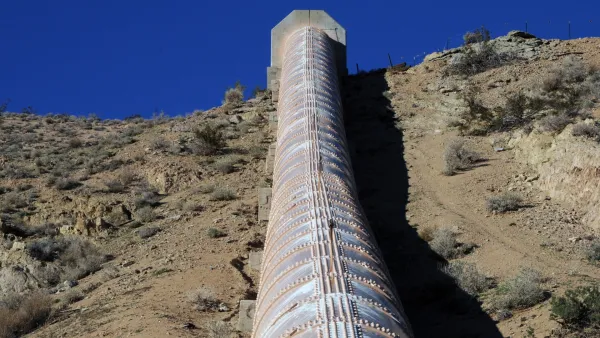
Home builders fear bans on connections of homes to water systems, issued from the state and cities, will increase next month when Gov. Jerry Brown's new water mandates take effect June 1.
Army Corps Finally Clears Way for Dallas' Trinity River Project
A long time coming—the U.S. Army Corps of Engineers now supports a comprehensive plan to transform the Trinity River in Dallas.
Cost of River Restoration Project Rising Quickly in Los Angeles
Questions are emerging about the funding equation for an ambitious $1 billion proposal to improve 11 miles of the Los Angeles River through some of the most urban parts of the city.
A $3 Billion Proposal to Engineer New Jersey's Passaic River
The Passaic River, upriver from Newark, is a chronic flood threat to the communities along its banks. But a new plan to build a permanent solution could also block access to the river.
Designing Permeable Cities for Drought Resilience
Take a kayak trip on the Los Angeles River with KQED science reporter Amy Standen to understand why cities were built on the premise of endless potable water and how we can build cities sustainably in regions that receive low rainfall.
Golf Joins Agriculture to Oppose EPA's Proposed 'Water of the United States' Rule
Laura Barron-Lopez reports on the golf industry's reaction to proposed rules that would expand and clarify the regulatory powers of the U.S. Environmental Protection Agency and the Army Corps of Engineers.
Water Resources Reform and Development Act of 2014 Signed into Law
President Obama has signed "a bipartisan $12.3 billion water bill that will help improve harbors, waterways, levees, and ecosystems across the United States," according to an article by Adie Tomer and Joseph Kane.
Army Corps Recommends $1 Billion Overhaul of the Los Angeles River
The U.S. Army Corps of Engineers is slowly changing its approach to the Los Angeles River. The executive leadership of the Corps took a major step in a new direction yesterday, when it recommended a $1 billion plan to revitalize the river bed.
Critical Water Bill Passes Senate, Awaits President's Signature
After passing the House earlier on a 412-4 vote, the Senate voted 91-7 on May 22 to pass a $12.3 billion water infrastructure bill known as Water Resources Reform and Development Act. It had been seven years since the act was last reauthorized.
Catastrophic Mud Slide in Washington—Could it Have Been Prevented?
The death toll in this rural area 55 miles north of Seattle in Snohomish County is expected to rise. Rain had saturated the ground and led to the collapse of a hillside about 600 feet high and 1,500 feet long. But was the slide foreseeable?
What's in the Water? House Overwhelmingly Approves Infrastructure Bill
The U.S. House of Representatives has nearly unanimously passed a new bill! While that's news in itself, the bill facilitates infrastructure improvements (water-oriented in this case), an often divisive issue.
Feds Weigh In on L.A. River Restoration After Seven Years of Study
While the alternative outlined in a long-awaited U.S. Army Corps of Engineers feasibility study envisions a major reshaping of an 11-mile stretch of the L.A. River, the recommendation falls far short of what local leaders and activists had preferred.
At What Cost an Ocean View?
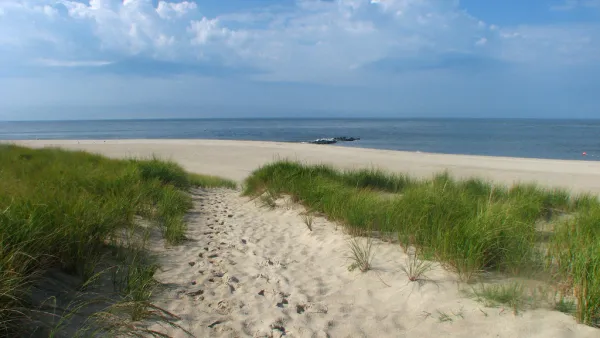
New Jersey has to decide how to protect homes, roads and development from future storms. The Army Corps of Engineers has proposed to build protective sand dunes, but a small number of beachfront property owners refuse to allow the plan to proceed.
'Moment of Truth' Could Change Course of the L.A. River
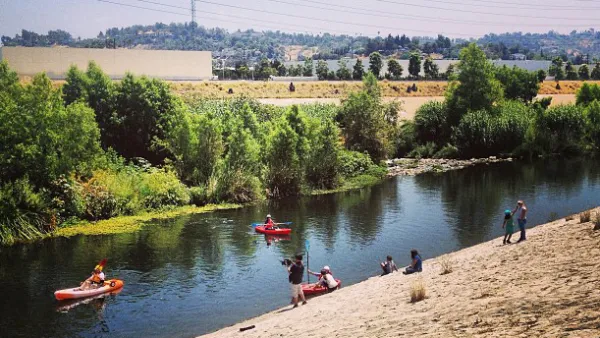
This summer marks a key moment in the effort to transform the Los Angeles River from eyesore to amenity. A newly announced greenway plan and much-delayed U.S. Army Corps of Engineers feasibility study could fundamentally change the river's course.

FREE Course: Walkable City 1: Why Walkability?
After describing his path towards focusing on walkability as the essence of good planning, Jeff Speck marches through his five principal reasons for making more walkable places.
Reinventing Malls: Planning Alchemy—Turning Gray Fields Into Gold
The course focuses on the opportunities and imperatives that shape reinvention of mall sites.

City of Rosemead
Rutgers University, Edward J. Bloustein School of Planning and Public Policy
One Hundred Miles
Hunter College, City University of New York (CUNY)
The Architects Foundation
University of Cincinnati Online
City of Cambridge
Montrose County
The Pocatello Development Authority









