Children
Schools: Planning's Enduring Blindspot
Schools are a prime driver of housing choices and transportation behavior. So why are schools and children often missing from the planning process? Ruth Miller diagnoses the problem and looks at how we can change it.
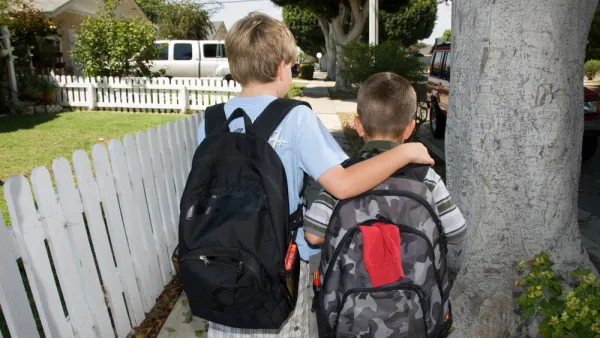
5 Good Reasons Why Children Should Walk To School
Susan Elkin points to alarmingly low statistics on the number of children who walk to school, especially when compared with historic rates. She lays out some “blindingly obvious” and “child-centered” reasons why this trend needs to be reversed.
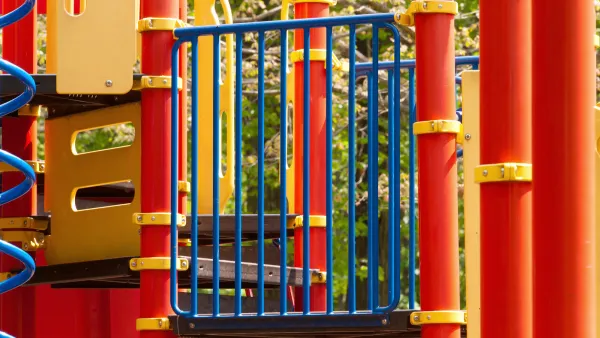
Is a Little Danger Good for Playgrounds?
New research in child development is giving rise to playgrounds designed to build children's confidence in facing challenges and evaluating risk, Sumathi Reddy reports.
Turning Kids Into Planners
An experiment in Germany engages kids to build micro-cities as playgrounds. The idea is coming to downtown Philadelphia.
How Cars Harm the Relationship Between Kids and Their Neighborhoods
Sarah Goodyear reports on a new study that illustrates the disastrous effect that commuting by car has on children's connection to their neighborhoods.
Roads Kill Kids
A new report by Kevin Watkins tries to make visible the horrifying threat to children's health that road traffic presents. It is the leading cause of death globally for young people between the ages of 10 and 24, reports Sarah Goodyear.
Communities Increase Pay For Play
Matt Bevilacqua looks at the ways in which communities across America are attempting to shrink the "play deficit" afflicting the country's children.
The "Growing Divide" Between Cities With Kids and Cities Without Them
William Frey with the Brookings Institution explains that 1/3rd of the largest cities in the U.S. have seen significant losses of kids under 15, while babies are booming in the Southwest, Utah and Idaho.
Playgrounds Pop Up in New York
Neighborhoods in New York City have built temporary "pop-up" playgrounds in an effort to encourage more physical activity among children.
Germany Has Fewer Children, More in Poverty
The population of children in Germany continues to fall, and those that exist are increasingly in poverty.
Downtown Minneapolis Unprepared for Influx of Children
The amount of children under five has jumped in downtown Minneapolis, which is posing problems for the city and its school system.
The New Way to Play
New playground designs are shaking up public parks around the world. So long, slides, hello interpretive playscapes.
Where Have All The Children Gone?
Decreasing fertility rates of non-Hispanic whites and black women, plus the tendency of families with children to cluster, have caused declines in the '18 and under' population share in 95% of U.S. counties.
Planning for Kids Makes Cities Better for All
While some cities have focused planning efforts on making their public spaces more accessible for the elderly, some argue that the age group they should be focusing on is kids.
The Kids Are All Blight
The cities that often top the "most livable" lists like San Francisco, Portland, Boston and D.C. also happen to have the lowest percentage of households with children. Does that mean that kids make places un-livable?
Cities Too Dangerous for Kids? Maybe Not
Cities are commonly thought of as dangerous places for kids to grow up. But a new study challenges that perception.
Urban Planning Gift Ideas For Children (Your Budding Planner)
I've gathered some of the best here, properly field tested by my boys, to help you with your holiday shopping list.
Won't Somebody Think of the Children?
Kids make up a big part of city populations. But often the built environment doesn't reflect a world planned with children in mind. This post from Polis looks at an effort to put children's needs back in the minds of planners.
Corner Stores and Fat Kids
Urban convenience stores are being further linked to childhood obesity after the release of a new study from Temple University.
Pearl District Revitalization Now Includes Kids
A new affordable housing development going up in Portland's dense Pearl District will include a public school on the ground floor.

FREE Course: Walkable City 1: Why Walkability?
After describing his path towards focusing on walkability as the essence of good planning, Jeff Speck marches through his five principal reasons for making more walkable places.
Reinventing Malls: Planning Alchemy—Turning Gray Fields Into Gold
The course focuses on the opportunities and imperatives that shape reinvention of mall sites.

City of Rosemead
Rutgers University, Edward J. Bloustein School of Planning and Public Policy
One Hundred Miles
Hunter College, City University of New York (CUNY)
The Architects Foundation
University of Cincinnati Online
City of Cambridge
Montrose County
The Pocatello Development Authority









