Last month the Trump administration directed Energy Secretary Rick Perry to require grid operators to purchase power from aging coal and nuclear power plants, enabling them to keep operating as a matter of "national security." Regulators disagree.


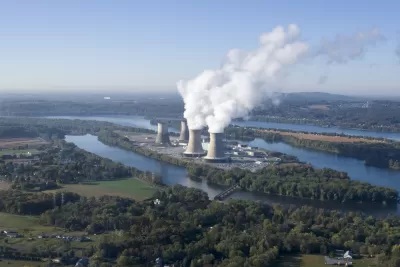
"The top regulators of the nation's power grid told Congress on Tuesday [June 12] that they see no immediate national security emergency to justify propping up coal and nuclear power plants with a government order, as the Trump administration is considering," reports John H. Cushman Jr. for InsideClimate News.
All five members of the Federal Energy Regulatory Commission, FERC, weighed in at a hearing of the Senate Energy and Natural Resources Committee on a debate that has been roiling the industry and its regulators for months. It was the first time in many years that the whole commission had appeared before the committee together.
As posted here June 4, the administration directed Energy Secretary Rick Perry to "use authority granted under a pair of federal laws to establish a 'strategic electric generation reserve' and compel grid operators to buy electricity from at-risk plants," notwithstanding the energy department's own analysis that shows the grid is more secure by relying on more, not fewer sources of electricity.
A related New York Times article on June 13 by Brad Plumer and Nadja Popovich has graphs showing the ascendancy of electricity generated from the burning of natural gas and wind and solar energy at the expense of coal.
In 2010, the United States had 580 coal-fired power plants. They provided 45 percent of the nation’s electricity. By March 2018, the number of plants had fallen below 350 and coal’s market share had dropped to 30 percent. [Natural gas market share is 32 percent].
"Even though [four of the five commissioners] were appointed by President Donald Trump, they seemed ambivalent or even hostile to his repeated attempts, along with Energy Secretary Rick Perry, to require grid operators to buy power from uneconomical coal and nuclear power plants," adds Cushman.
"FERC does not pick winners and losers in the market," said Commissioner Robert F. Powelson. "Instead we create an environment where the market can pick the winners and losers." He called it a "moral hazard" to do otherwise.
"We cannot try to stop the natural evolution of this industry by claiming that there is a national security emergency unless there is evidence that suggests that an emergency actually exists," added Commissioner Richard Glick.
Market forces create odd alliances
The American Petroleum Institute, whose members also produce natural gas, "has joined renewable energy advocates to strongly oppose the administration's efforts on behalf of coal and nuclear," notes Cushman.
The committee's chairman, Lisa Murkowski (R-Alaska), also was skeptical and expressed her priorities about the grid in a press release.
“In my view, FERC should be pointing the way on policy improvements that address grid vulnerabilities, while reaffirming our commitment to competition in wholesale power markets."
Ranking member Maria Cantwell (D-Washington) "applauded the Commission for rejecting the Trump administration’s first attempt to bolster the economically struggling industry but also told Commissioners that the President’s coal bailout threatens their independent authority," according to the Democratic news release on the hearing.
While the Trump's directive on the power grid was not warmly received at the hearing, it remains to be seen if Secretary Perry using his authority under the Federal Power Act and the Defense Production Act to subsidize aging coal and nuclear plants.
Cantwell suggested that the Trump directive stems from a March 2017 confidential memo by Trump-backer, Robert E. Murray, CEO of coal company Murray Energy, to Vice President Pence, asking for environmental rollbacks that would benefit the coal industry.
"The March 1 memo does not mention the grid, thoughphotographs of the cover page of the March 23 document to Mr. Perry obtained by In These Times shows its focus is “a plan for achieving reliable and low cost electricity," reported Lisa Friedman for The New York Times on Jan. 9, 2018.
Brad Plumer and Nadja Popovich of The Times pointed to the environmental impacts that the Trump directive would have on power generation. They note that the shift away from coal power "has lowered CO₂ emissions in America’s power sector 27 percent below their 2005 levels."
The decline of nuclear power, the nation’s largest source of carbon-free electricity, is more ominous for efforts to slow global warming. Experts have warned that if these reactors close, they will likely be replaced by natural gas in the near term and emissions will rise.
No decline in coal power on global level
Steve Goldstein of MarketWatch reports on June 13 on the release this month of BP’s annual statistical review of world energy Last year, the "share of power plants fueled by coal is the same as it was 20 years ago, at 38%," he writes.
That’s of course because of China, whose rapid expansion and dirtier power generation more than offset the U.S. switch to natural gas.
“I had no idea that so little progress had been made until I looked at these data,” said Spencer Dale, BP’s chief economist, who also held the same role at the Bank of England.
Read the full story: There's No Power Grid Emergency Requiring a Coal Bailout, Regulators Say

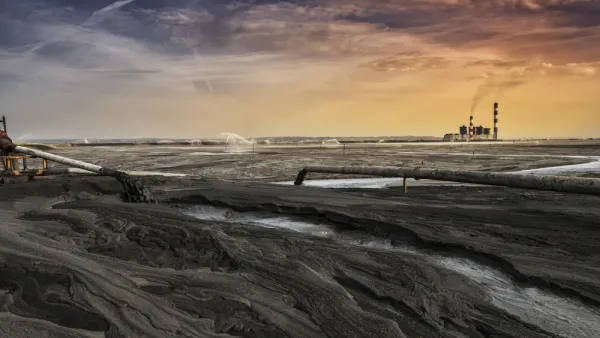
Keeping Old Coal Plants Operating Just Became a Matter of National Security
The president hopes to revitalize the nation's sagging coal industry by forcing utilities to purchase power from aging coal and nuclear power plants in the name of national defense. The news is already paying dividends for coal companies.
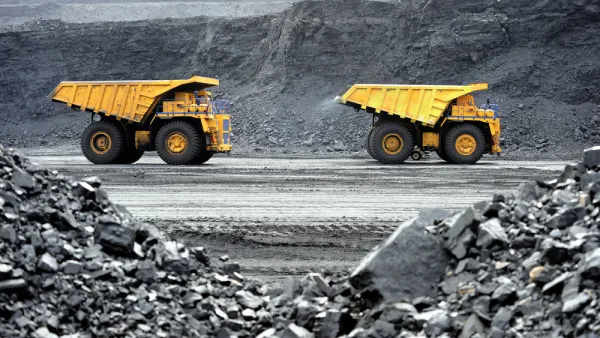
Global Coal Consumption Grows After Three Years of Decline
The rise is attributed to Asian nations, particularly India and China, where coal-power plants are newer than in the West. It shows a growing disconnect between energy and climate goals, warned the International Energy Agency.
The Far-Reaching Consequences of Remaking the Mercury Emissions Rule
The EPA intends to review the rulemaking process behind the mercury rule, the subject of a landmark Supreme Court ruling in 2015, to place more value on a rule's compliance cost to industry and less to its beneficial impact on human health.

Planetizen Federal Action Tracker
A weekly monitor of how Trump’s orders and actions are impacting planners and planning in America.

California plans to bury El Niño’s downpour
If the state plays its cards right, it may be able to store a billion acre-feet of El Niño’s water in aquifers.

Chicago breaks ground on $3 billion megadevelopment
The new neighborhood, titled Foundry Park, will one day host 3,700 residences.

Satanic Place Names
From streams and lakes to valleys and canyons, I mapped more than 1,000 places named after the Devil.

California High-Speed Rail Authority CEO resigns after $600,000 scandal
Under Ian Choudri, the authority used taxpayer dollars to fund first class flights and trips to nightclubs.

Want to study the Missouri River? Soon, you may need unanimous approval from 10 states
Legislation would require 10 governors’ permission to study or build projects moving water outside the basin.

FREE Course: Walkable City 1: Why Walkability?
After describing his path towards focusing on walkability as the essence of good planning, Jeff Speck marches through his five principal reasons for making more walkable places.
Reinventing Malls: Planning Alchemy—Turning Gray Fields Into Gold
The course focuses on the opportunities and imperatives that shape reinvention of mall sites.

City of Rosemead
Rutgers University, Edward J. Bloustein School of Planning and Public Policy
One Hundred Miles
Hunter College, City University of New York (CUNY)
The Architects Foundation
University of Cincinnati Online
City of Cambridge
Montrose County
The Pocatello Development Authority