A few pioneering fire departments are making room for safety (while demanding less space) on city streets.


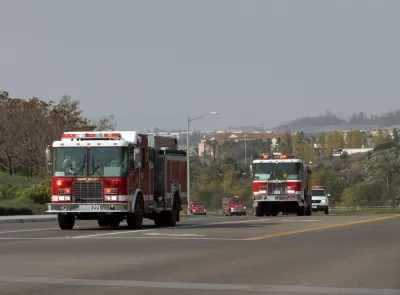
An article by Angie Schmidt reports on the early signs of a shift in the politics of street design in the United States. First, the background on the relationship between fire safety and traffic safety:
Fire officials often insist on wide clearance to operate their large vehicles, which can be at odds with the principles of safe street design. When cities want to narrow car lanes or add bike lanes to make streets safer for walking and biking, fire departments often water down or even stop the plans before they can get started. Even though traffic fatalities outnumber fire deaths in the U.S. by more than 10 to 1, fire officials tend to get the final word.
That familiar narrative isn't true in every corner of the country, however, and Schmidt points to Portland, Oregon, "where the Fire Department participates in the street design process led by the city’s Bureau of Transportation," for an example.
The Portland Fire Department's support safe streets doesn't stop during the design process, the Fire Department has followed up by tracking the performance of streets after changes.
“There has been no reduction in response times by working with urban planners and transportation leaders to build out Portland,” [Portland Fire Chief] Myers said on a recent webinar hosted by the National Association of City Transportation Officials.
Schmidt also finds another example in San Francisco, where the city has purchased eight smaller "'Vision Zero' engines made by Ferrara Fire Apparatus that can execute sharper turns than typical American fire trucks," according to Schmidt.
FULL STORY: How Fire Departments Stopped Worrying and Embraced Safer Street Design

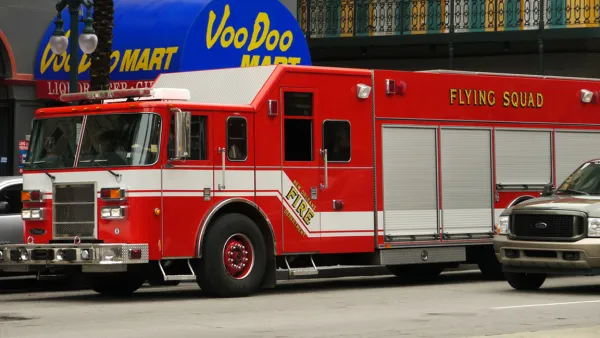
San Francisco Has a New 'Vision Zero' Fire Truck
The size of fire trucks frustrates advocates on many sides of the public safety debate. The San Francisco Fire Department sought a solution.
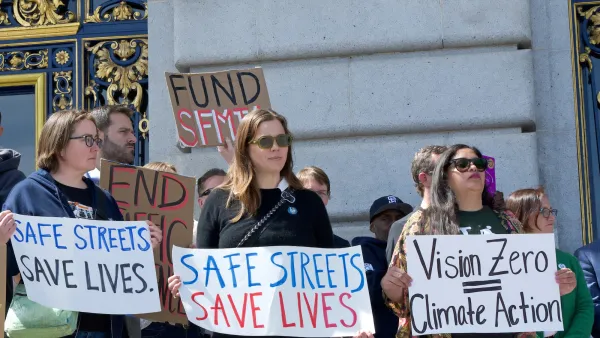
San Francisco Cut Traffic Deaths Almost in Half in 2025
The city credits its Vision Zero strategy and new traffic cameras for reducing the number of deaths and serious injuries on its roads.
SF Street Safety Act Replaces Expired Vision Zero Plan
In 2025, 15 people have died in crashes in San Francisco, putting the city far behind its goal of eliminating traffic deaths by 2024.

Planetizen Federal Action Tracker
A weekly monitor of how Trump’s orders and actions are impacting planners and planning in America.

The state-sanctioned urbicide of Austin
People don’t kill cities. Freeways do.

US to reduce Colorado River water deliveries to Mexico
A new Colorado Treaty amendment reduces Mexico’s Colorado River water allocation by 250,000 acre feet.

Mamdani overhauls NYC's Vision Zero plan with 100 new policy goals
The overhaul aims to reduce traffic deaths and make streets safer for pedestrians, cyclists and drivers through lower speed limits, new safety infrastructure and more.

Amtrak not solely to blame for New Jersey commuter rail's unreliability, report finds
A new study from the Garden State Initiative found that NJ Transit’s budget grew 20% across a 4 year period, but reliability declined significantly over the same period.

EPA erases limits on planet-warming pollution from power plants
Under Monday’s plan, power plants would still have some limits on how much mercury, arsenic and other contaminants they can emit.

FREE Course: Walkable City 1: Why Walkability?
After describing his path towards focusing on walkability as the essence of good planning, Jeff Speck marches through his five principal reasons for making more walkable places.
Reinventing Malls: Planning Alchemy—Turning Gray Fields Into Gold
The course focuses on the opportunities and imperatives that shape reinvention of mall sites.

Eagle County Government
Harvard University Graduate School of Design
Nashville Planning Department
The Architects Foundation
University of Cincinnati Online
The Pocatello Development Authority
The Urban Renewal Agency of the City of Pocatello
Journal of the American Planning Association