Alamo City enters the 300 club.


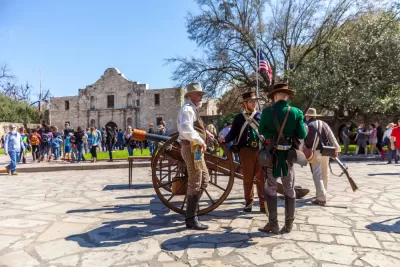
The city of San Antonio is spending the year celebrating its 300th birthday, with events focused on history, education, arts, and culture scheduled for the entire year. The city also just wrapped up its Commemorative Week, which celebrated the key milestones in the city's creation 300 years earlier. The San Antonio 300 website explains:
On May 1, 1718 the Mission San Antonio de Valero – later known as the Alamo – was established. Four days later the Presidio San Antonio de Bejár was formed to protect the new mission. San Antonio’s five area missions are Texas’ only UNESCO World Heritage site and will be at the forefront of many activities during the Tricentennial year.
The Texas Monthly spent the month of April running a series of articles to capture the city at 300.
A massive urban renewal project that’s reviving plaza culture. An Alamo fight centuries in the making. Avant-garde Mexican food inspired by Maya trade routes. From billionaire Kit Goldsbury to artist Ana Fernandez to former NBA All-Star Tim Duncan, seventeen San Antonians talk about why the historic city might be the most interesting place in America right now.
The articles are collected on the same web page, but we recommend starting with Robert Rivard's story about the ongoing evolution of the Alamo, described as besieged by "commerce and schlock" with "all the gravitas of a saloon." The Alamo Master Plan Management Committee is working hard on a renovation of the Alamo's plaza, to be revealed in the coming months.
Read the full story: San Antonio at 300

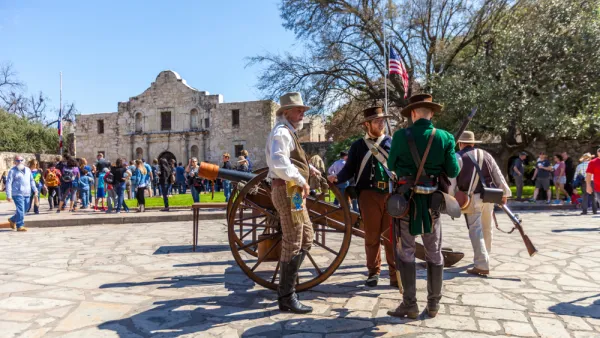
Alamo Master Plan Thrown Into Disarray
Remember that $450 million plan to renovate The Alamo in time for the 300th anniversary of the battle? It's in trouble.
Final Renovation Plan for the Alamo Plaza Approved
The San Antonio City Council culminated years of planning and design this week by approving a plan to overhaul the Alamo Plaza.
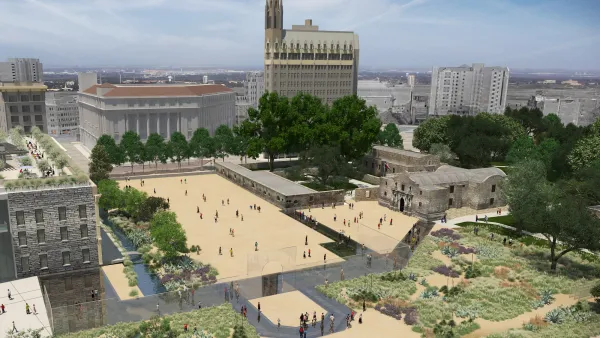
Alamo Plaza Revitalization Takes Small, Controversial Step Forward
Revitalization plans for the Alamo Plaza are moving forward, controversially, in San Antonio. The hope is to have investments complete by the 300th anniversary of the Alamo in 2024.

Planetizen Federal Action Tracker
A weekly monitor of how Trump’s orders and actions are impacting planners and planning in America.

The state-sanctioned urbicide of Austin
People don’t kill cities. Freeways do.

Colorado’s Largest Data Center Could Rise Next to Homes — Without a Public Hearing
The proposed campus would consume 11 times the power of Denver International Airport; as it has across the country, opposition mounts.

Nation's most wind-powered state turns to coal as data centers increase energy demand
For the first time in decades, Iowa has increased its generation of coal power.

NYC cools commuters with city's first rain garden above a bus stop
New York City officials say the plants in the rain garden can absorb 16 gallons of rainwater during heavy storms.

Brightline West’s future may rely on $6 billion federal loan
The company has until Nov. 2 to make a $400 million equity investment into its proposed high-speed rail line.

FREE Course: Walkable City 1: Why Walkability?
After describing his path towards focusing on walkability as the essence of good planning, Jeff Speck marches through his five principal reasons for making more walkable places.
Reinventing Malls: Planning Alchemy—Turning Gray Fields Into Gold
The course focuses on the opportunities and imperatives that shape reinvention of mall sites.

Greater Baltimore Committee
Eagle County Government
Harvard University Graduate School of Design
The Architects Foundation
University of Cincinnati Online
The Pocatello Development Authority
The Urban Renewal Agency of the City of Pocatello
Journal of the American Planning Association