In an interview, urbanism scholar Emily Talen discusses what it would take to restore "main street principles" to American towns and cities. Understandably, small retailers play a big role.


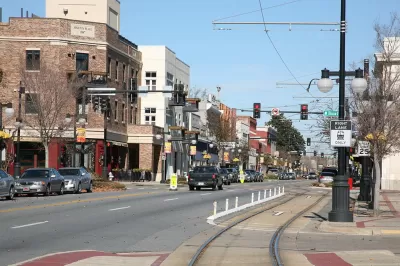
In an interview with Eric Jaffe, University of Chicago Urbanism Professor Emily Talen talks about why American streets have shed their main street lineage and what can be done to reactivate them. She references her study of Chicago, which found that only 13 blocks in the entire city conform to a list of main street must-haves.
Talen places emphasis on keeping small retailers in operation and giving their businesses room to grow. "First of all, I'd like to see more listening to what the retailers need. Are regulations hurting them? Is something the city's doing about parking requirements hurting them? It's my sense looking at the literature out there that there hasn't been enough listening to what the local independent retailer needs."
She argues that policymakers and community members should "[see] these small retailers along main street as more of a community anchor, an imperative. Right now it's not looked at like that at all. There is more emphasis on needing a park or a playground. Retailers are not looked at as part of the supporting fabric of neighborhoods."
Eliminating parking requirements and ensuring visibility through storefront windows are some of Talen's prescriptions. So are limits on chain stores and a healthy suspicion of e-commerce, which is "killing small retailers. That's a huge loss for the quality of our cities."
Read the full story: Quantifying the death of the classic American main street

‘Cut the Tape’ Report Takes Aim at Inefficiencies
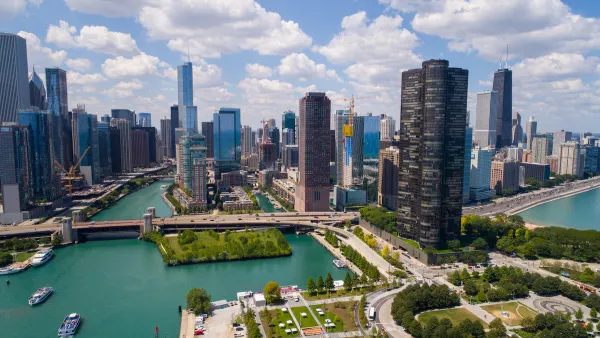
A set of recommendations from the Chicago mayor’s office calls for streamlining city processes to stimulate more residential and commercial development.
Proposed Chicago TOD Ordinance: Increase Density, Eliminate Parking Requirements
Mayor Rahm Emanuel announced an update of the city's 2013 transit oriented development ordinance. The new version of the ordinance would have a sweeping effect on the land uses around transit stations in Chicago.
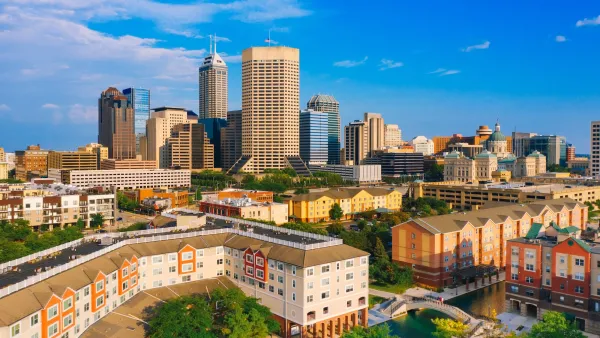
Indianapolis rents grew by 30% since 2020
The metro area has a shortage of roughly 137,000 affordable homes for the lowest-income households.

Planetizen Federal Action Tracker
A weekly monitor of how Trump’s orders and actions are impacting planners and planning in America.

The state-sanctioned urbicide of Austin
People don’t kill cities. Freeways do.

US to reduce Colorado River water deliveries to Mexico
A new Colorado Treaty amendment reduces Mexico’s Colorado River water allocation by 250,000 acre feet.

Nation's most wind-powered state turns to coal as data centers increase energy demand
For the first time in decades, Iowa has increased its generation of coal power.

NYC cools commuters with city's first rain garden above a bus stop
New York City officials say the plants in the rain garden can absorb 16 gallons of rainwater during heavy storms.

Brightline West’s future may rely on $6 billion federal loan
The company has until Nov. 2 to make a $400 million equity investment into its proposed high-speed rail line.

FREE Course: Walkable City 1: Why Walkability?
After describing his path towards focusing on walkability as the essence of good planning, Jeff Speck marches through his five principal reasons for making more walkable places.
Reinventing Malls: Planning Alchemy—Turning Gray Fields Into Gold
The course focuses on the opportunities and imperatives that shape reinvention of mall sites.


Eagle County Government
Harvard University Graduate School of Design
Nashville Planning Department
The Architects Foundation
University of Cincinnati Online
The Pocatello Development Authority
The Urban Renewal Agency of the City of Pocatello
Journal of the American Planning Association