The dichotomy in economic outcomes around the country won't be solved by one-off competitions like the bidding process to land Amazon's second headquarters.


After the process to site Amazon's second headquarters entered a dramatic new stage this week, the nation is left again to evaluate what the spectacle reveals of economic development strategy in the United States. According to Mark Muro and Amy Liu, "while the fall’s 'Amazon Idol' competition is garnering high ratings, the fact remains that it is a major distraction from the glaring need for the country to systematically think about a much larger development problem—the nation’s gaping regional prosperity divides."
Instead of "Amazon Idol," Muro and Liu propose a recommitment to regional growth. "At present, America possesses no strategy—let alone serious policies—for addressing the uneven allocation of growth across the nation’s 50 states and hundreds of metropolitan areas," according to Muro and Liu, who detail the landscape of economic development around the United States under the current political regime.
Muro and Liu identify a few useful existing precedents, both in theory and in practice, to "hack together some basic outlines of what policymakers, especially the federal government, might do to push back against the nation’s geographical distress."
Here's are two "watchwords" that organize their recommendations, with more details included in the source article: 1) "Make spatially balanced growth a priority" and 2) "Maintain (don’t cut) existing policies that enhance U.S. competitiveness—and support regional development."
[Editor's note: This article is from September 2017, but we share it this week due to its relevance to current events.]


Grappling With the Potential Impact of Amazon's HQ2
What does it mean for housing planning if your county gets Amazon's second headquarters? Virginia's Loudoun County contemplates that possibility with a mix of confidence and trepidation.
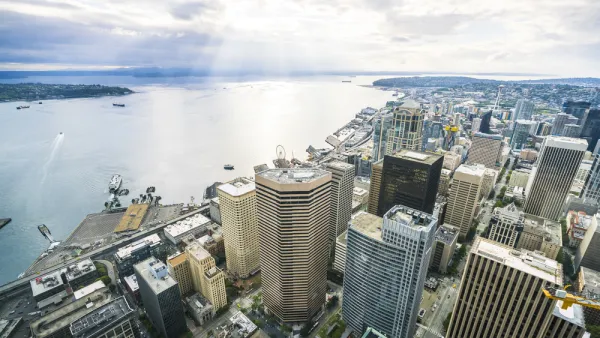
Regional Planning for Growth on Display in the Pacific Northwest
The Puget Sound Regional Council (PSRC) released a new "Regional Centers Framework."
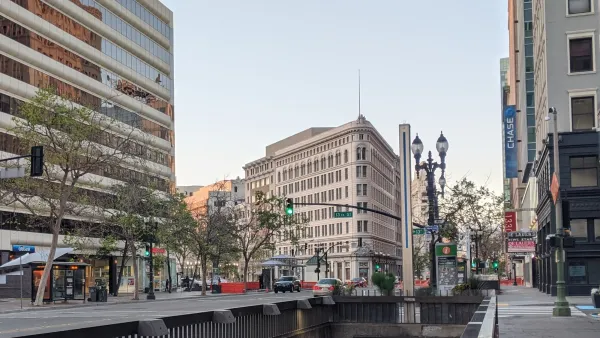
Oakland Drafts First Revision of General Plan Since 1998
The public has until April 23 to comment on the sweeping plan that addresses land use, transportation, and infrastructure.

Planetizen Federal Action Tracker
A weekly monitor of how Trump’s orders and actions are impacting planners and planning in America.

The state-sanctioned urbicide of Austin
People don’t kill cities. Freeways do.

US to reduce Colorado River water deliveries to Mexico
A new Colorado Treaty amendment reduces Mexico’s Colorado River water allocation by 250,000 acre feet.

5 New England states march closer to 800 megawatt wind energy project
Securing federal approval for the project may be complicated under the Trump administration, which has historically been hostile towards domestic wind power.

Baltimore to break ground on $50 million Transit Priority Project
The project will bring faster bus trips, safer streets and better bike connections to Baltimore.

Airbnb launches $250 million 'last-dollar financing' housing accelerator, makes first investment in Austin
The company will put $6.4 million towards affordable housing development in Texas’ capital.

FREE Course: Walkable City 1: Why Walkability?
After describing his path towards focusing on walkability as the essence of good planning, Jeff Speck marches through his five principal reasons for making more walkable places.
Reinventing Malls: Planning Alchemy—Turning Gray Fields Into Gold
The course focuses on the opportunities and imperatives that shape reinvention of mall sites.

Eagle County Government
Harvard University Graduate School of Design
Nashville Planning Department
The Architects Foundation
University of Cincinnati Online
The Pocatello Development Authority
The Urban Renewal Agency of the City of Pocatello
Journal of the American Planning Association