To get a handle on drivers whizzing through its main road, the small town of Betterton, Maryland installed a "smart" radar speed sign. The data it collected helped the local sheriff's department improve traffic enforcement.


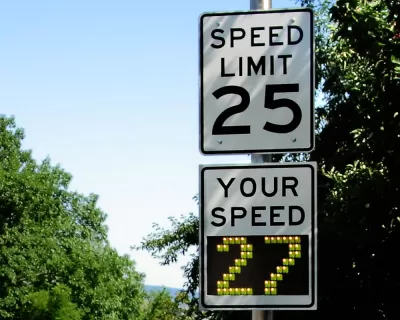
For Governing, Mayor Don Sutton of Betterton, Maryland writes, "In 2016, the challenge facing Betterton was a familiar one: drivers speeding through town. We found a surprising and cost-effective solution -- and one that illustrates how the use of data and analytics is not the province only of bigger, resource-rich cities."
The tiny town, with a population of only 400 year-round residents, contracts with the local sheriff's department for traffic enforcement services. A "smart" radar speed sign was deployed to help make that enforcement more effective. "The one we installed in November 2016, which cost about $3,500, came with software that captures data on driver speeds and documents the time of day that speeding occurs."
Sutton says that "For the first time we could use analytics to see when drivers were actually speeding." He goes on, "Of course, radar speed signs cannot replace law-enforcement officers, but they can certainly do a fine job of augmenting their work. That's because the signs operate 24/7 with or without an officer present, which maximizes our investment."
Read the full story: How One Small Town Slowed the Leadfoots Down
Santa Monica Lowers Speed Limits
Posted speed limits will be reduced by 5 miles per hour on dozens of the city’s streets.
Controversial Speed Camera Program for School Zones Likely to Be Repealed
A speed camera program near school zones in Nassau County on Long Island provides a cautionary tale about the limits of surveillance and fines in curbing speeding.

San Antonio could lower speed limit to 25mph
City officials want to lower speed limits and take other steps to reduce speeding and improve traffic safety on neighborhood streets.

Planetizen Federal Action Tracker
A weekly monitor of how Trump’s orders and actions are impacting planners and planning in America.

California plans to bury El Niño’s downpour
If the state plays its cards right, it may be able to store a billion acre-feet of El Niño’s water in aquifers.

Desperate measures: Advocates weigh draining Lake Powell to fill Colorado River
Draining the reservoir could reduce evaporation losses by a couple hundred thousand acre-feet.

Chicago voters approve permanent festival grounds, penalty for vacant property owners
Currently, major summer and fall festivals take over public parks for weeks at a time, drawing criticism from nearby residents

NYC votes to cut outdoor dining red tape, speed up permitting
New York City also voted to allow the Department of Transportation to begin work on urgent projects before notifying elected officials.

California appears to reject Prop. 45
The proposition would have expanded the projects that qualify for a streamlined environmental review, effectively paring down the California Environmental Quality Act.

FREE Course: Walkable City 1: Why Walkability?
After describing his path towards focusing on walkability as the essence of good planning, Jeff Speck marches through his five principal reasons for making more walkable places.
Reinventing Malls: Planning Alchemy—Turning Gray Fields Into Gold
The course focuses on the opportunities and imperatives that shape reinvention of mall sites.

City of Rosemead
Rutgers University, Edward J. Bloustein School of Planning and Public Policy
One Hundred Miles
Hunter College, City University of New York (CUNY)
The Architects Foundation
University of Cincinnati Online
City of Cambridge
Montrose County
The Pocatello Development Authority