Almost all of Cincinnati's police and fire stations, health clinics, recreation centers, and administrative buildings will run on renewable energy.


The city of Cincinnati will purchase 100% renewable energy for most of its municipal facilities, thanks to a contract signed recently with Dynegy.
Katie Pyzyk reports on the new contract, which "will cut the city's greenhouse gas emissions by more than 9% and its utility rates by more than $100,000 annually."
The deal also furthers the city's commitment to green energy, which had a year full of accomplishments. Pyzyk explains:
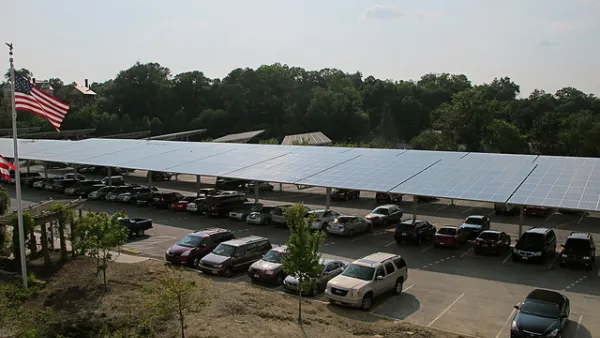
Over the summer, leaders announced that the Greater Cincinnati Water Works would end its use of coal power and switch to solar. That plan involves installing what leaders say is the largest municipal solar array in the country, covering up to 150 acres of city property.
And:
Cincinnati also has an electric aggregation program that provides green energy for about 80,000 households. Last year the program reportedly saved residents $1.5 million on electricity and $2 million on natural gas.
For more details on the deal, see also an announcement published on the city of Cincinnati's website.
Read the full story: Cincinnati signs deal to run most facilities on 100% green energy


Cincinnati To Electrify Municipal Fleet by 2035
The city of Cincinnati will beef up its efforts to shift to renewable energy starting next week with electric police cars, fire trucks, and other city vehicles.
As Climate Shifts, Cincinnati Mayor Boosts Solar Investments
The Ohio city recently announced a plan to build the nation's largest municipally owned onsite solar array. The plan builds on a decade of increasingly ambitious climate action.

Three agencies expanding on-demand transit
Multiple states across America increasing access to flexible public transportation.

Planetizen Federal Action Tracker
A weekly monitor of how Trump’s orders and actions are impacting planners and planning in America.

The state-sanctioned urbicide of Austin
People don’t kill cities. Freeways do.

US to reduce Colorado River water deliveries to Mexico
A new Colorado Treaty amendment reduces Mexico’s Colorado River water allocation by 250,000 acre feet.

Nation's most wind-powered state turns to coal as data centers increase energy demand
For the first time in decades, Iowa has increased its generation of coal power.

NYC cools commuters with city's first rain garden above a bus stop
New York City officials say the plants in the rain garden can absorb 16 gallons of rainwater during heavy storms.

Brightline West’s future may rely on $6 billion federal loan
The company has until Nov. 2 to make a $400 million equity investment into its proposed high-speed rail line.

FREE Course: Walkable City 1: Why Walkability?
After describing his path towards focusing on walkability as the essence of good planning, Jeff Speck marches through his five principal reasons for making more walkable places.
Reinventing Malls: Planning Alchemy—Turning Gray Fields Into Gold
The course focuses on the opportunities and imperatives that shape reinvention of mall sites.

Greater Baltimore Committee
Eagle County Government
Harvard University Graduate School of Design
The Architects Foundation
University of Cincinnati Online
The Pocatello Development Authority
The Urban Renewal Agency of the City of Pocatello
Journal of the American Planning Association