To counteract the effects of sprawl, a recent report from PricewaterhouseCoopers recommends locating job growth in the city of Melbourne, Australia, in locations outside the city's core.


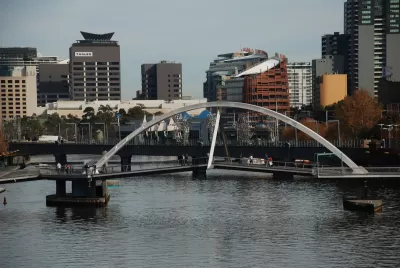
PricewaterhouseCoopers (PwC) released a report recently that recommends a collection of dispersed business districts around Australia's fastest growing city.
"A report released [in October] by PwC has made the case for Melbourne to move towards becoming a '30-minute city', where employment hubs outside the centre are strategically developed to cut commuting times and decentralise the city," reports Simone Fox Koob.
PwC partner and economics and policy specialist James van Smeerdijk is quoted in the article, who mentions about 20 "key precincts" outside the city's core where he believes Melbourne should focus on locating new jobs. "He said Fishermen’s Bend, Docklands and the Parkville area could be further developed in high-density employment hubs to service the city, as well as less centralised locations such as east Werribee, Maribyrnong, Monash University’s Clayton campus and La Trobe University’s Bundoora campus," writes Koob.
Read the full story: Melbourne’s 30-minute city hubs identified in new research
Not Enough Housing, Or Too Much of the Wrong Kind
Permits for new housing continue to lag despite a long economic boom. For coastal metros, it's a familiar story of job growth outpacing new construction. In some Sun Belt cities, sprawl is the bigger concern.
Toronto's High-Rise Boom Could Mean End of Sprawl
Toronto is swimming in high-rise construction, with the second highest rate in the world. Some say this shift to the urban core spells the end of sprawl in Toronto.
Curing Ills in Suburban Melbourne
Melbourne, Australia, has its own brand of suburban sprawl: suburbia without the space. A new comprehensive plan aims to address the woes of suburban Melbourne, but some say it doesn't go far enough.

Planetizen Federal Action Tracker
A weekly monitor of how Trump’s orders and actions are impacting planners and planning in America.

California plans to bury El Niño’s downpour
If the state plays its cards right, it may be able to store a billion acre-feet of El Niño’s water in aquifers.

Desperate measures: Advocates weigh draining Lake Powell to fill Colorado River
Draining the reservoir could reduce evaporation losses by a couple hundred thousand acre-feet.

US buildings threatened, destroyed by fires set to triple by 2060
Researchers found a high fire risk for socioeconomically vulnerable neighborhoods in the American West.

LA residents may be allowed to paint their own crosswalks
Councilwoman Katy Yaroslavsky put out a motion instructing the Los Angeles Department of Public Transportation to study the feasibility of allowing volunteers to paint crosswalks.

Dallas moves to overhaul its zoning code
The city's zoning reform will allow more multi-family and mixed-use developments.

FREE Course: Walkable City 1: Why Walkability?
After describing his path towards focusing on walkability as the essence of good planning, Jeff Speck marches through his five principal reasons for making more walkable places.
Reinventing Malls: Planning Alchemy—Turning Gray Fields Into Gold
The course focuses on the opportunities and imperatives that shape reinvention of mall sites.

City of Rosemead
Rutgers University, Edward J. Bloustein School of Planning and Public Policy
One Hundred Miles
Hunter College, City University of New York (CUNY)
The Architects Foundation
University of Cincinnati Online
City of Cambridge
Montrose County
The Pocatello Development Authority