Despite de Blasio's campaign promises, the city of New York still doesn't count vacant properties, a negligence that advocates for the homeless have been fighting for years.


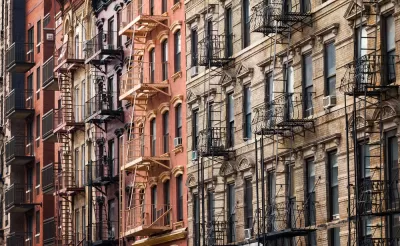
To encourage more housing, homeless advocates want the city of New York to track its vacancies. If a public record of vacancies exists, it becomes easier to create public pressure on owners to create housing. "Vacant properties are very common in New York City, but there is no official tracking mechanism of these buildings and lots," Oscar Perry Abello reports for Next City. Mayor Bill de Blasio promised to track vacancies as part of his housing plan, but after one term and a successful reelection campaign he still has not done that.
Some city departments are moving in other ways to address the vacant property issue. "The NYC Department of Housing Preservation and Development (HPD) recently launched a new “Zombie Homes Unit” to help the New York City Law Department hold non-compliant mortgage holders — generally banks, investors, or mortgage servicing companies — accountable for not maintaining vacant single-family home properties that are on the brink of foreclosure," Perry Abello reports.
FULL STORY: NYC Advocates Say It’s Past Time to Count Vacant Properties

A Dark Night for the Right to Housing Movement
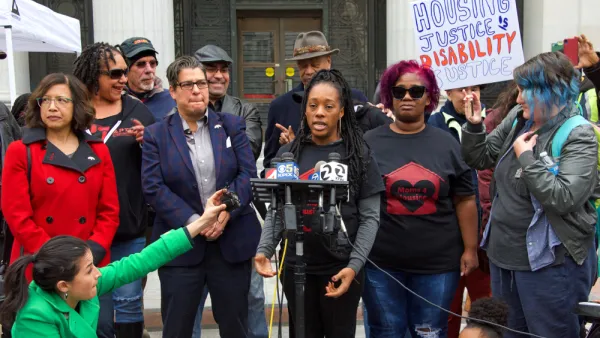
After a string of high-profile successes in places as geographically distant as Philadelphia and the East Bay Area, an ugly episode in L.A. County the day before Thanksgiving dealt a brutal setback to the burgeoning right to housing movement.
A New—and Hopefully Better—Way to Deal with the Homeless Crisis on the N.Y.C. Subway
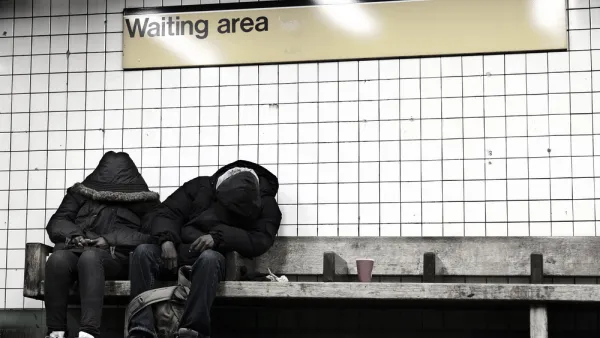
More homeless people are using the subway as temporary housing, and the delays and disruptions have increased as well. A new city program will replace fines with outreach to provide better access to social services.
More Housing, Less Homelessness
Downzoning and building height restrictions have kept supply well behind demand in New York City, according to this article.

Planetizen Federal Action Tracker
A weekly monitor of how Trump’s orders and actions are impacting planners and planning in America.

The state-sanctioned urbicide of Austin
People don’t kill cities. Freeways do.

US to reduce Colorado River water deliveries to Mexico
A new Colorado Treaty amendment reduces Mexico’s Colorado River water allocation by 250,000 acre feet.

Mamdani overhauls NYC's Vision Zero plan with 100 new policy goals
The overhaul aims to reduce traffic deaths and make streets safer for pedestrians, cyclists and drivers through lower speed limits, new safety infrastructure and more.

Amtrak not solely to blame for New Jersey commuter rail's unreliability, report finds
A new study from the Garden State Initiative found that NJ Transit’s budget grew 20% across a 4 year period, but reliability declined significantly over the same period.

EPA erases limits on planet-warming pollution from power plants
Under Monday’s plan, power plants would still have some limits on how much mercury, arsenic and other contaminants they can emit.

FREE Course: Walkable City 1: Why Walkability?
After describing his path towards focusing on walkability as the essence of good planning, Jeff Speck marches through his five principal reasons for making more walkable places.
Reinventing Malls: Planning Alchemy—Turning Gray Fields Into Gold
The course focuses on the opportunities and imperatives that shape reinvention of mall sites.

Eagle County Government
Harvard University Graduate School of Design
Nashville Planning Department
The Architects Foundation
University of Cincinnati Online
The Pocatello Development Authority
The Urban Renewal Agency of the City of Pocatello
Journal of the American Planning Association