The proposed 3roots San Diego is treading now familiar territory by attempting to appeal to Millennials. Much more novel, however, is the project's reclamation of a former mining pit.


"A 412-acre rock quarry in Mira Mesa, approved for reclamation in 1994, is being replanned to include a 25-acre community park instead of industrial development," reports Roger Showley.
Lehigh Hanson, a subsidiary of Dallas-based Heidelberg Cement Group, is creating the plan for the 3roots San Diego development, which would include 1,800 units in a mixed-use and residential community responding to demand from the Millennial generation. Showley quotes Lehigh Hanson consultant Brian Myers in the article, calling the development an "alt-Urban plan."
Antonio Pacheco picked up on the news of the proposed project for The Architect's Newspaper, with coverage that focuses a little more on the design work going into the project.
The development "would be constructed over what remains of the Carroll Canyon mine, a concrete aggregate and gravel mine that ceased operations in 2016," writes Pacheco. Here's more of his description of the current plan for the project:
The development is to be laid out with a mixed-use “innovation district” at its core that will maintain transit connections to a forthcoming extension of San Diego’s light rail system. The so-called Village Core area will feature 749 apartments, 120,000 square feet of retail spaces, and 20,000 square feet of creative office. Renderings for the project depict two parallel rows of warehouse-style structures surrounding a generous pedestrian courtyard.
Read the full story: Converting an old mining pit into 1,800 homes

What Millennials Want, and Why it Doesn't Matter
The debate about whether Millennials prefer urban or suburban misses a big, important point: what Millennials really prefer is possible in either setting.
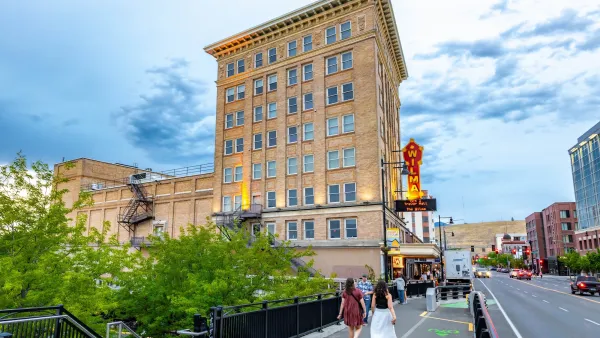
Missoula Approves Zoning Reform Emphasizing More Diverse Housing, Walkability
The city’s new zoning code, map, and development standards will guide more expansive housing options and improved walkability.
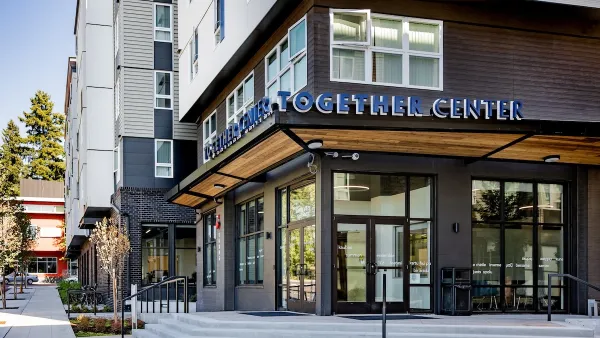
Washington Nonprofits Build Housing on Their own Offices
While affordable housing with some office space for nonprofits is relatively common, in Redmond, Washington, a group of human services organizations went the other way: they rebuilt their collective office space and added housing.

Planetizen Federal Action Tracker
A weekly monitor of how Trump’s orders and actions are impacting planners and planning in America.

California plans to bury El Niño’s downpour
If the state plays its cards right, it may be able to store a billion acre-feet of El Niño’s water in aquifers.

Desperate measures: Advocates weigh draining Lake Powell to fill Colorado River
Draining the reservoir could reduce evaporation losses by a couple hundred thousand acre-feet.

US buildings threatened, destroyed by fires set to triple by 2060
Researchers found a high fire risk for socioeconomically vulnerable neighborhoods in the American West.

LA residents may be allowed to paint their own crosswalks
Councilwoman Katy Yaroslavsky put out a motion instructing the Los Angeles Department of Public Transportation to study the feasibility of allowing volunteers to paint crosswalks.

Dallas moves to overhaul its zoning code
The city's zoning reform will allow more multi-family and mixed-use developments.

FREE Course: Walkable City 1: Why Walkability?
After describing his path towards focusing on walkability as the essence of good planning, Jeff Speck marches through his five principal reasons for making more walkable places.
Reinventing Malls: Planning Alchemy—Turning Gray Fields Into Gold
The course focuses on the opportunities and imperatives that shape reinvention of mall sites.

City of Rosemead
Rutgers University, Edward J. Bloustein School of Planning and Public Policy
One Hundred Miles
Hunter College, City University of New York (CUNY)
The Architects Foundation
University of Cincinnati Online
City of Cambridge
Montrose County
The Pocatello Development Authority