While affordable housing with some office space for nonprofits is relatively common, in Redmond, Washington, a group of human services organizations went the other way: they rebuilt their collective office space and added housing.


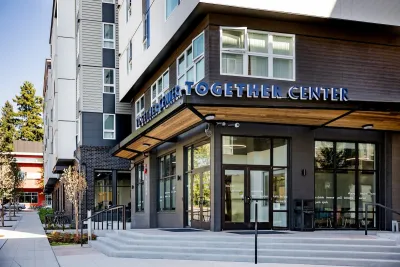
In Redmond, Washington, a coalition of human service nonprofits has reimagined what shared space can look like by redeveloping their campus into both a nonprofit hub and a housing community. Together Center, which began in 1991 when four organizations purchased and retrofitted a strip mall together, has grown into a home for more than 25 nonprofits. By co-locating services, the center has long offered residents the ability to access housing support, health care, job training, and counseling all in one place.
Facing a deteriorating building and skyrocketing land values — its 2.4-acre downtown parcel was worth $18 million — the board of directors confronted a difficult choice: sell, relocate, or reinvent. They chose to redevelop, holding fast to three principles: keeping the land under nonprofit ownership, guaranteeing a path back for tenant organizations, and expanding services. The result is a new campus that not only sustains nonprofit operations but also integrates 280 units of affordable housing.
Today, more than 500 people, including 250 children, live on site alongside the nonprofit organizations that serve them. With features like a coworking lounge, conference center, and community kitchen, Together Center demonstrates how community ownership and innovative partnerships can address both service delivery and the region’s urgent housing needs.
FULL STORY: Nonprofits Own These Offices—And Put Housing on Top of Them


‘City of Yes’ Zoning Reform Gains Planning Commission Approval
The proposal to overhaul New York City’s zoning code, popular with voters, to make housing development easier faces opposition in the City Council.

New York Passes Housing Package Focused on New Development and Adaptive Reuse
The FY 2025 budget includes a new tax incentive, funding for affordable housing on state land, and support for adaptive reuse and ADUs.
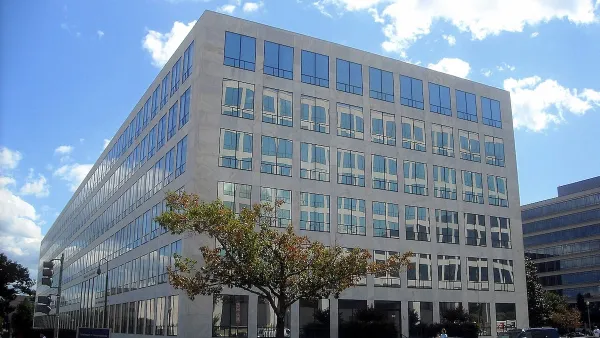
Legislation Introduced to Support Adaptive Reuse of Federal Buildings
The proposed bill would promote the conversion of vacant and underused buildings into affordable housing.

Planetizen Federal Action Tracker
A weekly monitor of how Trump’s orders and actions are impacting planners and planning in America.

The state-sanctioned urbicide of Austin
People don’t kill cities. Freeways do.

US to reduce Colorado River water deliveries to Mexico
A new Colorado Treaty amendment reduces Mexico’s Colorado River water allocation by 250,000 acre feet.

5 New England states march closer to 800 megawatt wind energy project
Securing federal approval for the project may be complicated under the Trump administration, which has historically been hostile towards domestic wind power.

Baltimore to break ground on $50 million Transit Priority Project
The project will bring faster bus trips, safer streets and better bike connections to Baltimore.

Airbnb launches $250 million 'last-dollar financing' housing accelerator, makes first investment in Austin
The company will put $6.4 million towards affordable housing development in Texas’ capital.

FREE Course: Walkable City 1: Why Walkability?
After describing his path towards focusing on walkability as the essence of good planning, Jeff Speck marches through his five principal reasons for making more walkable places.
Reinventing Malls: Planning Alchemy—Turning Gray Fields Into Gold
The course focuses on the opportunities and imperatives that shape reinvention of mall sites.

Eagle County Government
Harvard University Graduate School of Design
Nashville Planning Department
The Architects Foundation
University of Cincinnati Online
The Pocatello Development Authority
The Urban Renewal Agency of the City of Pocatello
Journal of the American Planning Association