Lyft's Emily Castor Warren situates the company's newest initiatives within the "rapid pace of innovation" occurring in transportation.



A Planning Report interview with Lyft's director of transportation policy, Emily Castor Warren, tracks the company's progression from serving lone riders to partnering with public agencies, moving into fixed-route "shuttle" service, and operating fleets of electric autonomous vehicles.
Lyft recently launched a research center to develop hardware and software for autonomous cars, and the company sees itself as playing a critical role in their rollout. Castor explains:
The experience we have in understanding how to provide an on-demand service, as well as the potential for us to roll out autonomous services in a controlled fashion through our platform—perhaps through the use of wheel-sensing technology or other types of controlled dispatching appropriate to the capabilities of the vehicles as they develop and become more mature—will be a huge asset for autonomous manufacturers who want to get rapid experience and testing, and to expose more products to real passengers who are already using the Lyft platform.
Throughout Lyft's lifepsan, partnerships have been a notable strategy. On top of the new in-house research center, Lyft has also pursued self-driving technology in collaboration with General Motors, Nutonomy, and Google's Waymo, among others. In TPR, Castor also elaborates on their first/last-mile programs in partnership with public transit authorities throughout California, as well as a nationwide partnership with Amtrak—all part of what she calls "a very significant shift that’s starting to arise in which the lines are blurred between traditional forms of public transit and new forms of on-demand mobility."
In contrast to common criticisms, Castor characterizes these programs as complementing, and indeed strengthening, public transit systems—whether by allowing the city to continue service on decommissioned bus routes, or by improving access to stations and "help[ing] commuters be able to choose the train for the vast majority of their commute." These types of partnerships, she suggests, are ideal for "suburban locations where traditional fixed-route transit simply can't gather enough riders to operate on a convenient or financially viable basis."
In some major urban centers, on the other hand, Lyft has launched its own fixed-route service: a "shuttle" option (which, despite its name, is operated out of personal vehicles.) It's intended to attract new customers who previously drove alone to share rides during peak commute hours, "when we know that our public transportation system is straining against its capacity."
The interview also covers Lyft's commitment to transportation electrification, its position on transportation infrastructure financing, and more.
FULL STORY: Lyft's Emily Castor: New Forms of On-Demand Mobility & Public Transit Mash Up

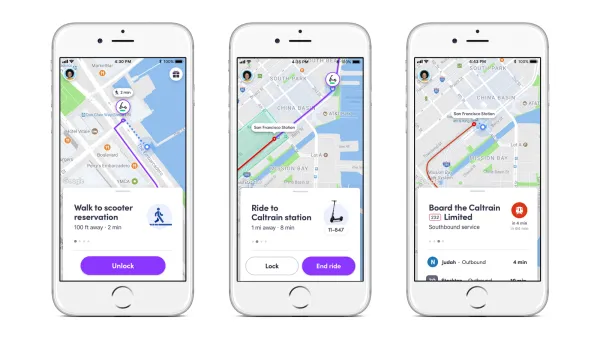
Lyft Moves Toward 'Full Mobility Package'
In cities around the country, Lyft is launching green, multimodal initiatives aimed at providing "all of the above" transportation options.
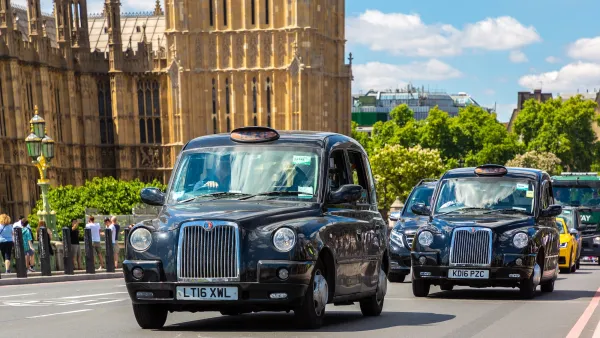
Can Robotaxis Handle London's Famously Tangled Streets?
Black Cab drivers say autonomous cars won’t be able to handle London’s unique conditions.
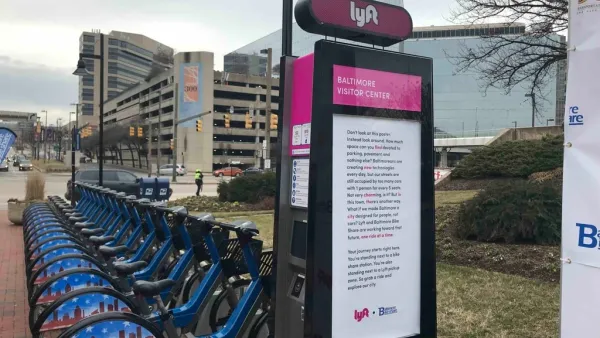
Uber and Lyft: A Tale of Two Companies
After years of resisting efforts by cities to regulate their business and constant—but unprofitable—growth, Uber and Lyft are homing in on their unique strengths.

Planetizen Federal Action Tracker
A weekly monitor of how Trump’s orders and actions are impacting planners and planning in America.

The state-sanctioned urbicide of Austin
People don’t kill cities. Freeways do.

US to reduce Colorado River water deliveries to Mexico
A new Colorado Treaty amendment reduces Mexico’s Colorado River water allocation by 250,000 acre feet.

5 New England states march closer to 800 megawatt wind energy project
Securing federal approval for the project may be complicated under the Trump administration, which has historically been hostile towards domestic wind power.

Baltimore to break ground on $50 million Transit Priority Project
The project will bring faster bus trips, safer streets and better bike connections to Baltimore.

Airbnb launches $250 million 'last-dollar financing' housing accelerator, makes first investment in Austin
The company will put $6.4 million towards affordable housing development in Texas’ capital.

FREE Course: Walkable City 1: Why Walkability?
After describing his path towards focusing on walkability as the essence of good planning, Jeff Speck marches through his five principal reasons for making more walkable places.
Reinventing Malls: Planning Alchemy—Turning Gray Fields Into Gold
The course focuses on the opportunities and imperatives that shape reinvention of mall sites.

Eagle County Government
Harvard University Graduate School of Design
Nashville Planning Department
The Architects Foundation
University of Cincinnati Online
The Pocatello Development Authority
The Urban Renewal Agency of the City of Pocatello
Journal of the American Planning Association