As the death toll from Mexico's 7.1 magnitude earthquake on Sept. 19 climbs above 300, the San Francisco Chronicle investigates how well prepared the Bay Area is for an earthquake of comparable magnitude. Not very well.


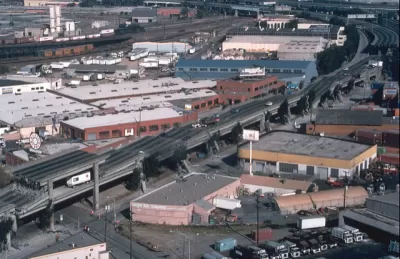
The day after Mexico City was hit with a 7.1 magnitude earthquake, Planetizen looked at the city of Los Angeles' "mandatory retrofit programs," which target pre-1978 wood-frame soft-story buildings and brittle concrete buildings.
With few exceptions, Bay Area cities are not as well prepared, somewhat similar to what Planetizen observed after a 6.0 earthquake shook Napa County on Aug. 24, 2014, resulting in over $1 billion in damage.
Ahead of the pack of the 101 cities and towns in the 9-county Bay Area is San Francisco which passed a law in 2013 requiring mandatory retrofits of wood-framed, multi-family buildings built before 1978 with a soft-story condition.
“That’s a visionary change and San Francisco was way out in front of other jurisdictions,” said geophysicist Ken Hudnut, science adviser for risk reduction for the U.S. Geological Survey, report John Wildermuth and J.K. Dineen “But in many cases, a lot of old stuff is grandfathered in and not all jurisdictions are as forward thinking as San Francisco.”
According to the Bay Area's council of governments, the Association of Bay Area Governments (ABAG), only two other cities have mandatory wooden soft-story retrofit programs: Berkeley and Fremont. However, the amount of vulnerable buildings is incomparable, with San Francisco having 6,700 and Fremont only 22.
Wildermuth and Dineen write that "a 7.1 earthquake in the Bay Area could even be more deadly than the Mexico City temblor." In addition to soft-story wood buildings, "older concrete buildings -- which in San Francisco tend to be commercial buildings — are particularly vulnerable." [See the three types of buildings most vulnerable].
Unlike Los Angeles, the San Francisco retrofit program doesn't include non-ductile concrete buildings. ["'Ductile' means flexible, while 'reinforced concrete' refers to concrete embedded with material such as steel mesh and rebar," according to the Live Science website.
Finally, Wildermuth and Dineen also report extensively on what went wrong in Mexico City.
"Non-engineered construction is common in Mexico,” said Mario Ordaz and Roberto Meli, two engineering professors at UNAM, Mexico’s premier university, in their paper presented at a 2004 Vancouver, B.C., conference on earthquake engineering.
“As a consequence, a large percentage of the building stock (and in some parts of the country, the vast majority) is built without construction permits, without compliance with codes and without the participation of qualified professionals.”
Behzad Fatahi, an associate professor of geo-technical and earthquake engineering at the University of Technology Sydney, said it best in a CNN interview on Sept. 20:
Earthquakes do not kill; but inadequately designed and poorly constructed buildings, infrastructure and lifeline systems can.
The best way to save lives is to design structures that can withstand earthquakes and retrofit old buildings to fit the code.
Read the full story: How ready will Bay Area be for next big quake?

Mexico City Earthquake Should Raise Questions About Building Safety
The epicenter of Tuesday's quake was in the state of Puebla, 80 miles southeast of Mexico City. Soft soil and unreinforced buildings magnified the damage. The quake comes two weeks after an 8.1 quake struck off the coast of the state of Oaxaca.
When it Comes to Seismic Safety, It's Each City for Itself
Buildings constructed of unreinforced masonry get much if not most of the media's attention on seismic safety, but so-called 'soft story' wood buildings, often with garages on the ground floor, compose the greatest numbers of vulnerable buildings.

San Francisco Considers More Aggressive Measures to Earthquake-Proof High Rises
The city has proposed tighter rules for new construction and a more active approach to securing existing tall structures from collapse.

Planetizen Federal Action Tracker
A weekly monitor of how Trump’s orders and actions are impacting planners and planning in America.

Amtrak, CN end decades-long dispute with eight-year agreement
The new operating agreement establishes an updated framework for the companies to work together, including processes to resolve disputes.

Judges permit Denver to divert 77,000 acre feet from the Colorado River for reservoir expansion
Overuse and climate change have caused the Colorado River’s water levels to plummet.

NYC DOT wants faster, more permanent street upgrades
The city is examining ways to build more concrete infrastructure without getting entangled in 'decades-long' projects.

'Something we’ve never seen before:' rising utility rates could strain city finances nationwide
Data centers, climate change and other factors have caused utility rates in the United States to increase by 38% since 2020.

Trump to overrule local leaders, lease millions of acres of America’s Pacific Island territories’ seafloors to mining companies
International law says that the Indigenous people of America’s territories have a right to prior and informed consent regarding projects that impact their countries.

FREE Course: Walkable City 1: Why Walkability?
After describing his path towards focusing on walkability as the essence of good planning, Jeff Speck marches through his five principal reasons for making more walkable places.
Reinventing Malls: Planning Alchemy—Turning Gray Fields Into Gold
The course focuses on the opportunities and imperatives that shape reinvention of mall sites.

Harvard University Graduate School of Design
KFH Group Inc.
Greater Baltimore Committee
The Architects Foundation
University of Cincinnati Online
The Pocatello Development Authority
The Urban Renewal Agency of the City of Pocatello