The Hilltop Urban Farm project is moving along in Pittsburgh. Few, if any, community gardens have been built on this scale before.


"For urban gardens and farms to sustain themselves, they have to be big enough for people to make money from them," reports Diana Nelson Jones. "The one being carved out on 23 vacant acres of the former St. Clair Village has that kind of massing."
St. Clair Village is the former site of a public housing project, demolished between 2006 and 20210. The idea for using the site as a community garden was born from a neighborhood organization called Hilltop Alliance, which draws membership from St. Clair and 11 other nearby neighborhoods.
So far, the Hilltop Urban Farm, as the new garden is called, has gathered about half of the $10 million it needs to get up and running. That much money has already garnered a ribbon cutting ceremony.
In addition to introducing the details of the Hilltop Urban Farm idea, Diana Nelson Jones places the project in context of a model for neighborhoods and cities growing in popularity around the country.
FULL STORY: Pittsburgh's serious commitment to urban farming: St. Clair Village


Urban Farming Addressing Hunger (and More) in Pittsburgh
Urban farming provides opportunities to increase food security in addition to other benefits.
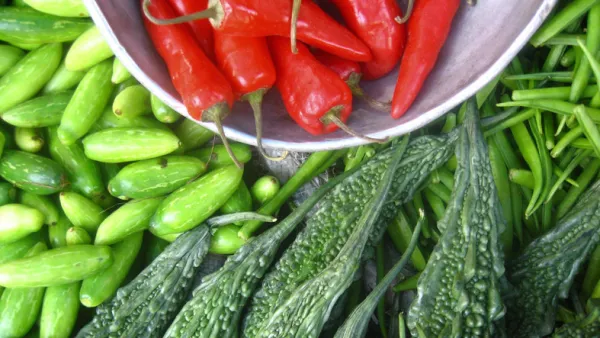
Urban Farming Model Takes Off In Boston Suburb
A suburban farming model based on shared private garden plots springs up in Needham, Massachusetts. Could Kate Canney's experiment be an antidote to the challenge of finding farmland that plagues prospective farmers nationwide?
Harvesting Data Essential for Saving Urban Gardens
To preserve the spread of urban gardening, activists are beginning to map and document the many haphazard community gardens to gain recognition from landlords and city officials in hopes of warding off bulldozers.

Planetizen Federal Action Tracker
A weekly monitor of how Trump’s orders and actions are impacting planners and planning in America.

The state-sanctioned urbicide of Austin
People don’t kill cities. Freeways do.

US to reduce Colorado River water deliveries to Mexico
A new Colorado Treaty amendment reduces Mexico’s Colorado River water allocation by 250,000 acre feet.

5 New England states march closer to 800 megawatt wind energy project
Securing federal approval for the project may be complicated under the Trump administration, which has historically been hostile towards domestic wind power.

Baltimore to break ground on $50 million Transit Priority Project
The project will bring faster bus trips, safer streets and better bike connections to Baltimore.

Airbnb launches $250 million 'last-dollar financing' housing accelerator, makes first investment in Austin
The company will put $6.4 million towards affordable housing development in Texas’ capital.

FREE Course: Walkable City 1: Why Walkability?
After describing his path towards focusing on walkability as the essence of good planning, Jeff Speck marches through his five principal reasons for making more walkable places.
Reinventing Malls: Planning Alchemy—Turning Gray Fields Into Gold
The course focuses on the opportunities and imperatives that shape reinvention of mall sites.

Eagle County Government
Harvard University Graduate School of Design
Nashville Planning Department
The Architects Foundation
University of Cincinnati Online
The Pocatello Development Authority
The Urban Renewal Agency of the City of Pocatello
Journal of the American Planning Association