Brian Libby reports from Willamette Falls in Oregon City, Oregon, where plans for the Willamette Falls Riverwalk are taking shape.


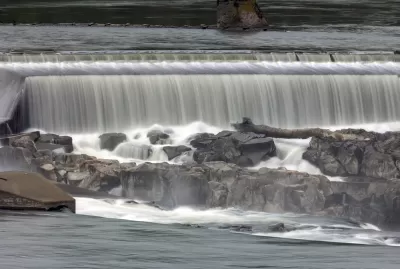
"Willamette Falls is the second largest waterfall by volume in the United States, after Niagara, and the largest in the waterfall-heavy Pacific Northwest," writes Libby. But, "[f]or more than a century, Willamette Falls has been all but hidden from public view because both sides of the river have been dominated by heavy industry."
Libby provides details of Oregon City's distant and more recent history, including the 2011 launch of the Willamette Falls Legacy Project. The project recently made a major announcement, unveiling a multi-phase river-walk plan. "Helming the design team is Snøhetta, the firm behind landmarks like the National September 11 Memorial Museum Pavilion, the Oslo Opera House, and the expansion of SFMoMA," writes Libby.
The article includes spectacular renderings released with the plan, and more details on what it will take to make these ambitious dreams for this singular confluence of nature, industry, and adaptive reuse a reality.
Read the full story: Oregon's Niagara Falls, Revealed

Whitewater Park Proposal Fails for Oregon City's Willamette Falls Project
There's still a lot to be excited about for the Willamette Falls Legacy Project in Oregon City. A whitewater park just isn't one of them.
Willamette Falls Access Approved as Part of Redevelopment Plan
The first U.S. incorporated west of the Rockies—Oregon City—is moving forward with a redevelopment plan that will provide public access to the stunning Willamette Falls.
Can Access to Willamette Falls Spur Urban Renewal?
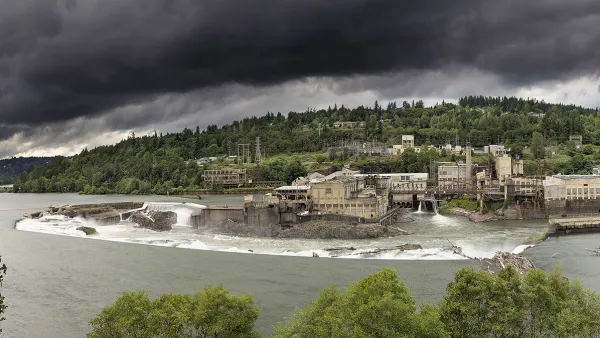
State and local officials in Oregon have launched a planning process to develop a public access esplanade to Willamette Falls in Oregon City. City planners could center urban renewal plans around what is expected to be a popular tourist destination.

Planetizen Federal Action Tracker
A weekly monitor of how Trump’s orders and actions are impacting planners and planning in America.

California plans to bury El Niño’s downpour
If the state plays its cards right, it may be able to store a billion acre-feet of El Niño’s water in aquifers.

Desperate measures: Advocates weigh draining Lake Powell to fill Colorado River
Draining the reservoir could reduce evaporation losses by a couple hundred thousand acre-feet.

Los Angeles just elected an urban planner as its mayor
Transportation analysts are optimistic that Raman will be more aggressive in addressing transit issues than Bass.

Mamdani’s pied-à-terre tax survives legal challenge
A panel of judges found that the plaintiffs failed to demonstrate injury as a result of New York City's implementation of the tax.

Eastern Nebraska is running out of electricity
Data centers and electrification are straining eastern Nebraska’s grid, throttling economic development.

FREE Course: Walkable City 1: Why Walkability?
After describing his path towards focusing on walkability as the essence of good planning, Jeff Speck marches through his five principal reasons for making more walkable places.
Reinventing Malls: Planning Alchemy—Turning Gray Fields Into Gold
The course focuses on the opportunities and imperatives that shape reinvention of mall sites.

City of Rosemead
Rutgers University, Edward J. Bloustein School of Planning and Public Policy
One Hundred Miles
University of Michigan School for Environment and Sustainability (SEAS)
Hunter College, City University of New York (CUNY)
The Architects Foundation
City of Cambridge
Montrose County
The Pocatello Development Authority