State and local officials in Oregon have launched a planning process to develop a public access esplanade to Willamette Falls in Oregon City. City planners could center urban renewal plans around what is expected to be a popular tourist destination.


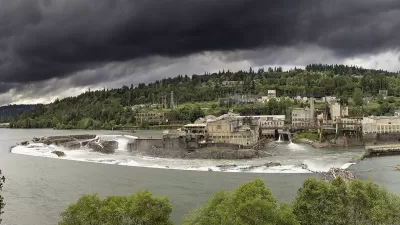
Steve Mayes reports on a recent decision to seek $4 million in planning and design funding for the “Willamette Falls Legacy Project.” The project involves redeveloping a 23-acre industrial site along the Willamette River as a cultural and scenic destination overlooking Willamette Falls in Oregon City.
The details of the project’s current status: “A consortium of state and local officials working on the project agreed Monday to identify how they might fund the $4 million design phase of an esplanade that would give the public a vantage point at the falls. Representatives from Oregon City, Clackamas County, Metro, state parks and the governor's office will report back in 30 days with how much money each might contribute to the project,” writes Mayes. Construction for the final project, “ may cost $30 million, according to a preliminary estimate.”
Part of the expense of the project comes from the difficult ownership state of the the 23-acre site required for the project—the former Blue Heron paper mill. “Currently, a bankruptcy court trustee controls the property,” writes Mayes. Efforts to sell the land have failed as three buyers made offers then quickly backed out.”
Tony Konkol, Oregon City's community development director, has also said that the city might consider tailoring its “existing urban renewal district to encompass the property or create a new district to help fund the work.”
Read the full story: Plan for public access to Willamette Falls moves ahead; $4 million needed for design, engineering


Whitewater Park Proposal Fails for Oregon City's Willamette Falls Project
There's still a lot to be excited about for the Willamette Falls Legacy Project in Oregon City. A whitewater park just isn't one of them.
Willamette Falls Access Approved as Part of Redevelopment Plan
The first U.S. incorporated west of the Rockies—Oregon City—is moving forward with a redevelopment plan that will provide public access to the stunning Willamette Falls.
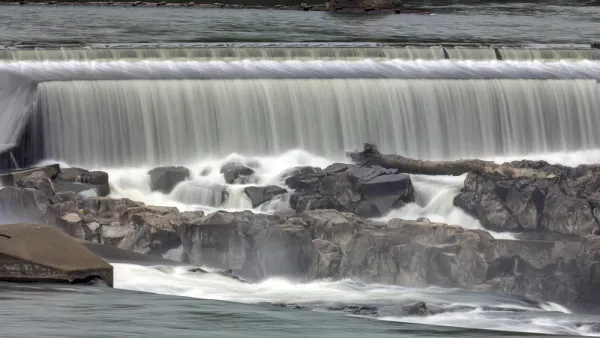
Oregon City's Spectacular Vision for the Willamette Falls Riverwalk
Brian Libby reports from Willamette Falls in Oregon City, Oregon, where plans for the Willamette Falls Riverwalk are taking shape.

Planetizen Federal Action Tracker
A weekly monitor of how Trump’s orders and actions are impacting planners and planning in America.

Amtrak, CN end decades-long dispute with eight-year agreement
The new operating agreement establishes an updated framework for the companies to work together, including processes to resolve disputes.

Judges permit Denver to divert 77,000 acre feet from the Colorado River for reservoir expansion
Overuse and climate change have caused the Colorado River’s water levels to plummet.

NYC DOT wants faster, more permanent street upgrades
The city is examining ways to build more concrete infrastructure without getting entangled in 'decades-long' projects.

'Something we’ve never seen before:' rising utility rates could strain city finances nationwide
Data centers, climate change and other factors have caused utility rates in the United States to increase by 38% since 2020.

Trump to overrule local leaders, lease millions of acres of America’s Pacific Island territories’ seafloors to mining companies
International law says that the Indigenous people of America’s territories have a right to prior and informed consent regarding projects that impact their countries.

FREE Course: Walkable City 1: Why Walkability?
After describing his path towards focusing on walkability as the essence of good planning, Jeff Speck marches through his five principal reasons for making more walkable places.
Reinventing Malls: Planning Alchemy—Turning Gray Fields Into Gold
The course focuses on the opportunities and imperatives that shape reinvention of mall sites.

Harvard University Graduate School of Design
KFH Group Inc.
Greater Baltimore Committee
The Architects Foundation
University of Cincinnati Online
The Pocatello Development Authority
The Urban Renewal Agency of the City of Pocatello