Los Angeles County's Parks after Dark (PAD) program and the city of Los Angeles' Summer Night Lights (SNL) program are proving to save lives, lower crime, and reduce costs, writes L.A. County parks planner Clement Lau.



Summer gang crime prevention was the original motive for adding nighttime programming in the parks of Los Angeles—city first, then followed by the county. The city of Los Angeles' has a program called Summer Night Lights (SNL). The county soon followed suit with its own program called Parks after Dark (PAD). Writes L.A. County parks planner Clement Lau:
According to a 2013 DPH study, 78 percent of PAD participants, many of whom used to be sedentary, reported through surveys that they engaged in physical activity. Increased physical activity offers numerous health benefits, including (but not limited t0) reducing the risk of heart disease, diabetes, depression, colon cancer, breast cancer, dementia, and premature death. DPH estimates that if PAD participants continued weekly physical activity throughout the year, it could translate into a 5 percent decrease in the burden of diabetes, dementia, and heart disease annually.
PAD has helped to make communities safer as well. Serious and violent crimes in the communities around the original three parks dropped 32 percent during the summer months between 2009 (the summer before PAD started) and 2013. It should be noted that this reduction in crime was not just due to increased Sheriff's Department presence, but also from a greater number of park patrons engaging in PAD activities and building relationships. During the same time period, such crimes increased 18 percent in nearby communities with parks that did not offer the PAD program.
For more about the summer night time park programming, please see the source article.
Read the full story: Surprising benefits from nighttime park programming in LA


Creativity Needed to Meet Recreational Needs During a Pandemic
With COVID-19, the Los Angeles County Department of Parks and Recreation modified its popular Parks After Dark program so that it could still meet community needs, while complying with public health orders.
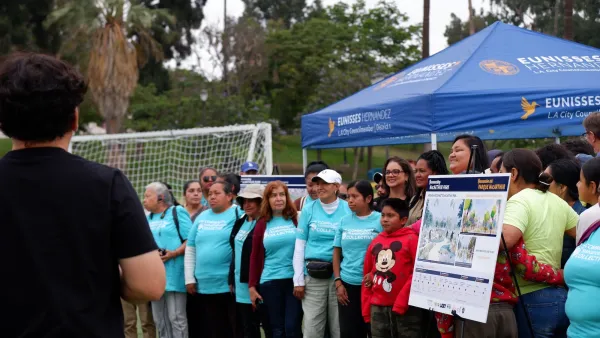
LA unveils plans to reconnect MacArthur Park
The construction of Wilshire Boulevard split the park in two in 1934.

Delivering on the Promise of Parks
In LA County, even amid budget challenges, new parks are opening, targeted investments are being made in underserved communities, and long-term plans are guiding progress — demonstrating a sustained commitment to parks as essential infrastructure.

Planetizen Federal Action Tracker
A weekly monitor of how Trump’s orders and actions are impacting planners and planning in America.

California plans to bury El Niño’s downpour
If the state plays its cards right, it may be able to store a billion acre-feet of El Niño’s water in aquifers.

Desperate measures: Advocates weigh draining Lake Powell to fill Colorado River
Draining the reservoir could reduce evaporation losses by a couple hundred thousand acre-feet.

California city breaks ground on transit connector
The project includes three mobility hubs and a pedestrian bridge.

After public outcry, Massachusetts city releases housing development tracker
Cambridge’s tracker currently shows 250 housing projects in various stages of development.

40 years after approval, Chicago breaks ground on new park
The park honors Jean Baptiste Point du Sable, the city’s first permanent non-native settler.

FREE Course: Walkable City 1: Why Walkability?
After describing his path towards focusing on walkability as the essence of good planning, Jeff Speck marches through his five principal reasons for making more walkable places.
Reinventing Malls: Planning Alchemy—Turning Gray Fields Into Gold
The course focuses on the opportunities and imperatives that shape reinvention of mall sites.

City of Rosemead
Rutgers University, Edward J. Bloustein School of Planning and Public Policy
One Hundred Miles
Hunter College, City University of New York (CUNY)
The Architects Foundation
University of Cincinnati Online
City of Cambridge
Montrose County
The Pocatello Development Authority