In Zoned Out!, Tom Angotti, of City University New York (CUNY) tries to make the case against upzoning New York's neighborhoods (or at least its poorer ones).


Generally, economists and smart growth advocates tend to favor allowing new urban housing, while homeowners believe that new housing should always be located in someone else's neighborhood—thus earning the epithet "NIMBY" (for "Not In My Back Yard"). Historically, leftists have tended to agree with the experts and to oppose exclusionary zoning—but in left-wing, high-cost cities this is not always the case. In fact, "progressive NIMBYism" has some support among planning academics. In the new book Zoned Out! Race, Displacement, and City Planning in New York City, CUNY's Tom Angotti criticizes upzoning; he favors lots of new public housing for poor people, but it is not clear to me whether he favors any market-rate housing anywhere.
Angotti argues that new housing actually increases rents; he reasons that upzoning "increases the future value of land."(p. 29) and that as a result "new development drives up land values and rents in surrounding blocks and tenants in the buildings on those blocks can't affford to pay higher rents and are forced out." (p. 37). I critiqued this argument in a Planetizen blog post a couple of months ago. (If you don't feel like clicking on the link, here's my one-sentence summary: cities that have downzoned don't seem to be very successful in keeping rents down.)
Moreover, Angotti makes concessions that damage his argument. If upzoning is always bad, it logically follows that anti-density exclusionary zoning should lower housing prices and should be welcomed. But Angotti seems to oppose exclusionary zoning in the city's suburbs and outer boroughs. After discussing a wide variety of common zoning policies such as minimum lot size requirements, he notes correctly that "Zoning can be used ... to make it impossible to build housing affordable to low-income people" (p. 51). He also adds that such exclusionary zoning is not limited to the suburbs: New York's outer boroughs still have "predominantly white enclaves [that] continue to be protected by zoning" (p. 52). For example, Angotti complains that in Hasidic Boro Park, "[i]nstead of contemplating a rezoning that would encourage new higher density residential development—and possible racial change," (Id.) the city zoned to protect the status quo. Similarly, he notes that in affluent Park Slope anti-density zoning "protected... the relatively affluent white portion of the neighborhood" (Id.) And in Staten Island, a plan that "would have brought higher-density development to the low-density white borough ... was rejected [due to racial fears]" (p. 55). So it seems to me that Angotti believes that 1) in middle-and upper-class white areas, restrictive zoning keeps property values high and blacks and Hispanics out while and 2) in racially diverse areas, restrictive zoning is necessary to keep property values low. I am not sure how both these propositions can be true.
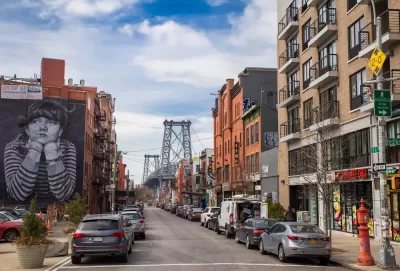
Having said that, Angotti's arguments are tethered to factual reality in one important respect: it is true that in some rapidly gentrifying areas, upzonings were followed by rent increases far exceeding those of citywide levels. (Angotti focuses on Williamsburg, Harlem and Chinatown.) So based on this data set, he concludes that upzoning leads to rent increases which leads to displacement. These cases certainly present a challenge for market urbanists—but it seems to me that there is more than one possible explanation for this phenomenon.
For one thing, New York's 2000s upzonings were accompanied by downzonings—sometimes even in the same neighborhood as the upzonings. For example, much of Williamsburg was upzoned in 2005—but in 2008, the city downzoned higher-income blocks (p. 91). So the overall effect of rezonings on housing supply is unclear.
Moreover, New York's combination of upzonings and downzonings might have caused localized rent spikes that would not have occurred in a more consistently pro-development city. If a city says (in so many words) "in zone A you can't build anything new, while in zone B you can build new stuff," housing demand from the people excluded from zone A might flood into zone B. So even if supply in zone B increases, so does demand—and, of course, so do land costs, as would-be landlords bid up the price of B's scarce land. So it seems to me that if upzoning in one place causes rent spikes, upzoning everywhere is more likely to contain rents than downzoning everywhere.
Even the correlation between gentrification and displacement is a bit more wobbly than Angotti thinks. He notes that between 2000 and 2013, the black population of one part of Harlem decreased by 5 percent (p. 111). But Harlem has been losing blacks for many decades. In 1950, Central Harlem had about 230,000 blacks; in 1990, Harlem had just under 90,000. (Details can be found here.) Gentrification may displace minorities—but poverty displaces even more, as people flee from declining neighborhoods. (Similarly, declining cities such as Detroit tend to have declining black populations, as all but the poorest flee to suburbia.)
Angotti's ultimate remedy to New York's affordability problems is unclear. The last chapter of his book endorses increased public housing construction and something called "community planning"—that is, increasing neighborhoods' veto power over new development. Since neighborhood activists often oppose new housing near them, I suspect that the latter policy would eliminate new market-rate housing in New York—which Angotti might (given his assumptions about land prices) view as a desirable result.


How Cities Are Resisting State Efforts To Increase Density
Cities are attempting to wrest back local control over land use and zoning via some ingenious—and sometimes disingenuous—strategies.
Does Zoning Create a Vicious Circle—Or Can It Fix Itself?
Ideally, planners could balance homeowners' interests in zoning against the public good, liberalizing zoning when prices got too high. But this may be politically impossible.

NYC Planning Head Defends Growth-Oriented Policies
Acknowledging anti-development sentiments currently simmering at an "all-time high," New York's planning director Marisa Lago defended de Blasio administration policies like mandatory inclusionary housing.

Planetizen Federal Action Tracker
A weekly monitor of how Trump’s orders and actions are impacting planners and planning in America.

‘Going backwards:’ Baltimore mayor, students rally against state's transit funding plan
Maryland's proposed six-year plan provides no funding for Baltimore’s BMORE bus program and reduces its road maintenance funding.
Mamdani sent nearly 6,000 pied-à-terre tax warnings to homes that didn’t qualify
A judge has ordered the administration to cancel thousands of pied-à-terre tax notices after it sent 35% of them erroneously.

MTA expects Trump’s tariffs to increase new NYC transit costs by $1 billion
The Metropolitan Transit Authority said the cost of new subway cars has risen by 30% since Trump began his second term as president.

Alaska takes public comment on new long-term plan for roads, bridges and more
Alaska's draft Statewide Transportation Improvement Program includes over $1 billion for the Alaska Marine Highway System.

A Colorado neighborhood is the testing ground for the future of home energy
A start up may have found a way to quickly bring geothermal energy to new communities.

FREE Course: Walkable City 1: Why Walkability?
After describing his path towards focusing on walkability as the essence of good planning, Jeff Speck marches through his five principal reasons for making more walkable places.
Reinventing Malls: Planning Alchemy—Turning Gray Fields Into Gold
The course focuses on the opportunities and imperatives that shape reinvention of mall sites.

City of Thousand Oaks
City of Wisconsin Rapids
Harvard University Graduate School of Design
The Architects Foundation
University of Cincinnati Online
Northern Illinois Transit Authority (NITA)
The Pocatello Development Authority
The Urban Renewal Agency of the City of Pocatello

