When Wolverine Human Services bought 11 acres of East Detroit planning to remove abandoned houses for a U-Pick Orchard, neighbors protested. Now they've pivoted and aim to provide a resource to the community rather than run an agro-business.


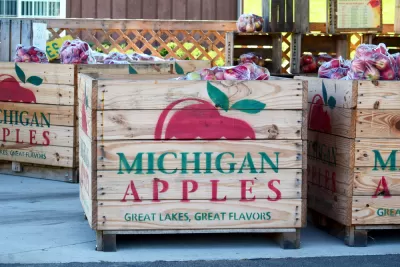
East Detroit has lost many people. About a third of the homes, many of which were built in the 1960s, are empty. So resident, Glen Jones, had long hoped that someone would build a house or a business in the vacant lots near his home. "When he and other residents saw renderings of an 11-acre redevelopment project that would instead convert the vacant land into one of the city’s first large-scale U-pick orchards featuring the Michigan apple, they balked," Serena Maria Daniels writes in Next City.
Wolverine Human Services, who had bought the land, looked to make something more consistent with their neighbors’ wishes; including shrinking the orchard down to a half acre, and providing employment opportunities for people in the neighborhood. "Planting is pending approval from the city to rezone the area for farm use, which Wolverine expects later this month," Daniels reports.
FULL STORY: Detroit Urban Farming Plan Shifts to Be More Neighborly

No Connection Between Gardens and Gentrification in Detroit, Study Says
Research from late 2021 documented the footprint of urban gardens in Detroit, finding evidence of inequities but not gentrification.

Bringing Urban Orchards to Food Deserts in Ohio
The Common Orchard Project has planted ten orchards in vacant lots in Cincinnati. The organization hopes to plant 100 urban orchards by the end of the decade.
Detroit's Unpermitted Goat Experiment Ends—Is a Second Chance Possible?
A hedge fund manager recently took it upon himself to bring 20 goats into Detroit as an experiment of urban agriculture. The city quickly shipped the herd off, but fans of goats wonder why these animals shouldn't have a place in the city.

Planetizen Federal Action Tracker
A weekly monitor of how Trump’s orders and actions are impacting planners and planning in America.

The state-sanctioned urbicide of Austin
People don’t kill cities. Freeways do.

US to reduce Colorado River water deliveries to Mexico
A new Colorado Treaty amendment reduces Mexico’s Colorado River water allocation by 250,000 acre feet.

Mamdani overhauls NYC's Vision Zero plan with 100 new policy goals
The overhaul aims to reduce traffic deaths and make streets safer for pedestrians, cyclists and drivers through lower speed limits, new safety infrastructure and more.

Amtrak not solely to blame for New Jersey commuter rail's unreliability, report finds
A new study from the Garden State Initiative found that NJ Transit’s budget grew 20% across a 4 year period, but reliability declined significantly over the same period.

EPA erases limits on planet-warming pollution from power plants
Under Monday’s plan, power plants would still have some limits on how much mercury, arsenic and other contaminants they can emit.

FREE Course: Walkable City 1: Why Walkability?
After describing his path towards focusing on walkability as the essence of good planning, Jeff Speck marches through his five principal reasons for making more walkable places.
Reinventing Malls: Planning Alchemy—Turning Gray Fields Into Gold
The course focuses on the opportunities and imperatives that shape reinvention of mall sites.

Eagle County Government
Harvard University Graduate School of Design
Nashville Planning Department
The Architects Foundation
University of Cincinnati Online
The Pocatello Development Authority
The Urban Renewal Agency of the City of Pocatello
Journal of the American Planning Association