Galveston, Texas stands on the Gulf of Mexico and sits on the path of a number of bird migrations. 395 of those birds were killed Wednesday night striking a single building in the city's downtown.


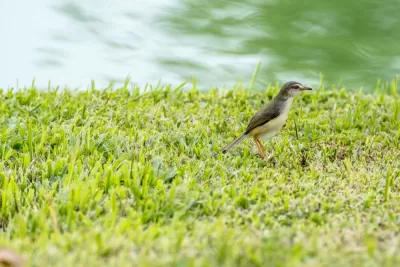
According to an article by Dana Guthrie, 398 birds struck the American National Building in downtown Galveston, Texas on a recent night. Of those birds, only three survived. The majority of the birds killed were warblers, which migrate this time of year, Guthrie reports for the Houston Chronicle.
Guthrie spoke to Sarah Flournoy, the communities program manager for Houston Audubon, who said that these numbers of bird strikes are unusually high and that simple strategies can prevent the deaths of these birds who are one of the town's key tourist attractions. "Flournoy said the easiest and most effective thing people can do to stop bird-building collisions is to turn building lights off at night, especially during fall and spring migrations," Guthrie reports.
Read the full story: Bird experts call for community action after 398 birds crash into Galveston building
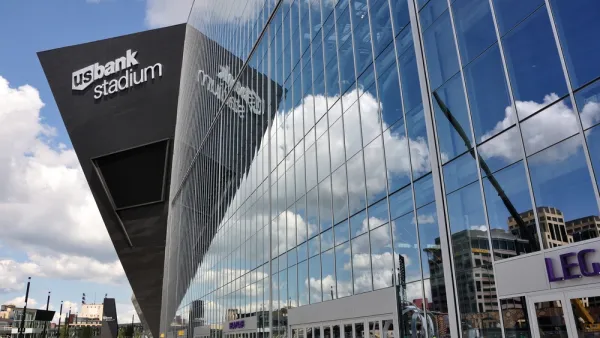
U.S. Bank Stadium: Home to Super Bowl LII and a Death Trap for Migratory Birds
This isn't a joke about the Philadelphia Eagles. This story is about the deadly consequences of planning and architecture decisions.

Protecting Birds From Window Glass
Glass windows kill billions of birds each year. Simple fixes can help.
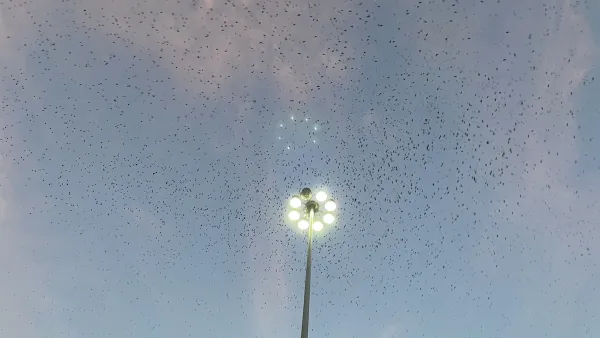
Purple Martins Call Nashville Home. Some Wish They Wouldn't
Each year, the city plays host to hundreds of thousands of birds on their way to and from South America.

Planetizen Federal Action Tracker
A weekly monitor of how Trump’s orders and actions are impacting planners and planning in America.

California plans to bury El Niño’s downpour
If the state plays its cards right, it may be able to store a billion acre-feet of El Niño’s water in aquifers.

Desperate measures: Advocates weigh draining Lake Powell to fill Colorado River
Draining the reservoir could reduce evaporation losses by a couple hundred thousand acre-feet.

Mamdani’s pied-à-terre tax survives legal challenge
A panel of judges found that the plaintiffs failed to demonstrate injury as a result of New York City's implementation of the tax.

Eastern Nebraska is running out of electricity
Data centers and electrification are straining eastern Nebraska’s grid, throttling economic development.

Seattle passes record-breaking transit services expansion
Proposition 1 will double the city’s transit tax to add 95,000 more bus trips and preserve 180,000 bus trips annually.

FREE Course: Walkable City 1: Why Walkability?
After describing his path towards focusing on walkability as the essence of good planning, Jeff Speck marches through his five principal reasons for making more walkable places.
Reinventing Malls: Planning Alchemy—Turning Gray Fields Into Gold
The course focuses on the opportunities and imperatives that shape reinvention of mall sites.

City of Rosemead
Rutgers University, Edward J. Bloustein School of Planning and Public Policy
One Hundred Miles
University of Michigan School for Environment and Sustainability (SEAS)
Hunter College, City University of New York (CUNY)
The Architects Foundation
City of Cambridge
Montrose County
The Pocatello Development Authority