As the supply of affordable housing in Gowanus continues to diminish, a new coalition demands that any rezoning plan fill the gaps.



As New York considers extending its rezoning efforts to the largely industrial neighborhood of Gowanus, non-profits have convened the Gowanus Neighborhood Coalition for Justice to represent the needs of low-income tenants and residents of public housing.
A new report by the nonprofit Fifth Avenue Committee found that 33 percent of housing in Gowanus is affordable — but those numbers are declining. Between 2007 and 2014, the number of rent-stabilized apartments dropped 22 percent in Gowanus, Boerum Hill, Carroll Garden and Park Slope thanks to market-rate development in those areas. That compares to a 6 percent drop citywide.
To counteract these trends, the coalition demands that "any rezoning, large land use action or public investment" be organized around five basic principles:
1. Advance racial and economic justice
2. Create real affordable housing and protect tenants from displacement
3. Promote environmental justice
4. Protect local businesses where we work and shop
5. Uplift the culture and community of long-time residents
Strategies to meet these goals—including workforce development, community policing, and racial desegregation—are outlined in the statement.
Gowanus community groups have advocated protections for longtime residents and small businesses since at least fall 2016, with the launch of the Bridging Gowanus community planning process.
Read the full story: Gowanus lost 22% of its rent-stabilized housing between 2007 and 2014: study


Neighborhoods Push for Benefits in New York Zoning Plan
The Brooklyn neighborhood of Gowanus was recently added to Mayor de Blasio’s sweeping zoning reform plan. But Gowanus also has plans of its own.

One Fourth of East Harlem Housing Set to Lose Affordability
The area could lose up to 500 units of affordable housing every year for the next 30 years if the city doesn't extend existing protections.
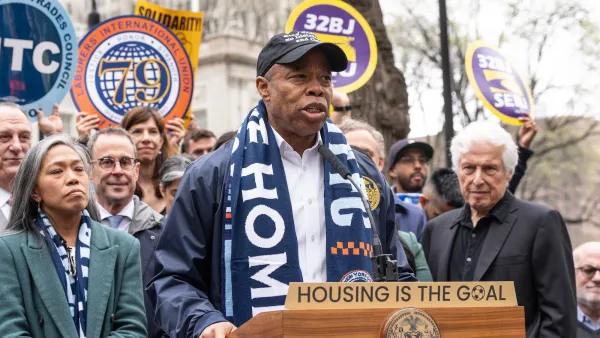
What Actually Got Built Under Eric Adams’ ‘Pro-Housing’ Administration
The outgoing mayor claims credit for hundreds of thousands of new homes. The truth is more complicated.

Planetizen Federal Action Tracker
A weekly monitor of how Trump’s orders and actions are impacting planners and planning in America.

Amtrak, CN end decades-long dispute with eight-year agreement
The new operating agreement establishes an updated framework for the companies to work together, including processes to resolve disputes.

Northwest rail fans eager for Sept. 30 debut of Amtrak’s Airo fleet
Get ready for that new train smell and more seats. But they won’t go faster or run more frequently on the Cascades route in Washington and Oregon.

St. Louis Metro to test if single-car trains can reduce operating costs, maintain rider satisfaction
The pilot program will run from October to spring 2027, and begin with one single-car train operating on Metrolink’s Red and Blue lines.

Pennsylvania is building data centers in abandoned mines
Housing data centers in mines provides an alternative to destroying local forests and may spare residents from data centers’ noise and air pollution.

If Corpus Christi can’t revive desalination plant project, it may owe Texas $235 million
Earlier this month, city officials declined to pursue developing the plant for the second time in a year.

FREE Course: Walkable City 1: Why Walkability?
After describing his path towards focusing on walkability as the essence of good planning, Jeff Speck marches through his five principal reasons for making more walkable places.
Reinventing Malls: Planning Alchemy—Turning Gray Fields Into Gold
The course focuses on the opportunities and imperatives that shape reinvention of mall sites.

City of Thousand Oaks
City of Wisconsin Rapids
Harvard University Graduate School of Design
The Architects Foundation
University of Cincinnati Online
The Pocatello Development Authority
The Urban Renewal Agency of the City of Pocatello