Fatehpur Sikri, an example of Mughal architecture in Northern India, has some lessons and reminders for modern architects, writes Indian trained Bay Area architect, artist, and planner Ayub Patel.


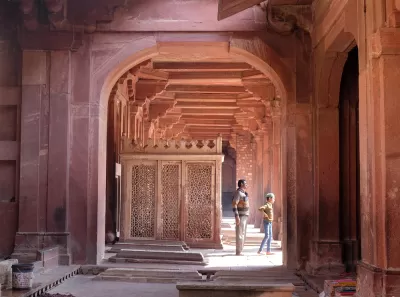
On a recent trip to Northern India, Bay Area architect, artist, and planner Ayub Patel visited Fatehpur Sikri, a hilltop fortress and palace built by the Mughal Emperor Akbar the Great. Akbar was a 16th century Indian ruler from the Islamic Mughal dynasty who conquered and united far flung parts of India, including Hindu and Muslim kingdoms. Patel writes of Fatehpur Sikri:
“The drama of movement to and within the complex is heightened by shifting axes, both major and minor, coupled with the courtyard planning principles of the Persians and local Hindus. These amalgamate very well in response to both climate, privacy, and multiple vistas. As one circulates within the ensemble and it’s cleverly designed level changes, one realizes that each building within is different yet somehow extremely well connected to the rest. The ever so subtle yet powerful changes in level that separate forecourt or hind court from building or elevated plinths (that just slightly raise each building above its apron) provide boundaries of definition in a vast continuum of spatial interweave and spatial locks, allowing the onlooker to take in vistas from various vantage points. The dynamics of space within is aided by shifting axes that in some respects provide practical adjustments to the contoured terrain for each piece of the ensemble while gesturing the eye to move on to another potential vista or vantage point. Studies have revealed that the entire complex is planned with proportion based on the Golden Rectangle ratio.”
Patel concludes by quoting:
“It is the manifestation of Aldo Van Eyck’s words ‘Man, after all, breathes both in and out; when will architecture do the same?’”
For more of Patel’s words, drawings, and photos of Fatehpur Sikri, please visit the source article.
Read the full story: A peek into the timeless past of Mughal architecture in India


Federal Government Will no Longer Recognize Architects as ‘Professionals’
The change could dramatically impact how many people can afford to enter graduate professional degree programs.

University of Hawai‘i Appoints New Architecture School Dean
The University of Hawai‘i at Mānoa has named Mo Zell as the new dean of its School of Architecture, bringing over two decades of experience in academia, innovative educational programs, and industry partnerships to advance design education.

Avoiding Misplacement of a Place
To balance the interests of current residents and economic well-being, does a city's signature identity need an update?

Planetizen Federal Action Tracker
A weekly monitor of how Trump’s orders and actions are impacting planners and planning in America.

Amtrak, CN end decades-long dispute with eight-year agreement
The new operating agreement establishes an updated framework for the companies to work together, including processes to resolve disputes.

Northwest rail fans eager for Sept. 30 debut of Amtrak’s Airo fleet
Get ready for that new train smell and more seats. But they won’t go faster or run more frequently on the Cascades route in Washington and Oregon.

Brightline Florida files for bankruptcy
The transit company is over $5 billion in debt.

St. Louis Metro to test if single-car trains can reduce operating costs, maintain rider satisfaction
The pilot program will run from October to spring 2027, and begin with one single-car train operating on Metrolink’s Red and Blue lines.

Pennsylvania is building data centers in abandoned mines
Housing data centers in mines provides an alternative to destroying local forests and may spare residents from data centers’ noise and air pollution.

FREE Course: Walkable City 1: Why Walkability?
After describing his path towards focusing on walkability as the essence of good planning, Jeff Speck marches through his five principal reasons for making more walkable places.
Reinventing Malls: Planning Alchemy—Turning Gray Fields Into Gold
The course focuses on the opportunities and imperatives that shape reinvention of mall sites.

City of Thousand Oaks
City of Wisconsin Rapids
Harvard University Graduate School of Design
The Architects Foundation
University of Cincinnati Online
The Pocatello Development Authority
The Urban Renewal Agency of the City of Pocatello