The "sanctuary cities" that President Trump has repeatedly characterized as incubators of crime are generally safer than other cities, according to a new analysis of FBI crime data.


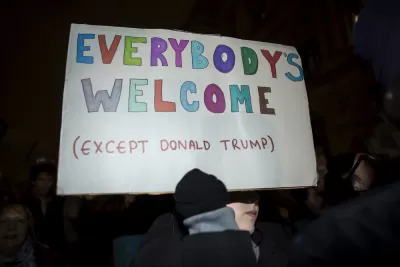
"The 'sanctuary cities' that President Trump has repeatedly characterized as incubators of crime are generally safer than other cities, according to a new analysis of FBI crime data," reports Christopher Ingraham.
Ingraham is reporting an analysis of FBI crime data by Tom Wong, a professor of political science at the University of California at San Diego, which "finds that counties designated as 'sanctuary' areas by ICE typically experience significantly lower rates of all types of crime, including lower homicide rates, than comparable non-sanctuary counties."
The Center for American Progress, a progressive think tank, published the analysis.
A few more details of Wong's findings: "In smaller counties and even rural areas, crime rates were also lower for sanctuary areas," with the exception of "medium metros and counties on the fringes of large metro areas, which had slightly higher crime rates if they were sanctuary areas."
The study includes a lot more on the analysis into sanctuary cities, and the now debunked talking points that helped President Donald Trump get elected.
Read the full story: Trump says sanctuary cities are hotbeds of crime. Data say the opposite.


Election 2024: Red vs. Blue States
In a speech on Sunday at the Ronald Reagan Presidential Library in Simi Valley, California, likely Republican presidential contender Gov. Ron DeSantis of Florida said that the pandemic was “a great test in governing philosophies."

Infrastructure Investment for Public Safety: Lessons from Medellín
A natural experiment in Medellín indicates that infrastructural investments can reduce crime and improve perceptions of public safety.

U.S. Cities Brace to Lose Infrastructure Funding Over Immigration Policies
Politico explores some of the projects that could be scrapped as a result of being located in sanctuary cities.

Planetizen Federal Action Tracker
A weekly monitor of how Trump’s orders and actions are impacting planners and planning in America.

Amtrak, CN end decades-long dispute with eight-year agreement
The new operating agreement establishes an updated framework for the companies to work together, including processes to resolve disputes.

Judges permit Denver to divert 77,000 acre feet from the Colorado River for reservoir expansion
Overuse and climate change have caused the Colorado River’s water levels to plummet.

Atlanta City Council unanimously backs $3.5 billion Beltline light rail project
The resolution was drafted after Atlanta Mayor Andre Dickens pulled support for the Atlanta Streetcar extension last year.

SEPTA to bring nearby frequent transit to over 1 million new riders as part of decade-long plan
The agency's Accelerate plan will also bring frequent transit to twice the amount of jobs that are currently located near it.

NYC plants over 18,000 trees, the most new foliage in a decade
Many of the trees were planted in communities vulnerable to extreme heat.

FREE Course: Walkable City 1: Why Walkability?
After describing his path towards focusing on walkability as the essence of good planning, Jeff Speck marches through his five principal reasons for making more walkable places.
Reinventing Malls: Planning Alchemy—Turning Gray Fields Into Gold
The course focuses on the opportunities and imperatives that shape reinvention of mall sites.

City of Thousand Oaks
City of Wisconsin Rapids
Harvard University Graduate School of Design
The Architects Foundation
University of Cincinnati Online
The Pocatello Development Authority
The Urban Renewal Agency of the City of Pocatello