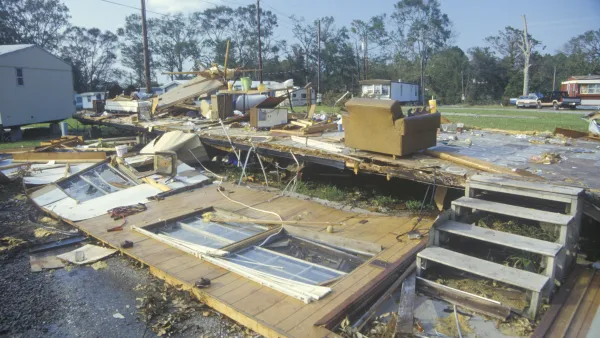
The effects of tornadoes like those that touched down in South Georgia on Sunday are exacerbated in areas where many residents live in mobile homes.


Jeremy Redmon reports on the ubiquity of mobile homes in the state of Georgia—a fact of residential life in that state, and others, that introduces extreme risks when tornadoes touch down.
Georgia ranks fifth among states for its number of mobile homes — or manufacture houses — with 381,978, according to the Virginia-based Manufactured Housing Institute, a national trade organization. About 70,000 are in the metro Atlanta area, according to the U.S. Census Bureau. Of those, at least 14,900 are not anchored.
So when deadly storms swept across South Georgia on Sunday, seven people died at a mobile home park in Cook County. Redmon reports, via information from the National Weather Service, that the "average annual tornado-related death rate in mobile homes is 20 times higher than in permanent homes." Moreover, "between 1985 and 2005, mobile homes were the most common location for tornado-related fatalities at 44 percent, followed by permanent homes at 25.3 percent and vehicles, 9.9 percent."
Read the full story: Georgia ranks fifth for mobile homes with nearly 400,000

600,000 Florida homes vulnerable to incoming El Niño
Florida has more manufactured homes than any other state, the majority of which may have been built before federal regulations required them to be capable of withstanding extreme weather.
Should the public sector buy mobile home parks?
One writer argues that the crisis facing the nation's mobile home owners warrants public intervention.

Poor Conditions in Mobile Home Parks Put Residents at Risk
Failing infrastructure, poor water and air quality, and predatory owners endanger the health of manufactured home residents, many of whom are elderly and low-income.

Planetizen Federal Action Tracker
A weekly monitor of how Trump’s orders and actions are impacting planners and planning in America.

California plans to bury El Niño’s downpour
If the state plays its cards right, it may be able to store a billion acre-feet of El Niño’s water in aquifers.

Chicago breaks ground on $3 billion megadevelopment
The new neighborhood, titled Foundry Park, will one day host 3,700 residences.

California High-Speed Rail Authority CEO resigns after $600,000 scandal
Under Ian Choudri, the authority used taxpayer dollars to fund first class flights and trips to nightclubs.

Want to study the Missouri River? Soon, you may need unanimous approval from 10 states
Legislation would require 10 governors’ permission to study or build projects moving water outside the basin.

Desperate measures: Advocates weigh draining Lake Powell to fill Colorado River
Draining the reservoir could reduce evaporation losses by a couple hundred thousand acre-feet.

FREE Course: Walkable City 1: Why Walkability?
After describing his path towards focusing on walkability as the essence of good planning, Jeff Speck marches through his five principal reasons for making more walkable places.
Reinventing Malls: Planning Alchemy—Turning Gray Fields Into Gold
The course focuses on the opportunities and imperatives that shape reinvention of mall sites.

City of Rosemead
Rutgers University, Edward J. Bloustein School of Planning and Public Policy
One Hundred Miles
Hunter College, City University of New York (CUNY)
The Architects Foundation
University of Cincinnati Online
City of Cambridge
Montrose County
The Pocatello Development Authority