The Glenner Town Square development in Chula Vista, California will be one of the first "immersive facilities" in the United States, designed to trigger memories for Alzheimer's patients.


"There’s going to be a new town square in Chula Vista, a suburb near San Diego County, California," according to an article by Linda Poon. "But while most cities try to update their town squares to be trendy and modern, this one takes inspiration from the 1950s."
"Come 2018, when Glenner Town Square is schedule to open, that city hall will be surrounded by a park, a movie theater, a hospital, a diner, and more than a dozen other functioning buildings typically found in any city," adds Poon. But there's a fundamental feature of the town still missing from that description. Glenner Town Square is a replica of a functioning city, scaled down inside a 15,000-square-foot industrial building with a 24-foot-high ceiling.
"The fake city is part of 'reminiscence therapy,' an increasingly popular alternative to nursing homes and drug treatments for Alzheimer’s patients," according to Poon. Alzheimer’s patients from the San Diego-based nonprofit George G. Glenner Alzheimer’s Family Centers will be the primary visitors to Glenner Town Square. The most thorough examples of the developments designed for reminiscence therapy are located in Amsterdam, Cleveland, and another example planned for Rome, Italy.
FULL STORY: How Throwback Model Towns Could Help Alzheimer's Patients

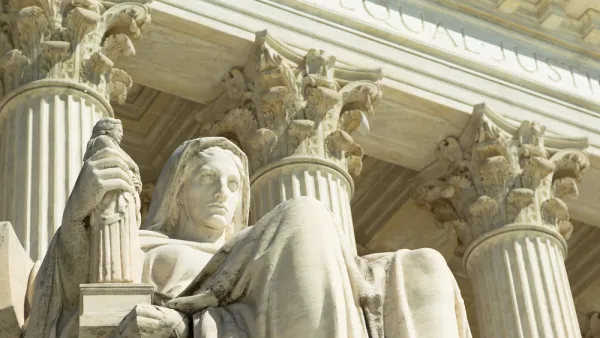
U.S. Supreme Court Rules on State-Imposed Social Distancing Restrictions
In a 5-4 decision, the court voted to uphold the prohibition of religious services that was part of California Gov. Gavin Newsom's stay-at-home order. While the restriction had since been loosened, the plaintiff wanted all restrictions removed.

Power Shifts to Cities in San Diego County's Embattled Regional Planning Agency
Larger cities in California's second most populous county will be given more power thanks to a bill that reforms the San Diego Association of Governments (SANDAG). One result may be that more public transit measures appear on the ballot.
The Joys and Surprises of Teaching "Guerilla Planning"
One of my prerogatives teaching a landscape design studio exploring public space at UCLA Extension is being able to pick the class projects with which to challenge the students. Time for them to get real and get down, walk the streets, wallow in the sites; to see, hear, smell, taste and touch. Me and my colleague, the loquacious landscape legend Rhett Beavers, are in effect the clients, the students the professional consultants, and the particular projects our whim, no matter how it might be a sugar coated pedanticism in the school’s offering of an urban laboratory.

Planetizen Federal Action Tracker
A weekly monitor of how Trump’s orders and actions are impacting planners and planning in America.

The state-sanctioned urbicide of Austin
People don’t kill cities. Freeways do.

US to reduce Colorado River water deliveries to Mexico
A new Colorado Treaty amendment reduces Mexico’s Colorado River water allocation by 250,000 acre feet.

5 New England states march closer to 800 megawatt wind energy project
Securing federal approval for the project may be complicated under the Trump administration, which has historically been hostile towards domestic wind power.

Baltimore to break ground on $50 million Transit Priority Project
The project will bring faster bus trips, safer streets and better bike connections to Baltimore.

Airbnb launches $250 million 'last-dollar financing' housing accelerator, makes first investment in Austin
The company will put $6.4 million towards affordable housing development in Texas’ capital.

FREE Course: Walkable City 1: Why Walkability?
After describing his path towards focusing on walkability as the essence of good planning, Jeff Speck marches through his five principal reasons for making more walkable places.
Reinventing Malls: Planning Alchemy—Turning Gray Fields Into Gold
The course focuses on the opportunities and imperatives that shape reinvention of mall sites.

Eagle County Government
Harvard University Graduate School of Design
Nashville Planning Department
The Architects Foundation
University of Cincinnati Online
The Pocatello Development Authority
The Urban Renewal Agency of the City of Pocatello
Journal of the American Planning Association