The reviews are pouring in for the new National Museum of African American History and Culture, set to open on September 24, 2016.


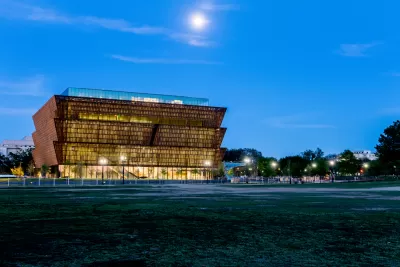
Inga Saffron offers a positive review of the new of National Museum of African American History and Culture, opening on September 24 on the National Mall in Washington, D.C., in a location overlooking the Washington Monument.
Designed by Tanzanian-born superstar David Adjaye and Central High grad Philip Freelon - two of a tiny contingent of black architects working in the U.S. - the stunningly radiant building is unlike anything else on the mall, or, for that matter, anything else in official Washington.
Saffron begins by noting the absence of African-American history along the National Mall, and in the rest of Washington, D.C., saying the museum makes up for that omission.
Of all the civic buildings that dot the park and its environs, the museum is the only one not weighed down by a quarry's worth of stone, most of it white. Instead, in a refreshing break from tradition, the architects have fashioned the African American museum out of glass and wrapped it in a lacy metal scrim the color of dark honey. The scrim rises in three angled tiers that suggest both a traditional African crown and America's celebrated waves of amber grain.
Not lost on Saffron is the museum's proximity to the Washington Monument—which honors the father of the country, who also happened to be a slave owner. Saffron's review gets into the mechanics of the building, and notes some of the political obstacles it had to overcome to take its place on the National Mall. This Pulitzer Prize-winning critic, however, obviously believes that the museum makes a fitting contrast to its neighboring cultural institutions.
If that review hasn't sated your thirst for the architectural and engineering details of the new museum, another article by Annys Shin has more.
Read the full story: Changing Skyline: With new D.C. museum, the African American story moves to nation's main stage

Reviving the National Mall
After receiving thousands of comments and suggestions, planners in Washington D.C. have narrowed options down to five plans for remaking the National Mall.
A Mall Any City Could Love
The long-term planning principles that have made the National Mall a successful and adaptable public space were in the spotlight during the Inauguration. Cities should take a lesson, argues Christopher Hawthorne.

From robotaxis to robotrains: LA, DC weigh driverless transit
If approved, the projects will take years to implement and face financial and technical hurdles.

Planetizen Federal Action Tracker
A weekly monitor of how Trump’s orders and actions are impacting planners and planning in America.

California plans to bury El Niño’s downpour
If the state plays its cards right, it may be able to store a billion acre-feet of El Niño’s water in aquifers.

Desperate measures: Advocates weigh draining Lake Powell to fill Colorado River
Draining the reservoir could reduce evaporation losses by a couple hundred thousand acre-feet.

How a Chicago-sized wind farm beat the odds and powered on
The project spanned five presidential administrations and a standoff with a U.S. military base.

MTA gives itself 30 days to transform pit into basketball court
The site has been under construction since 2022; the city originally estimated it would finish the court in 2024.

Non-stop party: Chicago voters weigh permanent festival grounds
A stable place for bleachers, stages and drainage may streamline the setup and teardown of large events.

FREE Course: Walkable City 1: Why Walkability?
After describing his path towards focusing on walkability as the essence of good planning, Jeff Speck marches through his five principal reasons for making more walkable places.
Reinventing Malls: Planning Alchemy—Turning Gray Fields Into Gold
The course focuses on the opportunities and imperatives that shape reinvention of mall sites.

City of Rosemead
Rutgers University, Edward J. Bloustein School of Planning and Public Policy
One Hundred Miles
Hunter College, City University of New York (CUNY)
The Architects Foundation
University of Cincinnati Online
City of Cambridge
Montrose County
The Pocatello Development Authority