About 6,500 apartments in 19 towers within 10 square blocks on Flatbush Avenue are expected to be available within two years, but don't expect rents to plunge. Renters should look for perks like one or more months of free rent.


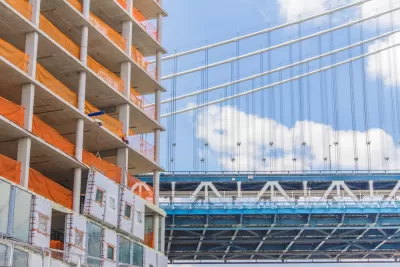
The section of Flatbush Avenue that is seeing intense development stretches from Barclays Center north to Myrtle Avenue.
"There are so many new apartments in the neighborhood — roughly one-fifth of all rental units expected to become available in the city in 2016 and 2017, according to Nancy Packes Data Services, a research firm — that the Brooklyn rental market seems poised to zoom right past boom, to glut," reports Charles V. Bagli, who "covers the intersection of politics and real estate" for The New York Times. "Another four buildings on Myrtle Avenue will add almost 1,000 more units."
Developers and consultants are not predicting that rents will plunge, but they do expect them to stagnate and perhaps ease in the short term.
Is Supply Finally Coming to Rescue the Rental Market? Only on the high-end. And it won't last.
Bagli describes the generous incentives, usually in the form of one, two, or even three months of free rent offered to those who sign leases for high-end apartments, in some ways similar to what is being seen is some new apartments coming on-line in San Francisco.
At 7 DeKalb, a new 23-story tower atop the City Point mall complex, the landlord is offering two months of free rent with a 14-month lease, and use of the building’s fitness center and other amenities for a year without charge. That means a one-bedroom, one-bathroom place can be had for $3,428 a month; a two-bedroom, two-bath apartment goes for $5,057.
In some ways, the effect of the construction here is mirroring the 'market correction' that happened earlier this year across the East River. But the saturation is not seen in the housing market as a whole.
“It’s too many units skewed to the upper end of the market,” above $3,500 a month in rent, stated Jonathan J. Miller, president and chief executive of Miller Samuel, a real estate appraisal and consulting firm. “The top of the market is soft for both rentals and condos. That’s where the bulk of the new supply is coming.”
Ironically, what is in part driving the market is the city's tax incentive program to stimulate development of low and moderate income housing.
[N]early one-quarter of the apartments — a total of 1,654 units — in the Flatbush corridor are reserved for low-, moderate- and middle-income tenants under the city’s 421-a housing program, which offered developers generous property tax breaks for setting aside 20 percent of a project’s apartments for such tenants.
At the Hub, a 56-story tower at 333 Schermerhorn Street with 750 apartments [which will be the borough's tallest building], 150 units are subsidized for poor and working-class families, while 76 of the 379 rentals at 300 Ashland Place and 200 of the 250 units at 7 DeKalb Avenue are set aside for below-market tenants.
Bagli report that the 421-a program will end in January, and consequently the "construction of rental buildings [is] expected to fall to almost zero in 2018."
Hat tip to Mark Boshnack.
Read the full story: ‘The Market Is Saturated’: Brooklyn’s Rental Boom May Turn Into a Glut

Vacancies Come in All Forms, Even New Affordable Apartments in Brooklyn
A 298-unit, 18-story tower in Pacific Park Brooklyn opened its doors to new renters in various categories of affordability over five months ago. 27% remain empty in the higher income tiers, and unlike market-rate units, the asking rent won't drop.
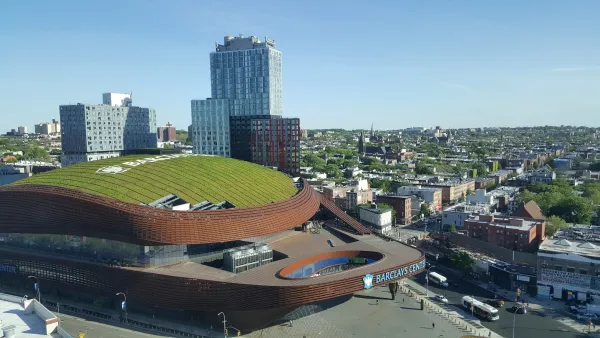
NYC's New Atlantic Yards Plan Would Bring Taller Towers and Raise Income Limits
The area around Barclays Center could get 10,000 new housing units, with those deemed affordable available to households making as much as $200,000.
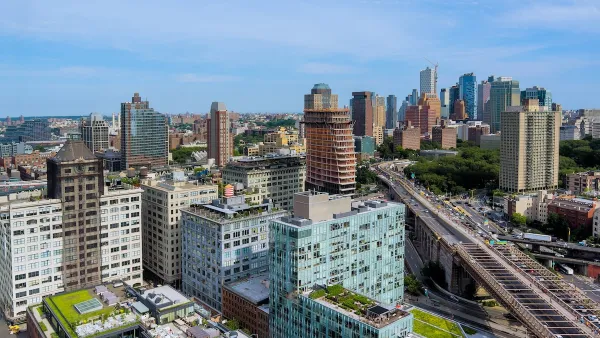
Brooklyn Built 3,700 Homes in 6 Months — and It’s Nowhere Near Done
Since its rezoning in 2004, downtown Brooklyn has added close to 27,000 new housing units.

Planetizen Federal Action Tracker
A weekly monitor of how Trump’s orders and actions are impacting planners and planning in America.

Amtrak, CN end decades-long dispute with eight-year agreement
The new operating agreement establishes an updated framework for the companies to work together, including processes to resolve disputes.

Judges permit Denver to divert 77,000 acre feet from the Colorado River for reservoir expansion
Overuse and climate change have caused the Colorado River’s water levels to plummet.

How ‘post-disaster gentrification’ alters neighborhoods after natural calamities
After hurricanes, fires or other calamities, the original residents of a community are often replaced by younger, wealthier residents.

Maryland local governments examine if they should have more power to raise property taxes
Maryland’s housing market is out of reach for the majority of moderate-income residents.

Northwest rail fans eager for Sept. 30 debut of Amtrak’s Airo fleet
Get ready for that new train smell and more seats. But they won’t go faster or run more frequently on the Cascades route in Washington and Oregon.

FREE Course: Walkable City 1: Why Walkability?
After describing his path towards focusing on walkability as the essence of good planning, Jeff Speck marches through his five principal reasons for making more walkable places.
Reinventing Malls: Planning Alchemy—Turning Gray Fields Into Gold
The course focuses on the opportunities and imperatives that shape reinvention of mall sites.


Harvard University Graduate School of Design
KFH Group Inc.
Greater Baltimore Committee
The Architects Foundation
University of Cincinnati Online
The Pocatello Development Authority
The Urban Renewal Agency of the City of Pocatello