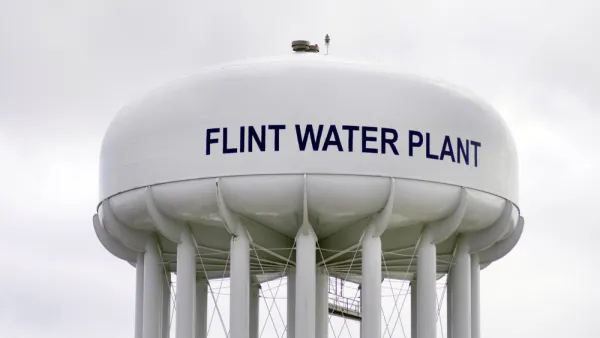
There's good but guarded news on drinking water. Lead levels are lower, below the federal action threshold, but residents are advised not to drink it without using filters. A federal state of emergency in effect since January was lifted Sunday.



Researchers from Virginia Tech with Flint residents conducted 162 random sampling of drinking water obtained from Flint homes in July. Their findings for lead, Legionella, water heater study, and disinfection by-products were released August 11.
Good news!
"The 90th percentile level for lead was 13.9 ppb," reports Rebecca Williams, environment reporter for Michigan Radio, an NPR member station. "This is below the EPA action level of 15 ppb."
“Things are dramatically better now,” said Marc Edwards, the Virginia Tech environmental engineering professor who played a key role in bringing the lead crisis to the nation's attention last year.
By comparison, sampling in August, 2015 showed 28.7 ppb and results in March, 2016 were 22.5 ppb. [See slide 13, page 13/47.]
"This is nearing the end of the beginning of the end of the public health disaster response," said Edwards, a MacArthur Foundation fellow. "Flint water now looks like it’s entering a range that’s considered normal for other U.S. cities."
But before you drink the water....
"Kelsey Pieper, a postdoctoral fellow at Virginia Tech, said their sampling pool is a random sample of homes and does not specifically target the highest risk homes for lead," adds Williams. "So, while their results show the homes they tested are below the action level, it’s not an official result that would qualify under the EPA’s Lead and Copper Rule."
"Residents certainly should continue using bottled water and filters until notification from the Environmental Protection Agency or the state — no one is saying the water is safe," added Edwards in the Virginia Tech News.
End of federal state of emergency
"With the end of the emergency, the state will now be responsible for all the costs associated with getting clean water to Flint citizens and running the city's eight community stations (the federal government covered 75 percent of the costs, and the state was responsible for 25 percent during the January to August Federal State of Emergency)," reports the Detroit Metro Times. President Barack Obama had declared a state of emergency on January 16 in response to a request by Gov. Rick Snyder.
Roots of crisis
The lead crisis began when the state-appointed emergency manager for the city of 102,000, 57 percent African American, made the fateful decision in April 2014 by going off the Detroit drinking water system, which draws from Lake Huron and switch to the Flint River to save money, without adding an anti-corrosive ingredient. See Michigan Radio's timeline on the crisis beginning July 2011.
After switching back to Lake Huron water last October, Flint took the first step to alleviating the crisis by 'coating the pipes' with the "chemical phosphates that were missing from the water between April 2014 and October 2015, because of mistakes by the Michigan Department of Environmental Quality(MDEQ) and City of Flint," notes the January 30 post.
The lack of corrosion controls allowed corrosive Flint River water to carry away lead from pipes, joints and fixtures. Over time, Gov. Rick Snyder said, the phosphates will build up a protective coating between the pipes and the water they carry, making them capable of delivering safe drinking water.
Ongoing investigation
In April, two state officials in MDEQ and a Flint water plant administrator were criminally charged in the lead crisis. On July 29, six additional state employees were charged, reports CNN. "The allegations show a concerted effort to cover up warning signs of lead poisoning, according to prosecutors."
Lead pipe replacement?
"Many buildings and homes still have lead pipes, which health officials say need to be replaced, but that will take time," reports PBS. “It might very well, across the country, take 100 years before we get all the lead plumbing out,” said Edwards.
Read the full story: Virginia Tech's latest Flint water tests: not safe to drink, but getting better
How the U.S. Environmental Protection Agency Failed the People of Flint
While blame squarely lays with Michigan state officials, agencies, and possibly Gov. Rick Snyder himself, the EPA also played a role by both detecting the cause of the problem but not acting on the reports of improper treatment of river water.
First Step to Restoring Drinking Water for Flint—Coat the Existing Pipes
Gov. Rick Snyder (R-Mich.) announced on Wednesday that the state is working to ensuring safe tap water for Flint residents. While there is no schedule to replace the corroded lead pipes, they are being treated to prevent further lead leaching.
1,700 Flint Residents Sue U.S. EPA for $722 Million in Damages
Flint residents are suing the U.S. Environmental Protection Agency for damages caused by exposure to lead in the city's drinking supply.

Planetizen Federal Action Tracker
A weekly monitor of how Trump’s orders and actions are impacting planners and planning in America.

California plans to bury El Niño’s downpour
If the state plays its cards right, it may be able to store a billion acre-feet of El Niño’s water in aquifers.

Desperate measures: Advocates weigh draining Lake Powell to fill Colorado River
Draining the reservoir could reduce evaporation losses by a couple hundred thousand acre-feet.

Chicago voters approve permanent festival grounds, penalty for vacant property owners
Currently, major summer and fall festivals take over public parks for weeks at a time, drawing criticism from nearby residents

NYC votes to cut outdoor dining red tape, speed up permitting
New York City also voted to allow the Department of Transportation to begin work on urgent projects before notifying elected officials.

California appears to reject Prop. 45
The proposition would have expanded the projects that qualify for a streamlined environmental review, effectively paring down the California Environmental Quality Act.

FREE Course: Walkable City 1: Why Walkability?
After describing his path towards focusing on walkability as the essence of good planning, Jeff Speck marches through his five principal reasons for making more walkable places.
Reinventing Malls: Planning Alchemy—Turning Gray Fields Into Gold
The course focuses on the opportunities and imperatives that shape reinvention of mall sites.

City of Rosemead
Rutgers University, Edward J. Bloustein School of Planning and Public Policy
One Hundred Miles
Hunter College, City University of New York (CUNY)
The Architects Foundation
University of Cincinnati Online
City of Cambridge
Montrose County
The Pocatello Development Authority