The eagerly anticipated selection of the future site of the Obama Presidential Library has leaked to the press. A formal announcement is expected soon.


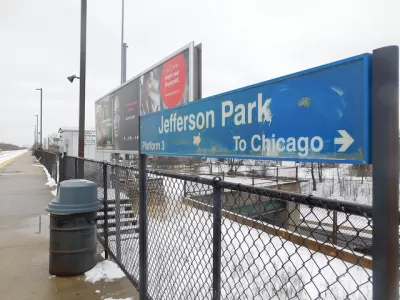
"President Barack Obama and first lady Michelle Obama have selected historic Jackson Park, just east of the University of Chicago, as the site for the Obama Presidential Center," reports Kathy Bergen, Blair Kamin, and Katherine Skiba for the Chicago Tribune.
The news comes via a source, and an official announcement is not expected until possibly next week.
In the meantime, the Tribune reporters imagine the possibilities:
Located near the Museum of Science and Industry, the lakefront and the eastern edge of the University of Chicago campus, the site allows for the creation of a museum campus in the heart of the park, accented by an existing lagoon, lush woods and greenery. The winding 543-acre park is an oasis on the South Side. The center would be a short hop to either Lake Shore Drive or to two Metra train stations, strong pulls for visitors.
The article also discusses the potential for the Obama Library to revitalize the nearby neighborhood of Woodlawn, which "has seen decades of unfulfilled promises for redevelopment" and "has tracts available for nearby projects."
The breaking news has been flying fast with regard to the Obama Library. At the end of June, the Obama Foundation announced the selection of Tod Williams Billie Tsien Architects | Partners (TWBTA) to design the library.
Read the full story: Obama chooses historic Jackson Park as library site

Obama's Presidential Center Raises Displacement Concerns
As the former president seeks to distinguish the Obama Presidential Center from for-profit development, many locals still want to see a binding community benefits agreement.
Land Swap could Bring Obama Presidential Library to Chicago's South Side
Chicago is putting the pieces in place to land the Obama Library. One proposal hinges on the availability of parkland on the South Side near the University of Chicago.
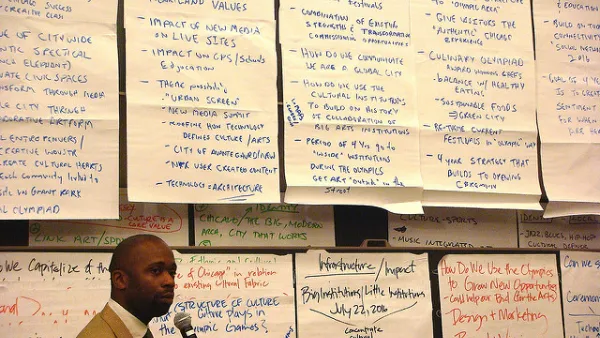
Creative Placemaking a Boon for Underserved Communities, Report Says
The work of Chicago urban planner and developer Theaster Gates provides a proof of concept in a new report from the Urban Land Institute.

Planetizen Federal Action Tracker
A weekly monitor of how Trump’s orders and actions are impacting planners and planning in America.

California plans to bury El Niño’s downpour
If the state plays its cards right, it may be able to store a billion acre-feet of El Niño’s water in aquifers.

Desperate measures: Advocates weigh draining Lake Powell to fill Colorado River
Draining the reservoir could reduce evaporation losses by a couple hundred thousand acre-feet.

Mamdani’s pied-à-terre tax survives legal challenge
A panel of judges found that the plaintiffs failed to demonstrate injury as a result of New York City's implementation of the tax.

Eastern Nebraska is running out of electricity
Data centers and electrification are straining eastern Nebraska’s grid, throttling economic development.

Seattle passes record-breaking transit services expansion
Proposition 1 will double the city’s transit tax to add 95,000 more bus trips and preserve 180,000 bus trips annually.

FREE Course: Walkable City 1: Why Walkability?
After describing his path towards focusing on walkability as the essence of good planning, Jeff Speck marches through his five principal reasons for making more walkable places.
Reinventing Malls: Planning Alchemy—Turning Gray Fields Into Gold
The course focuses on the opportunities and imperatives that shape reinvention of mall sites.

City of Rosemead
Rutgers University, Edward J. Bloustein School of Planning and Public Policy
One Hundred Miles
University of Michigan School for Environment and Sustainability (SEAS)
Hunter College, City University of New York (CUNY)
The Architects Foundation
City of Cambridge
Montrose County
The Pocatello Development Authority