A group of "citizen data scientists" produced a predictive analytic model that offers citizens better information about water quality on beaches along Lake Michigan in Chicago.



"Chicago is piloting an analytical model to enhance its Park District’s regular beach water quality inspection process," reports Sean Thornton.
"The model aims to predict which beaches may need to close based on likely E. Coli contamination, which will help protect the public by providing more timely advisories," adds Thornton for more detail on the predictive analytics model and its need.
Not only does this predictive analytics model provide a useful example for other cities with similar environmental circumstances, the process that produced the tool is also worth noting. The model was built entirely by volunteers from Chicago's civic tech community. In this case, the model grew from the weekly Chi Hacknight event. Thornton details the process and the people that produced the new beach quality predictive analysis model, thus modeling an example of cooperation between government and civic tech communities to be duplicated in other cities around the country.
Read the full story: Taking Predictive Analytics to the Beach

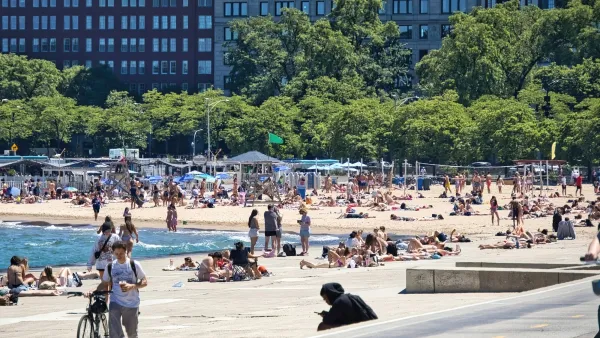
Chicago residents love their 'concrete beach'
A concrete seawall is a popular swimming and sunbathing location for locals.

Chicago River Clean Enough for Swimming for the First Time in 98 Years
A historic two-mile river race through downtown highlighted the success of decades-long efforts to clean up the city’s river.

How Smart Cities Influence Real Estate Investment
By integrating technology and infrastructure, smart cities are attracting investors with their potential for improved quality of life, efficient resource management, and innovative urban development projects.

Planetizen Federal Action Tracker
A weekly monitor of how Trump’s orders and actions are impacting planners and planning in America.

Amtrak, CN end decades-long dispute with eight-year agreement
The new operating agreement establishes an updated framework for the companies to work together, including processes to resolve disputes.

Judges permit Denver to divert 77,000 acre feet from the Colorado River for reservoir expansion
Overuse and climate change have caused the Colorado River’s water levels to plummet.

Atlanta City Council unanimously backs $3.5 billion Beltline light rail project
The resolution was drafted after Atlanta Mayor Andre Dickens pulled support for the Atlanta Streetcar extension last year.

SEPTA to bring nearby frequent transit to over 1 million new riders as part of decade-long plan
The agency's Accelerate plan will also bring frequent transit to twice the amount of jobs that are currently located near it.

NYC plants over 18,000 trees, the most new foliage in a decade
Many of the trees were planted in communities vulnerable to extreme heat.

FREE Course: Walkable City 1: Why Walkability?
After describing his path towards focusing on walkability as the essence of good planning, Jeff Speck marches through his five principal reasons for making more walkable places.
Reinventing Malls: Planning Alchemy—Turning Gray Fields Into Gold
The course focuses on the opportunities and imperatives that shape reinvention of mall sites.

City of Thousand Oaks
City of Wisconsin Rapids
Harvard University Graduate School of Design
The Architects Foundation
University of Cincinnati Online
The Pocatello Development Authority
The Urban Renewal Agency of the City of Pocatello