A Tampa Bay Times columnist continues a crusade against the faulty projections that enable toll road construction projects in Florida, and the sprawling development patterns that follow.



"State officials justify a $6 billion interstate project by making a bold claim: It will ease gridlock throughout the Tampa Bay area," according to an article by Craig Pittman.
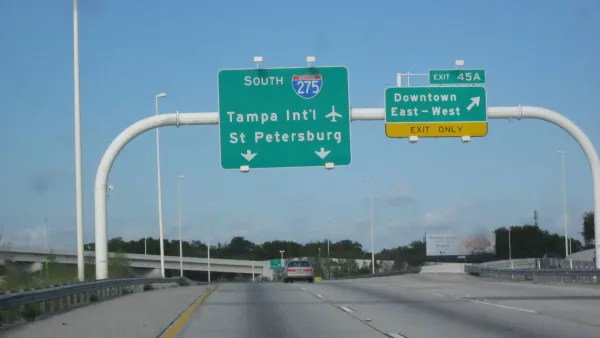
The Florida Department of Transportation is making those big claims for the Tampa Bay Express, a $6 billion toll road that would add 90 miles of toll lanes to highways in Pinellas and Hillsborough counties. But according to Pittman, project planners have yet to produce traffic volume projections for the proposal. Moreover, according to Pittman, looking at the track record of the statd in building toll roads, "the forecast is almost certain to show that TBX will make money and ease congestion," and, "It will also most likely be wrong."
To prove that simple claim, Pittman only need look to the name of one of the companies paid to generate traffic projections for the project: Aecom. Aecom recently acquired long-time traffic projections consultant URS. According to Pittman, both have a track record of inaccurately projecting future traffic volumes. Pittman reported the details of that spotted track record for a similar story earlier this year—that time with the setting of Citrus County and a project called the Suncoast Parkway.
According to Pittman, the faulty projections used to justify toll road projects are hardly unique to the state of Florida, or the group of consultants it relies on to produce these numbers. The in-depth coverage inspired by the Tampa Bay Express example also ranges to other states, and examines the political context that enables this project and others like it.
Read the full story: Why the outlook for Tampa Bay's $6 billion highway expansion is hazy

Environmentalists Urge Gov. Ron DeSantis to Veto Florida Toll Roads Bill
Florida has the distinction of having more toll roads than any other state. Environmentalists want Gov. DeSantis (R) to veto a bill that would build three new ones, adding over three hundred miles of asphalt through mostly rural, unpopulated areas.
Toll Road Cautionary Tale: Florida's Suncoast Parkway
The Suncoast Parkway has produced $22 million a year in revenue after a consultant said it would bring in $150 million a year. Yet the Florida Department of Transportation wants to expand the road.
An In-Depth Look at the Indiana Toll Road Bankruptcy
Angie Schmitt and Payton Chung have created a three-part series on the Indiana Toll Road and how its example informs the use of private finance to build and maintain highways.

Planetizen Federal Action Tracker
A weekly monitor of how Trump’s orders and actions are impacting planners and planning in America.

Northwest rail fans eager for Sept. 30 debut of Amtrak’s Airo fleet
Get ready for that new train smell and more seats. But they won’t go faster or run more frequently on the Cascades route in Washington and Oregon.

Trump is considering data centers on 6 states' public land — some state officials say they had no idea
If the administration approves the proposed projects, data center and data center-related developments will cover 17,600 acres of public land.

After decades of planning, Sacramento gains new light rail station
Trains will arrive every 15 minutes during peak hours and every 30 minutes during non-peak hours.

Massive tunnel-boring machine breaks ground on Gateway Project
The Trump administration revoked funding for the project in October 2025, and then restored it earlier this year.

Airo trainsets begin service on Amtrak Cascades route
The trains feature panoramic windows, complementary wifi and over 300 seats per train set.

FREE Course: Walkable City 1: Why Walkability?
After describing his path towards focusing on walkability as the essence of good planning, Jeff Speck marches through his five principal reasons for making more walkable places.
Reinventing Malls: Planning Alchemy—Turning Gray Fields Into Gold
The course focuses on the opportunities and imperatives that shape reinvention of mall sites.

City of Thousand Oaks
City of Wisconsin Rapids
Harvard University Graduate School of Design
The Architects Foundation
University of Cincinnati Online
Northern Illinois Transit Authority (NITA)
The Pocatello Development Authority
The Urban Renewal Agency of the City of Pocatello