As cities around the U.S. scramble to figure out how to address the housing affordability crisis, one of them has now leaned on the benevolence of what some consider the least benevolent of them all.


As cities around the U.S. scramble to figure out how to address the housing affordability crisis, one of them has now leaned on the benevolence of what some consider the least benevolent of them all.
Amazon, the world’s largest online retailer, declared Seattle (specifically its South Lake Union district) its new home several years ago, and began moving employees in last year. The corporation’s planned campus, to consist of three towers and at least 20 other office buildings, will bring more than 20,000 jobs to Seattle. Amazon’s presence has already propelled smaller tech startups (and big tech company, Google) to set up shop, and the buying and building frenzy that continues to ensue caused the mayor to declare a “housing state of emergency” last year in what is now the country's 4th-fastest growing city.
Amazon's move to this once-desolate neighborhood in Seattle has been the catalyst for the largest number of residential permit applications since 1984, according to The New York Times, and its masses of employees have attracted food trucks and other small business activity in and around the district.
Ironically, Seattle’s attractiveness to the tech sector is in part due to the fact that housing in the Bay Area—the nation’s largest tech hub—has become too pricey, and more and more people in the field are fleeing to what they consider more affordable housing in Seattle.
The relativity of “affordable” comes into play, as the city was not overflowing with housing to begin with, and now the influx of people with deeper pockets has caused many low- to moderate-income city residents to feel the pressure of rising rents, and the city to face a surging homeless population. A January 2016 homeless count in Seattle and Kings counties reported 4,505 individuals living unsheltered, including about 400 families.
FULL STORY: Did Amazon Really Just Create a Pop-up Homeless Shelter?

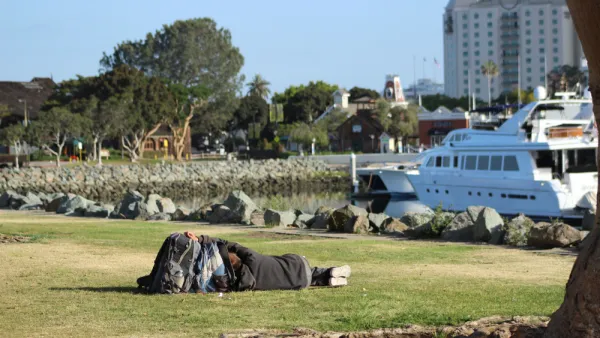
San Diego Not Even Close to Meeting Permanent Housing Goals for Homeless
The city’s new $6.5 million "bridge shelters" are providing a place to stay, but not accomplishing what they set out to do.

Seattle's Homeless Population Is Booming Too
While rates of homelessness drop elsewhere, tents and cardboard are becoming a very regular sight in Seattle. New wealth and newly unaffordable housing may be twin culprits.
California Cities Continue Fight Against State Preemption
Lafayette City Council Member Susan Candell penned an op-ed in support of a lawsuit to invalidate Senate Bill 9 by four Southern California cities, highlighting a recent supportive court filing by UCLA economic geographer Michael Storper.

The state-sanctioned urbicide of Austin
People don’t kill cities. Freeways do.

US to reduce Colorado River water deliveries to Mexico
A new Colorado Treaty amendment reduces Mexico’s Colorado River water allocation by 250,000 acre feet.

New Jersey’s second-largest city bans standalone data centers
Jersey City will continue to allow co-location facilities, such as those meant for research institutions that store their own data.

Amtrak not solely to blame for New Jersey commuter rail's unreliability, report finds
A new study from the Garden State Initiative found that NJ Transit’s budget grew 20% across a 4 year period, but reliability declined significantly over the same period.

EPA erases limits on planet-warming pollution from power plants
Under Monday’s plan, power plants would still have some limits on how much mercury, arsenic and other contaminants they can emit.

Phoenix announces new on-demand transit service, more frequent RAPID buses
Both new services will launch in October, and are part of Phoenix's Project Effective Access Solutions for Easing Congestion.

FREE Course: Walkable City 1: Why Walkability?
After describing his path towards focusing on walkability as the essence of good planning, Jeff Speck marches through his five principal reasons for making more walkable places.
Reinventing Malls: Planning Alchemy—Turning Gray Fields Into Gold
The course focuses on the opportunities and imperatives that shape reinvention of mall sites.

Eagle County Government
Harvard University Graduate School of Design
Nashville Planning Department
The Architects Foundation
University of Cincinnati Online
The Pocatello Development Authority
The Urban Renewal Agency of the City of Pocatello
Journal of the American Planning Association