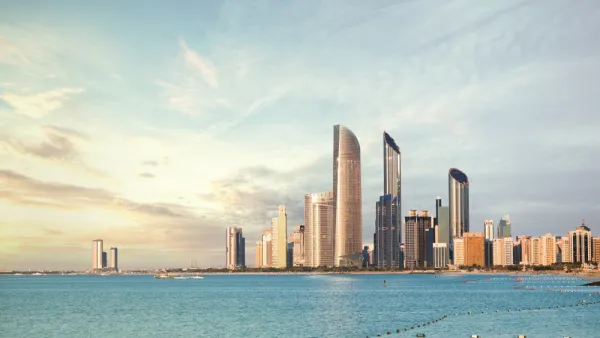
Building a new eco-friendly city in the middle of a country so reliant on fossil fuels is no easy task, but development is well underway for Masdr City to rise in the UAE



Located near Abu Dhabi's airport, along it's southern edge, and just a 45-minute drive from Dubai, Masdr City is set to rise over the next five years into what could become a model for future development in the Middle East and elsewhere. Alan Mammoser reports in CNU's Public Square Journal that the Masdr company, a government development corporation of the UAE, has partnered with MIT on the planning for the new city, which will combine modern and traditional planning practices to create a sustainable city that utilizes street patterns to funnel cooler air, in the model of old-Cairo and Muscat.
As a city built on a grid that gathers natural breeze, linked internally and externally by transit, and with an educational institute at its center, Masdar will strive to be what planners call a complete community. “It will be a place where lifelong learning is possible,” says Chris Wan, “and where ongoing innovation will occur.” Wan, a Hong Kong native who studied architecture in Britain, is contributing to that now, with his participation in the development of an “Eco-Villa”. The prototype house, requiring 42% less energy than a typical new house in Abu Dhabi, will be a model for residential builders in the city. When equipped with solar panels it can achieve “net zero” energy consumption.
Read the full story: New eco-city combines ancient practice and modern technology

Largest Desalinated Water Reserve Ever Unveiled in Abu Dhabi
The UAE has created a storage facility under the desert that can provide up to 100 million liters per day in the event of an emergency.
Connecting Residents With Services in Abu Dhabi Master Plan
The revitalization master plan for two older neighborhoods in Abu Dhabi includes creating "new roads, clinics, schools, police stations and neighborhood centers" and making them easily accessible to residents.
The State of Development in Abu Dhabi and Doha
Nicolai Ouroussoff, architecture critic for The New York Times, offers this lengthy look at the state of development and design in Abu Dhabi and Doha.

Planetizen Federal Action Tracker
A weekly monitor of how Trump’s orders and actions are impacting planners and planning in America.

Amtrak, CN end decades-long dispute with eight-year agreement
The new operating agreement establishes an updated framework for the companies to work together, including processes to resolve disputes.

Judges permit Denver to divert 77,000 acre feet from the Colorado River for reservoir expansion
Overuse and climate change have caused the Colorado River’s water levels to plummet.

NYC DOT wants faster, more permanent street upgrades
The city is examining ways to build more concrete infrastructure without getting entangled in 'decades-long' projects.

'Something we’ve never seen before:' rising utility rates could strain city finances nationwide
Data centers, climate change and other factors have caused utility rates in the United States to increase by 38% since 2020.

Trump to overrule local leaders, lease millions of acres of America’s Pacific Island territories’ seafloors to mining companies
International law says that the Indigenous people of America’s territories have a right to prior and informed consent regarding projects that impact their countries.

FREE Course: Walkable City 1: Why Walkability?
After describing his path towards focusing on walkability as the essence of good planning, Jeff Speck marches through his five principal reasons for making more walkable places.
Reinventing Malls: Planning Alchemy—Turning Gray Fields Into Gold
The course focuses on the opportunities and imperatives that shape reinvention of mall sites.

Harvard University Graduate School of Design
KFH Group Inc.
Greater Baltimore Committee
The Architects Foundation
University of Cincinnati Online
The Pocatello Development Authority
The Urban Renewal Agency of the City of Pocatello