It's not your typical walking tour: A resident-led project in Wilkinsburg, Pennsylvania explores the history of a community through its blighted properties.


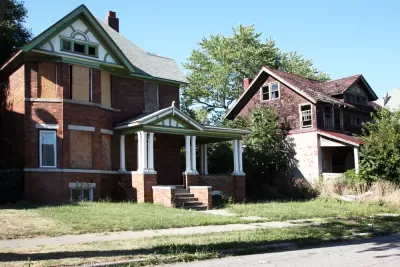
Founded by Carnegie Mellon students in 2014, the Vacant Home Tour tells the story of blighted properties in Wilkinsburg—a borough of 2.3 square miles with nearly 800 vacant parcels.
Each year, residents volunteer to research the history of vacant properties on the route, put together resources and workshops, and act as tour guides for other community members.
One aim of the project is to "dematerialize" the empty structures, reorienting tour-goers to the human value of former homes. In a Q&A with the Center for Community Progress, organizer Marita Garrett explains:
When people drive or walk by a boarded up home, that’s all they see. By sharing the stories of these homes — the people who lived in them, the businesses they ran in the business district, the holidays that were celebrated in the home, the children that grew up there, the architectural details that made each property so full of character, the gardens that grew in the yard — the Vacant Home Tour aims to honor the value of these properties regardless of what the future holds for [them] (restoration, demolition, or continued vacancy).
Residents old and new—including some featured properties' former occupants—participate in the tour as both guides and visitors, enabling a community-wide conversation about the neighborhood’s past and future. Another key goal of the project is to "reframe the issue of blight as an opportunity rather than a problem," Garrett says:
Blight negatively affects communities, not just because it’s dangerous, but because it can make residents feel hopeless. For those of us who weren’t there during its heyday, it’s hard to imagine Wilkinsburg ever had a heyday. But that’s why preserving that history and that narrative is so important. Wilkinsburg was once the most affluent communities in southwestern PA, so what happened? How can it come back? How can it come back in a way that is equitable for all people? And how can we prevent communities from this type of drastic decline in the future? These are the questions that the Vacant Home Tour raises, and though we don’t have the answers, we are starting the discussion.
Read the full story: Vacant Home Tour changes the conversation around vacancy in Wilkinsburg
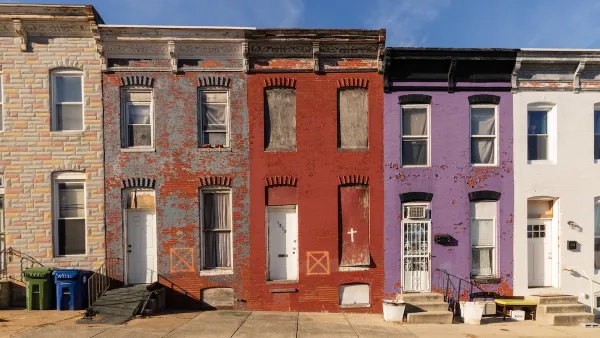
Baltimore Program Could Repurpose Thousands of Vacant Housing Units
The city and state are investing $3 billion in rescuing vacant residential properties to promote homeownership and reduce blight.
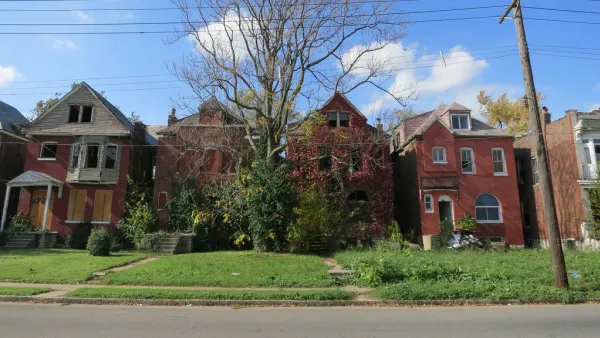
Why Did a 'Mysterious' Company Buy Hundreds of Properties in St. Louis?
Over the course of a year beginning in June 2008, a 'mysterious holding company' named Urban Assets bought 240 parcels across a five-mile swath of the north side of St. Louis. Since then, it's just let them decay.
Whither Vacant Buildings?
Officials in Fort Worth, Texas, are searching for ways to deal with buildings left vacant by businesses struggling during the recession. Other cities and the state of Texas are also addressing the issue.

Planetizen Federal Action Tracker
A weekly monitor of how Trump’s orders and actions are impacting planners and planning in America.

California plans to bury El Niño’s downpour
If the state plays its cards right, it may be able to store a billion acre-feet of El Niño’s water in aquifers.

Desperate measures: Advocates weigh draining Lake Powell to fill Colorado River
Draining the reservoir could reduce evaporation losses by a couple hundred thousand acre-feet.

Los Angeles just elected an urban planner as its mayor
Transportation analysts are optimistic that Raman will be more aggressive in addressing transit issues than Bass.

Mamdani’s pied-à-terre tax survives legal challenge
A panel of judges found that the plaintiffs failed to demonstrate injury as a result of New York City's implementation of the tax.

Eastern Nebraska is running out of electricity
Data centers and electrification are straining eastern Nebraska’s grid, throttling economic development.

FREE Course: Walkable City 1: Why Walkability?
After describing his path towards focusing on walkability as the essence of good planning, Jeff Speck marches through his five principal reasons for making more walkable places.
Reinventing Malls: Planning Alchemy—Turning Gray Fields Into Gold
The course focuses on the opportunities and imperatives that shape reinvention of mall sites.

City of Rosemead
Rutgers University, Edward J. Bloustein School of Planning and Public Policy
One Hundred Miles
University of Michigan School for Environment and Sustainability (SEAS)
Hunter College, City University of New York (CUNY)
The Architects Foundation
City of Cambridge
Montrose County
The Pocatello Development Authority