Anti-transit advocates in Seattle got ammunition this week from an article about the party thrown by Sound Transit to celebrate the recent opening of the light rail extension from downtown to Capitol Hill and the University of Washington.


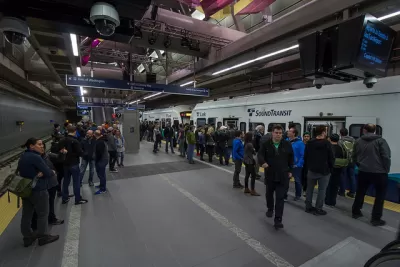
"In all, taxpayers spent $858,379 for Sound Transit’s March 19 grand-opening party for the Capitol Hill and UW stations," reports Mike Lindblom.
Of that bill, $209,436 went to crowd management, $29,520 went to police overtime, $260,000 went to event management, and $130,198 went to a multi-media advertising campaign. In all, planning for the event took a year's time.
Inspiring the Seattle Times' coverage is the organization Smarter Transit, whose co-founder is quoted in the article talking about how the party was designed to launch the campaign for the Sound Transit 3 ballot measure.
Prior to Lindblom's critical take on the event's costs, the reports on the new light rail line had only been positive—noting the project's on-time and under-budget delivery, as well higher-than-expected ridership in its early days.
The Capitol Hill Seattle blog was quick to push back on Lindblom's article, noting that Sound Transit spends a lot of money for advertising, including a lot of money to Lindblom's Seattle Times. Capitol Hill Seattle blog's argument is that the Seattle Times coverage cherry-picked its evidence in the pursuit of a specific, anti-transit argument.
FULL STORY: Party at UW, Capitol Hill light-rail stations cost taxpayers $858K


Planetizen Federal Action Tracker
A weekly monitor of how Trump’s orders and actions are impacting planners and planning in America.

The state-sanctioned urbicide of Austin
People don’t kill cities. Freeways do.

US to reduce Colorado River water deliveries to Mexico
A new Colorado Treaty amendment reduces Mexico’s Colorado River water allocation by 250,000 acre feet.

5 New England states march closer to 800 megawatt wind energy project
Securing federal approval for the project may be complicated under the Trump administration, which has historically been hostile towards domestic wind power.

Baltimore to break ground on $50 million Transit Priority Project
The project will bring faster bus trips, safer streets and better bike connections to Baltimore.

Airbnb launches $250 million 'last-dollar financing' housing accelerator, makes first investment in Austin
The company will put $6.4 million towards affordable housing development in Texas’ capital.

FREE Course: Walkable City 1: Why Walkability?
After describing his path towards focusing on walkability as the essence of good planning, Jeff Speck marches through his five principal reasons for making more walkable places.
Reinventing Malls: Planning Alchemy—Turning Gray Fields Into Gold
The course focuses on the opportunities and imperatives that shape reinvention of mall sites.

Eagle County Government
Harvard University Graduate School of Design
Nashville Planning Department
The Architects Foundation
University of Cincinnati Online
The Pocatello Development Authority
The Urban Renewal Agency of the City of Pocatello
Journal of the American Planning Association