As the 2016 admission season winds down, thoughts turn to the 2017 application process. For students considering the idea, there are several good reasons to attend graduate school in 2017, and a few that may cause problems later.




As the 2016 admission season winds down thoughts turn to the 2017 application process. For students wanting to go to planning school in the fall of 2017 the process can take nearly a year—investigating programs, compiling applications, waiting for admission decisions, choosing the best offer, and preparing for program. Why would you want to do this? There are several good reasons to go to graduate school, and a few that may cause problems later.
- You have hit a point in your career where you have substantial questions that you need time to answer. Graduate school can give you a structured way to explore topics from the political strategies and ethical approaches to technical tools and participatory processes. I went back to graduate school in the 1980s in part to understand the newish processes of globalization and also to learn how to use a number of statistical methods that had seemed important in projects I had worked on.
- You want to understand the profession of planning better, including its general approach and specialties. Graduate school can provide a structured way to understand planning’s breadth as well as to delve more deeply into one of its specialties.
These are good reasons and the structure of planning programs is meant to help answer questions and foster understanding of the field and its context. Having a cohort of peers to do this with can being a variety of perspectives and also create a network to draw on over the years.
There are other reasons people contemplate going to graduate school, as well. When the job market is difficult applications go up. People applying before they graduate from their undergraduate program may see graduate school as more familiar than the work world. Still others are working and see the need for a credential to confirm their existing skills. For those looking for credentials, statements of purpose may sound like job letters where the applicant already knows everything about planning.
These are not impossible reasons to go to planning school, though if admitted such students are likely to be less satisfied with the experience. These are the ones who may question why they are studying and not maximize the value they might get if fully ready. Part of the role of admissions committees is to try to make sure—from statements of purpose, resumes, and letters of reference—that applicants really are at a stage where they are eager to engage with important issues. Overall, having good reasons for contemplating grad school is a productive place to start.
Over the years, I have provided substantial advice about various phases of the admissions process. Many topics are linked to the bullets on the top of this page.

Getting Into Grad School in Planning
Ten years ago I wrote "Graduate School 2008: Nuts and Bolts of Applying". As deadlines draw near for this year’s round of applications it is a good time to revisit and update this advice.
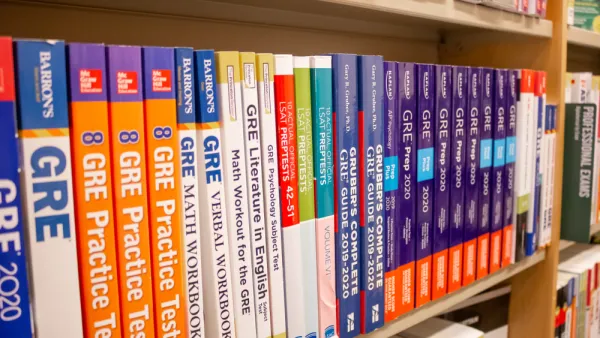
How Much do GREs Matter for Graduate School in Planning?
If you are applying to graduate school in planning, how much do GREs matter? Like many things in planning the answer varies with the person and program. Below I provide some general advice.

There's More Than One Path to AICP Certification
The AICP Candidate Pilot Program launched in 2017 allows for planners to begin the journey to AICP certification earlier in their careers—even while they are still in school.

Planetizen Federal Action Tracker
A weekly monitor of how Trump’s orders and actions are impacting planners and planning in America.

California plans to bury El Niño’s downpour
If the state plays its cards right, it may be able to store a billion acre-feet of El Niño’s water in aquifers.

Desperate measures: Advocates weigh draining Lake Powell to fill Colorado River
Draining the reservoir could reduce evaporation losses by a couple hundred thousand acre-feet.

Los Angeles just elected an urban planner as its mayor
Transportation analysts are optimistic that Raman will be more aggressive in addressing transit issues than Bass.

Mamdani’s pied-à-terre tax survives legal challenge
A panel of judges found that the plaintiffs failed to demonstrate injury as a result of New York City's implementation of the tax.

Eastern Nebraska is running out of electricity
Data centers and electrification are straining eastern Nebraska’s grid, throttling economic development.

FREE Course: Walkable City 1: Why Walkability?
After describing his path towards focusing on walkability as the essence of good planning, Jeff Speck marches through his five principal reasons for making more walkable places.
Reinventing Malls: Planning Alchemy—Turning Gray Fields Into Gold
The course focuses on the opportunities and imperatives that shape reinvention of mall sites.

City of Rosemead
Rutgers University, Edward J. Bloustein School of Planning and Public Policy
One Hundred Miles
University of Michigan School for Environment and Sustainability (SEAS)
Hunter College, City University of New York (CUNY)
The Architects Foundation
City of Cambridge
Montrose County
The Pocatello Development Authority

