There are few political third rails in the world of planning like Agenda 21, a nonbinding United Nations resolution often found at the center of planning controversies in the United States.


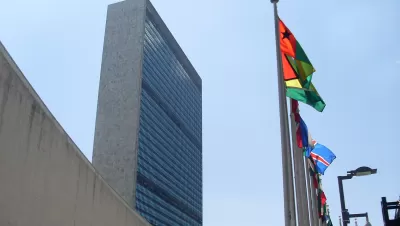
President of the United Nations General Assembly Mogens Lykketoft announced new United Nations Form-Based Code Guidelines today, as part of the recently ratified COP 21 climate agreement.
Lykketoft described the new Form-Based Codes as "Agenda 21 times 2" and said it would "scare people into mixing uses and adding density."
Form-based codes are a relatively new invention of development regulation, relying on issues of form rather than land use as organizing principles.
What could go wrong with adding a new-fangled and complex regulatory scheme to an already controversial international policy directive? A lot, actually, and the United Nations is counting on it.
Lykketoft responded to questions about the potential controversy that would surround the Form-Based Code Guidelines by insisting that Agenda 21 is not a U.N. plot to overthrow the sovereignty of the United States. "It's actually just a U.N. plot to annoy planners," said a noticeably smug Lykketoft before dropping the mic and getting on a private jet with Kanye West.
Read the full story: U.N. Releases 'Agenda 21 Times 2'

Self-Driving Cars Still Can't Recognize the Difference Between a Wedding Planner and an Urban Planner
Pundits agree that planners need to prepare for self-driving cars. Self-driving cars still need to prepare for planners.

Florida Man Thought the New Comp Plan Included Zoning Changes
A Florida man is accused of not realizing an entirely separate process would be required to implement the zoning changes recommended in a recently approved comprehensive plan.

April Fool's Headlines That Didn't Make the Cut
"Who's the more foolish, the fool, or the fool who follows him?"

Planetizen Federal Action Tracker
A weekly monitor of how Trump’s orders and actions are impacting planners and planning in America.

California plans to bury El Niño’s downpour
If the state plays its cards right, it may be able to store a billion acre-feet of El Niño’s water in aquifers.

Desperate measures: Advocates weigh draining Lake Powell to fill Colorado River
Draining the reservoir could reduce evaporation losses by a couple hundred thousand acre-feet.

US buildings threatened, destroyed by fires set to triple by 2060
Researchers found a high fire risk for socioeconomically vulnerable neighborhoods in the American West.

LA residents may be allowed to paint their own crosswalks
Councilwoman Katy Yaroslavsky put out a motion instructing the Los Angeles Department of Public Transportation to study the feasibility of allowing volunteers to paint crosswalks.

Dallas moves to overhaul its zoning code
The city's zoning reform will allow more multi-family and mixed-use developments.

FREE Course: Walkable City 1: Why Walkability?
After describing his path towards focusing on walkability as the essence of good planning, Jeff Speck marches through his five principal reasons for making more walkable places.
Reinventing Malls: Planning Alchemy—Turning Gray Fields Into Gold
The course focuses on the opportunities and imperatives that shape reinvention of mall sites.


City of Rosemead
Rutgers University, Edward J. Bloustein School of Planning and Public Policy
One Hundred Miles
Hunter College, City University of New York (CUNY)
The Architects Foundation
University of Cincinnati Online
City of Cambridge
Montrose County
The Pocatello Development Authority