The unlikely alliance of a ballpark billionaire, tax watchdog, and environmentalists in San Diego circulate a planning ballot initiative that makes an all-too-familiar sacrifice: urban neighborhoods.


A struggle is taking shape in San Diego. It's a struggle oft repeated in the last century of urban development in this country, writes land use attorney and UrbDeZine editor Bill Adams in this opinion piece. It pits the goals of a city-at-large against the aspirations and gains of urban neighborhoods. It's also a struggle of money, race, and ethnicity.
A year and a half ago, the city overrode the Community Plan adopted by Barrio Logan, a predominantly Hispanic urban neighborhood adjacent to downtown, with the highest air pollution and asthma rates in the county. It did so via ballot initiative funded by maritime industries bordering the community resulting in a city-wide election that invalidated the Community Plan buffer between industry expansion and Barrio Logan residents.
Once again, a well-funded planning ballot initiative has been gathering signatures. It would directly impact not only Barrio Logan but also East Village and several adjacent neighborhoods. Again, the ballot initiative excluded input from the impacted neighborhoods—failed even to acknowledge their existence. This ballot initiative is funded by former Padres pro-baseball team owner and downtown developer John Moores / JMI Realty. It is also funded and supported by tax, transparency, and environmental watchdog attorney Cory Briggs. Donna Frye, a former city council member, mayoral candidate, and environmentalist, is also a staunch supporter of the initiative.
The initiative, if passed, accomplishes several goals for its proponents: It brings a convention center expansion, and possibly an NFL stadium, closer to JMI landholdings and hotels. It facilitates the transfer of the old home of the NFL Chargers—Qualcomm Stadium—to San Diego State University. It sets aside park space along the San Diego River at the Qualcomm stadium site. It creates additional funding for coastal access, recreation, and river restoration. It eliminates direct taxpayer stadium funding—it's most admirable ingredient—although it's effect on indirect funding, e.g., as by donation of city property, is murky. It stops expansion of the Convention Center on the waterfront - a coastal access issue (although the impact on coastal access appears minimal). It replaces the expansion with a sub-optimal (from a convention viewpoint) non-contiguous annex. It would also increase the transient occupancy tax on hotel guests—a previously contested issue.
The selling point to the public? It offers the hope of a downtown NFL stadium—the Chargers' preferred stadium location before seeking to move to L.A.—in the city's attempt to retain them or replace them with another NFL team. (The Chargers have been given another year by NFL owners to work out a deal with either the city of San Diego or with Rams owner Stan Kroenke on a shared L.A. stadium.)
However, the initiative repeats a traditional bias. It's the same bias that resulted in the routing of highways through working class urban neighborhoods while avoiding more well-to-do neighborhoods, and the destruction of urban neighborhoods in "urban renewal" programs benefiting developers more than residents of the impacted urban enclaves. The initiative backers failed to ask the impacted neighborhoods if they wanted a convention center, stadium, parking structures and lots, and ancillary lodging and "entertainment" development in or adjacent to their neighborhoods. The initiative would infuse more low wage service sector employment near these neighborhoods. The initiative threatens the fledgling renaissance of innovation district type businesses—providing upward mobility jobs—that have recently moved into the urban core. The initiative would continue the pattern of keeping higher wage employment at the outskirts of the public transit network (think multiple transfers). Finally, by utilizing Public Resources code 21178, signed into law in 2011 by Governor Brown, the Plan would deprive residents of input or recourse, even regarding health impacts (especially sensitive issue in Barrio Logan) from such things as increased traffic to the proposed convention or stadium facilities.
In sum, the initiative would override neighborhood plans, goals, and internally-initiated revitalization in a city-wide election in which suburbanites and NFL fans vastly outnumber urban voters.
FULL STORY: A beach, burb, and billionaire "Citizens' Plan" for San Diego's urban neighborhoods

Will San Diego's Sweeping Stadium and Tourism Initiative Pass Constitutional Muster?
A coalition of unlikely allies are circulating a sweeping ballot initiative in San Diego that would decide a hodge-podge of land use and tax issues confronting the city in one fell swoop. But is it legal?
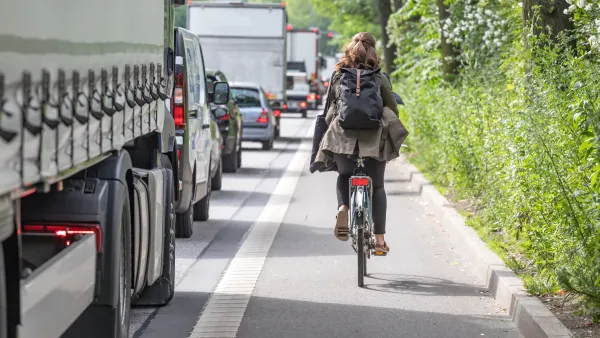
Op-ed: Federal austerity is funding what kills us
Tracing the backstory of the last year of cuts to multimodal transportation reveals an alarming definition of road safety that only serves one mode.
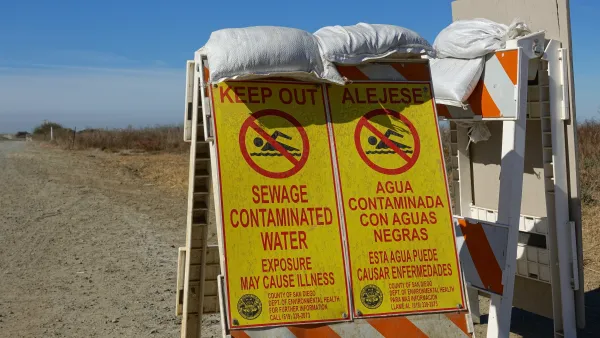
San Diego County to build treatment plant for Tijuana River sewage pollution crisis
The river has carried millions of gallons of untreated sewage into San Diego’s South Bay region.

The state-sanctioned urbicide of Austin
People don’t kill cities. Freeways do.

US to reduce Colorado River water deliveries to Mexico
A new Colorado Treaty amendment reduces Mexico’s Colorado River water allocation by 250,000 acre feet.

New Jersey’s second-largest city bans standalone data centers
Jersey City will continue to allow co-location facilities, such as those meant for research institutions that store their own data.

Amtrak not solely to blame for New Jersey commuter rail's unreliability, report finds
A new study from the Garden State Initiative found that NJ Transit’s budget grew 20% across a 4 year period, but reliability declined significantly over the same period.

EPA erases limits on planet-warming pollution from power plants
Under Monday’s plan, power plants would still have some limits on how much mercury, arsenic and other contaminants they can emit.

Phoenix announces new on-demand transit service, more frequent RAPID buses
Both new services will launch in October, and are part of Phoenix's Project Effective Access Solutions for Easing Congestion.

FREE Course: Walkable City 1: Why Walkability?
After describing his path towards focusing on walkability as the essence of good planning, Jeff Speck marches through his five principal reasons for making more walkable places.
Reinventing Malls: Planning Alchemy—Turning Gray Fields Into Gold
The course focuses on the opportunities and imperatives that shape reinvention of mall sites.

Eagle County Government
Harvard University Graduate School of Design
Nashville Planning Department
The Architects Foundation
University of Cincinnati Online
The Pocatello Development Authority
The Urban Renewal Agency of the City of Pocatello
Journal of the American Planning Association